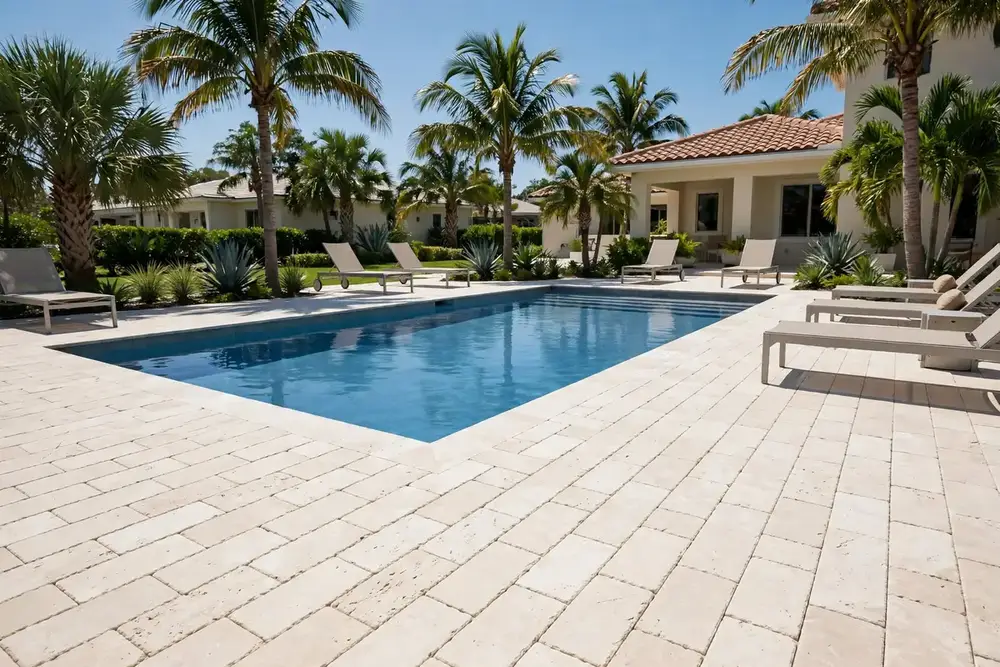
Travertine pavers are limestone pavers that suit Florida pool decks and patios. They look upscale, come in light tones that reflect more sun, and single pavers can be lifted and reset. They cost more than concrete pavers, about $20 to $26 per square foot installed as a national average (Homewyse, May 2026), and they need sealing near salt pools.
Travertine suits you if you want a high-end look at the pool or on the patio and you accept a little upkeep. If you want the lowest cost or a surface you never have to seal, concrete pavers may fit better. In this guide, we share an honest take on travertine: its pros and cons, real 2026 costs, finish choices, salt pool care, and a short check against concrete pavers.
What Are Travertine Pavers?
Travertine is a type of limestone formed by mineral springs. Over time, minerals build up in layers, and the stone is cut into pavers for outdoor use. The stone has small pores and holes, which give each paver its own natural pattern.
In Florida, you will see travertine most often in ivory, walnut, and silver tones. Light tones suit our sunny climate because they reflect more sun than dark stone. We install travertine on pool decks, patios, and walkways across Flagler County, where sandy soil and summer storms shape how we build the base.
If you are planning a new patio, our custom patio ideas can help you picture how travertine fits the space.
Pros and Cons of Travertine Pavers
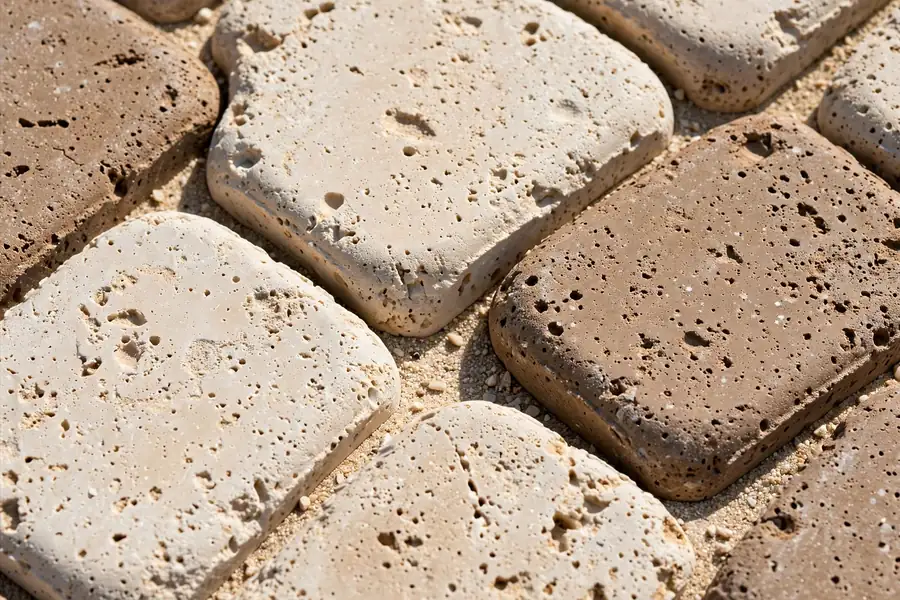
No paver is perfect for every yard. Travertine wins on looks and feel, but it asks more of your budget and your upkeep routine. This table sums up the trade-off.
| Pros | Cons |
|---|---|
| Natural, upscale look | Higher cost than concrete pavers |
| Light tones reflect more sun | Porous stone, so sealing helps |
| Single pavers can be lifted and replaced | Can pit or erode with salt if unprotected |
| Textured finishes give grip when wet | Natural color variation from paver to paver |
| Suits pool decks, patios, and walkways | Open holes can collect dirt if left unfilled |
The main trade-off is simple. You pay more and seal more often, and in return you get a natural stone surface that looks high-end and can be fixed one paver at a time.
Travertine Paver Cost in 2026
Homewyse puts the basic cost to install travertine pavers at $20.37 to $26.24 per square foot. That figure is a national average from May 2026 for basic, mid-range work. It leaves out general contractor markup of 13% to 22% and sales tax. These are national averages, not Dreamscapes pricing. Your local cost depends on your site, so ask us for a quote based on your yard.
Several factors push the price up or down. Removing an old surface, building a base on sandy soil, and choosing a detailed pattern all add labor. Pool coping, sealing, and tight access for machines and materials add cost too. Our hardscaping cost breakdown explains how each part of a hardscape project affects the total.
Travertine costs more than concrete pavers in most cases. The stone itself costs more, and cutting and setting natural stone takes care. That gap is the main reason many homeowners use travertine at the pool and choose concrete pavers for large driveways.
Finishes: Tumbled, Honed, Filled, or Unfilled
The finish changes how travertine looks and feels underfoot. Here are the four choices in plain terms.
Tumbled
Tumbled pavers have rounded edges and a textured surface. The texture gives grip, which helps in wet areas. For pool decks, we recommend a tumbled or textured finish.
Honed
Honed travertine has a smooth, matte surface. It looks clean and even, but it can feel slick when wet. It suits patios and walkways better than pool decks.
Filled or Unfilled
Travertine holes can be filled or left open. Filled pavers look cleaner and are easier to sweep, since dirt has nowhere to settle. Unfilled pavers look more rustic and natural, but their holes can collect dirt over time. For most Florida pool decks, filled and tumbled pavers are the easy choice.
Travertine Around Salt-Water Pools
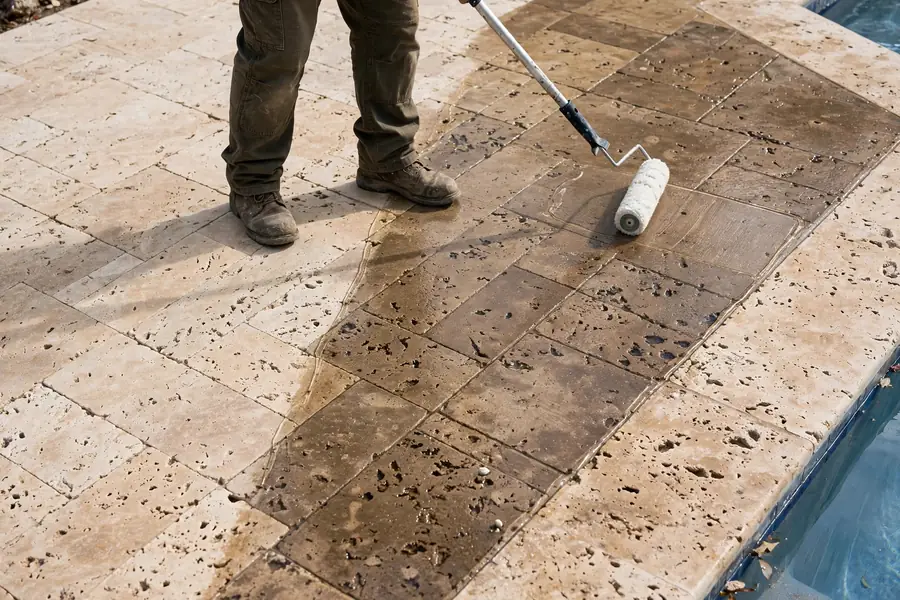
Salt pools need extra care with travertine. Travertine Mart, a travertine seller, warns that salt water can attack the stone in three ways: spalling, efflorescence, and leeching. Spalling means pits form when salt crystals get trapped beneath the surface. Efflorescence is a white, chalky residue on the stone. Leeching wears the stone down over time.
The supplier’s guidance is clear. Use a water-repellent, impregnating sealer, which it says gives reasonable protection for 5 to 10 years. Rinse the deck often to wash salt off the surface. With sealing and rinsing, travertine can work around a salt-water pool. Our rectangular pool landscape design post also lists travertine as a salt-friendly choice when it is protected.
Travertine vs Concrete Pavers
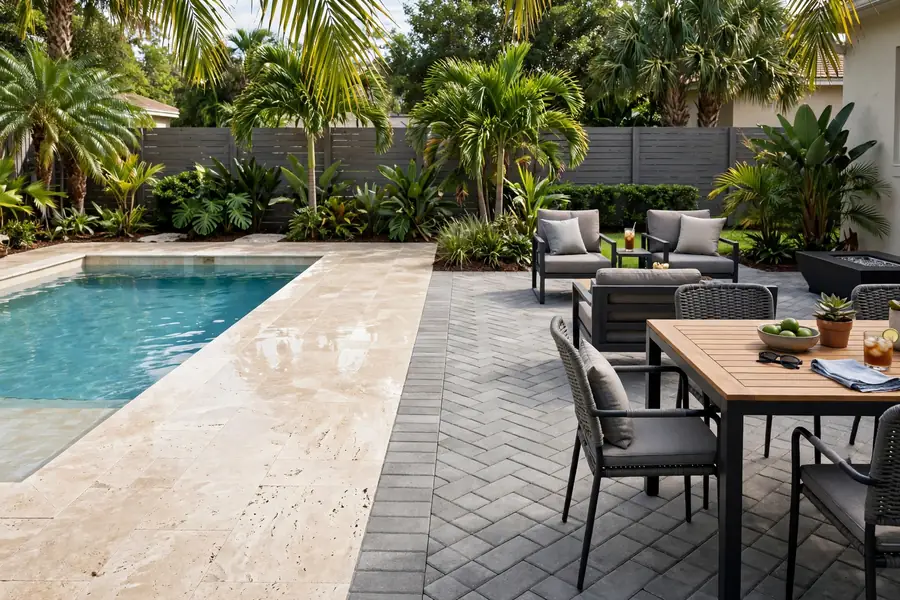
Here is a short, travertine-focused check. For the full comparison, see our pavers vs concrete patio post.
| Feature | Travertine pavers | Concrete pavers |
|---|---|---|
| Cost | Higher per square foot | Costs less in most cases |
| Look | Premium natural stone | Clean, uniform look |
| Color | Natural variation in ivory, walnut, and silver | Wide color range, easy to match |
| Sealing | Seal often, most of all near salt pools | Seal to protect color and joints |
| Salt pools | Fine when sealed and rinsed | A common pool deck choice too |
| Repair | Lift and reset single pavers | Lift and replace single pavers with ease |
Concrete pavers cost less and are easier to match when you add on later. Travertine looks more premium and suits pool decks and high-end patios. Many Palm Coast homes split the job: travertine at the pool, concrete pavers on the driveway. If a driveway is on your list, see our paver driveway cost guide for 2026 prices.
How to Care for Travertine Pavers
Simple care keeps travertine looking good for years. Follow this routine.
- Sweep the surface often to keep sand and dirt out of the joints.
- Rinse with water after pool use, most of all near salt pools.
- Clean algae in shaded spots before it spreads.
- Reseal when water stops beading on the surface. Follow the sealer label for timing and coats.
- Refill joints when sand washes out.
- Fix loose pavers early, before they shift or trip.
For a deeper clean, see our paver cleaning and sealing guide. If a section sinks or shifts, our how to fix sunken pavers guide shows the repair steps.
Is Travertine Right for Your Yard?
Use this quick list to decide.
- Best for: pool decks and high-end patios where looks matter most.
- Think twice for: driveways on a tight budget, where concrete pavers cost less.
- Think twice for: deep shade, where algae needs more cleaning.
- Think twice for: yards where you do not want to reseal on a schedule.
If you want the full poolside picture, see our poolside landscape guide for safety notes around the pool.
Travertine Pool Decks and Patios in Palm Coast
Dreamscapes Florida installs and seals travertine pool decks and patios across Palm Coast, Flagler Beach, Bunnell, Ormond Beach, and St. Augustine. We help you choose between travertine and concrete pavers for each area of your yard. See our hardscape services for what we build, or request a free estimate today. Call us at (386) 237-2983.
Since 2015, we have built outdoor spaces across Flagler County. Tell us about your pool deck or patio, and we will help you pick the right stone.
Frequently Asked Questions
Yes, for pool decks and patios, when you choose a textured finish and seal the stone. Travertine looks upscale and its light tones reflect more sun than dark stone. It costs more than concrete pavers and needs more care near salt pools. With sealing and rinsing, it holds up well in Florida yards.
Travertine pavers cost about $20.37 to $26.24 per square foot installed, as a national average from Homewyse in May 2026. That figure covers basic, mid-range work. It leaves out contractor markup of 13% to 22% and sales tax. Removal, base work, and coping add cost, so get a local quote for your yard.
Sealing is strongly recommended in Florida, most of all near salt-water pools. Travertine is porous, so water and salt can soak in without a sealer. A water-repellent, impregnating sealer protects the stone and makes cleaning easier. Follow the sealer label for how often to reapply it.
Yes, with protection. Salt can pit unprotected travertine through spalling, and it can leave white residue on the surface. Use a water-repellent, impregnating sealer, which the supplier says gives reasonable protection for 5 to 10 years. Rinse the deck often to wash salt away.
Tumbled or textured finishes give better grip than smooth, polished stone. That grip matters most on pool decks, where the surface stays wet. Choose a tumbled or textured finish for any pool deck or walkway that gets splashed. Honed travertine feels smooth and suits dry patios better.
It depends on the area. Concrete pavers cost less and are easy to match and replace, which suits driveways and large areas. Travertine looks more upscale and suits pool decks and high-end patios. Many Palm Coast homes use travertine at the pool and concrete pavers on the driveway.