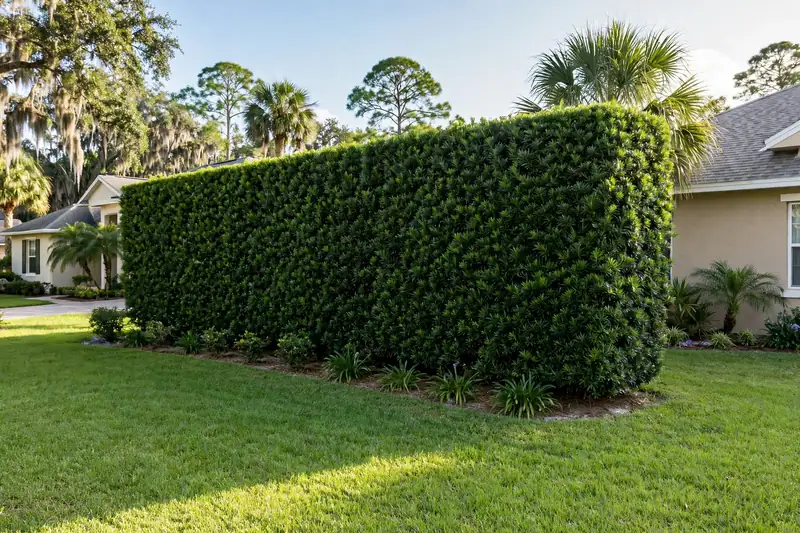
A podocarpus hedge in Florida is a slow-growing evergreen privacy screen made from Podocarpus macrophyllus. It grows 6 to 12 inches a year, reaches 4 to 12 feet as a trimmed hedge, and handles shade, salt, and cold down to zone 8. Plant 3 feet apart, water daily for the first month, and trim once or twice a year.
For a neat, dark green wall between your yard and the neighbors, podocarpus is one of the best choices in Palm Coast. It is not the fastest hedge, but it stays thick and tidy with the least work once it is in.
What Is a Podocarpus Hedge?
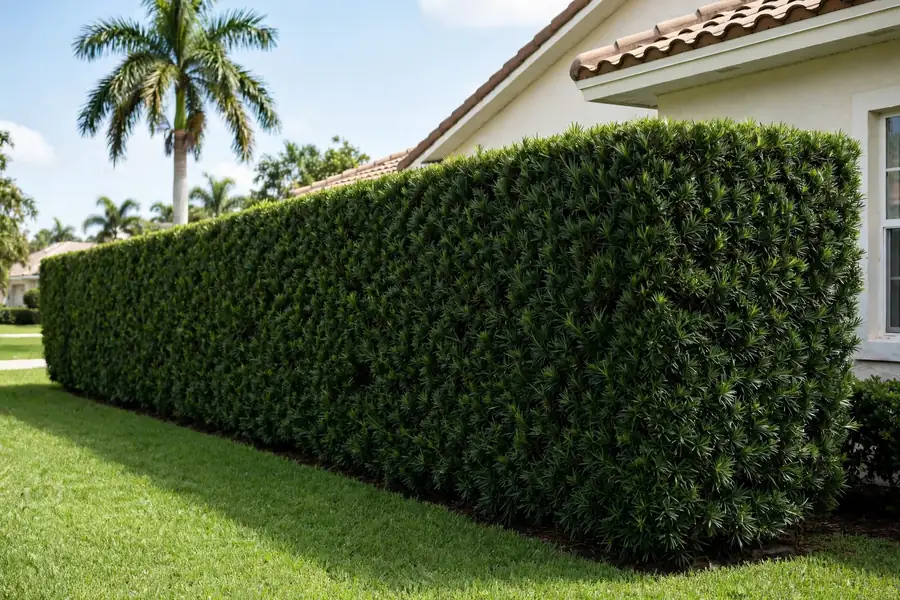
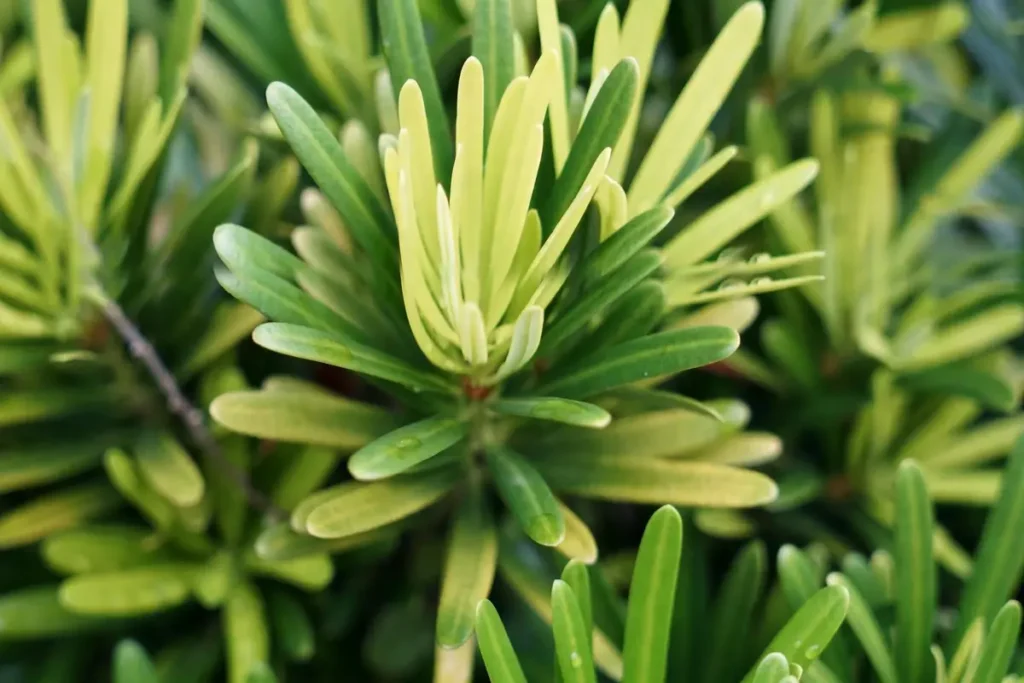
Podocarpus macrophyllus, also called Japanese yew or yew pine, is an evergreen conifer with soft, narrow, dark green leaves. Left alone it grows into a small tree 30 to 40 feet tall. Planted in a row and sheared, it forms a dense, formal hedge that stays green all year and holds its shape without going bare in the middle.
Why Palm Coast Homeowners Plant Podocarpus
Privacy is the main reason. A podocarpus hedge fills in top to bottom, blocking the view at ground level and at eye level.
The second reason is the look: a fine, formal texture that suits a front yard, a pool deck, or a driveway border. The third is low upkeep. Once established, it needs a trim once or twice a year and little else. For homeowners comparing privacy plants for a Florida yard, podocarpus is the low-drama pick, as long as you can accept its slow start.
How Fast Does a Podocarpus Hedge Grow?
Podocarpus grows 6 to 12 inches a year in Florida. That is slow next to clusia, which puts on 12 to 24 inches a year. A 3-gallon podocarpus planted 3 feet apart usually closes into a solid hedge in two to three growing seasons.
Full sun and steady water in the first year give the fastest growth. Heavy shade slows it to a crawl, and soggy soil stops it cold.
Do not buy podocarpus if you need privacy this summer. Larger plants help: a 15-gallon plant starts around 4 to 5 feet tall. Prices vary by size and nursery. A South Florida nursery, Dino’s Palms, lists 3-gallon plants from $7.99 and 25-gallon plants at $119.99.
Podocarpus Hedge Spacing: How Far Apart to Plant
For a solid hedge, plant podocarpus 3 feet apart on center. That spacing closes into a wall in two to three seasons from 3-gallon stock. Larger plants can go a little wider, because each one already has width.
| Pot size | Typical height at planting | Spacing on center |
|---|---|---|
| 3-gallon | 1 to 2 feet | 1 foot apart |
| 7-gallon | 2 to 3 feet | 1.5 feet apart |
| 15-gallon | 4 to 5 feet | 2 feet apart |
| 25-gallon | 5 to 6 feet | 2.5 feet apart |
Measure the run and divide by 3 to get your plant count. Keep plants 2 to 3 feet from the house and 4 to 5 feet back from a walk or driveway.
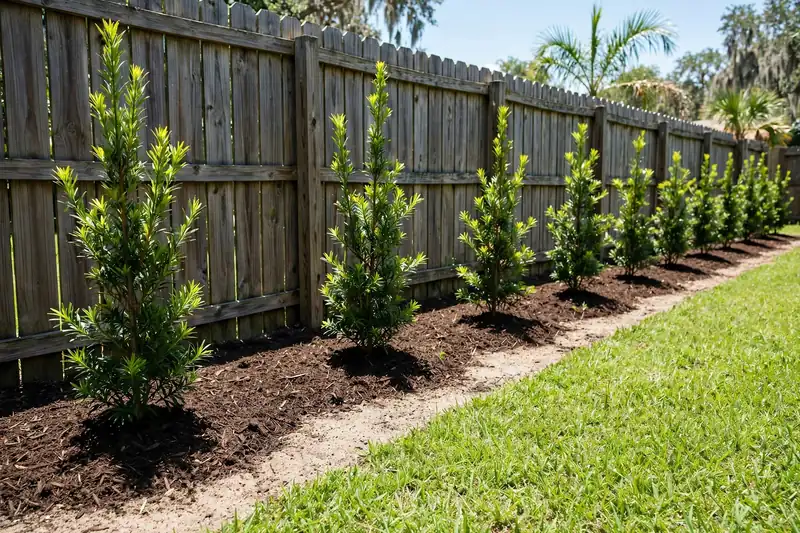
How to Plant a Podocarpus Hedge
Plant in spring or early fall, when the soil is warm and rain is regular.
Step 1: Pick the Spot and Mark the Line
Choose a run with at least 4 hours of sun a day. Full shade makes it thin and sparse. Check drainage first: dig a 12-inch test hole and fill it with water. If water still sits there the next day, pick a higher spot. Podocarpus hates wet feet.
Step 2: Dig the Holes and Set the Plants
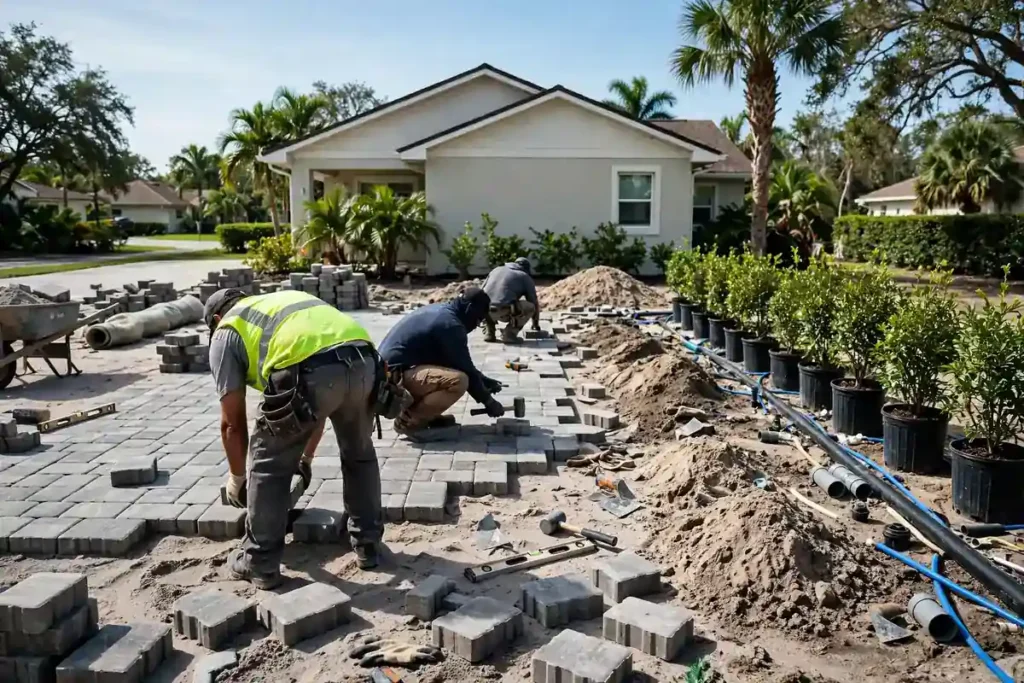
Dig each hole twice as wide as the pot and just as deep. Loosen circling roots, then set the plant with the root ball level with the soil. Never bury the trunk. Backfill, firm gently, and water until it settles.
Step 3: Water In and Mulch
Soak each plant right after planting, then spread 2 to 3 inches of mulch around the base, a few inches away from the trunk.
Watering and Feeding in the First Year
Water daily for the first 10 to 14 days, then every 2 to 3 days through the first two months. After that, deep water twice a week during dry stretches, and skip watering after heavy rain. Podocarpus drowns faster than it dries out.
After the first year, the plant is drought tolerant. Water only during long dry spells. If the soil stays soggy a full day after rain, you are watering too much or the drainage is poor.
Feed with a slow-release granular fertilizer two to three times a year, in spring and fall. Yellowing between the leaf veins often points to iron shortage in our alkaline sandy soil. A foliar iron spray helps when the veins stay green and the leaf turns pale around them.
Pruning and Trimming: When and How Often
Podocarpus needs a trim once or twice a year to stay dense and even. Leave new plants alone for the first season so the roots can settle. After that, trim lightly in early spring, and again in early summer to hold the shape.
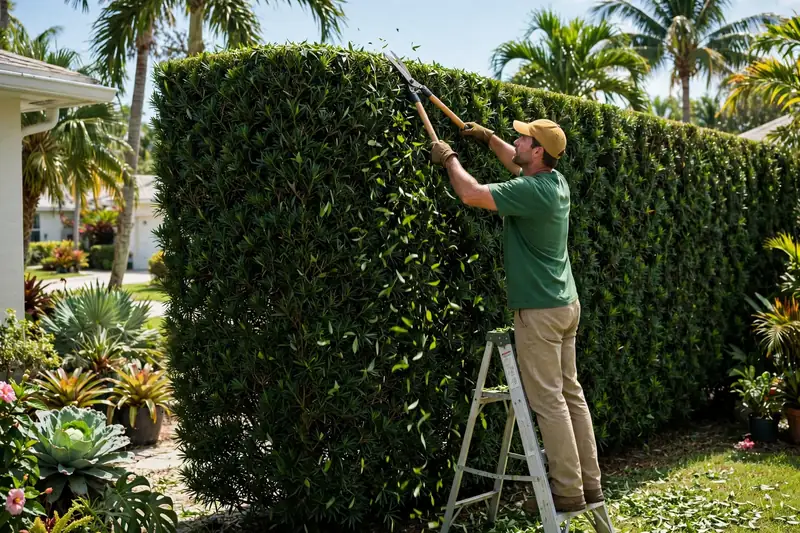
How to Shape the Hedge
Shear the top flat and the sides straight, but keep the base a little wider than the top so light reaches the lower leaves and the bottom stays full. Cut back to a leaf joint, not into bare wood.
What Not to Cut
Do not prune after September. Late trimming pushes soft new growth that a cold snap can burn. Do not cut the leader off a young plant you want to grow taller. Spring pruning is the safe window, and podocarpus follows the same rule.
Cold, Salt, and Shade in Flagler County
Northeast Florida’s Palm Coast sits in USDA zone 9b, and podocarpus is hardy in zones 8 to 11. A mature plant handles short dips to 15 degrees, so our normal winters are no threat. A long freeze below 20 degrees can cause dieback.
Salt tolerance is moderate. Podocarpus handles salt spray better than most hedge plants, which suits most Palm Coast yards. It is not the right pick for a beachfront lot in Flagler Beach.
Shade is where podocarpus beats the field. It stays dense in partial shade under live oaks and palms, where clusia thins out. Give it 4 or more hours of sun for the best density.
Podocarpus vs Clusia: Which Hedge Fits Your Yard?
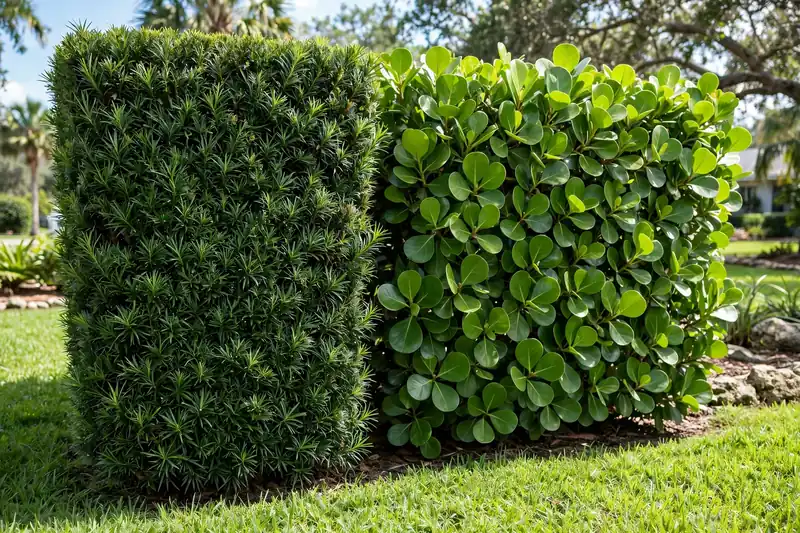
Clusia and podocarpus are the two hedges Palm Coast homeowners compare most.
| Podocarpus | Clusia | |
|---|---|---|
| Growth rate | Slow, 6 to 12 inches a year | Moderate, 12 to 24 inches a year |
| Spacing | 3 feet on center | 3 to 4 feet on center |
| Cold hardiness | Zones 8 to 11, short dips to 15 degrees | Zones 10 to 11, cold sensitive |
| Salt tolerance | Moderate | Moderate to high |
| Shade | Handles partial shade well | Needs full sun, thins in shade |
| Trimming | Once or twice a year | Two to three times a year |
Pick podocarpus if your yard has shade, if you want a formal look, or if you want the lowest trimming schedule. Pick clusia if you need privacy fast and your yard gets full sun. Our full guide to a clusia hedge in Florida covers its types, care, and cold risk in detail. Do not mix the two in one run: the faster clusia will overtake the podocarpus.
Common Problems and How to Fix Them
Podocarpus has few pest and disease problems, but three issues show up again and again in Florida yards.
Leaves Turning Yellow
Yellowing usually means too much water, poor drainage, or iron shortage in alkaline soil. If the soil stays soggy a day after rain, raise the planting height or fix the drainage, and cut back on watering. If the soil drains fine and the veins stay green while the leaf turns pale, feed with an iron micronutrient spray. Our guide to a hedge turning brown covers the same checks for brown foliage.
Sparse, Leggy Growth
Thin growth almost always means too little light. A hedge under a heavy canopy will never fill in like one in sun. Trim back overhanging branches to let in more light. A light spring trim also pushes side branches and thickens a young hedge.
Scale Insects and Brown Needles
Scale insects show up as small bumps on the stems and leave a sticky residue on the leaves below. Prune out the worst stems and wash the rest with a strong jet of water. Brown inner needles usually mean the plant went too dry, so water deeply and mulch to hold moisture. Podocarpus leaves and berries are toxic to children and pets, so keep fallen berries cleaned up.
If privacy is the goal and podocarpus feels too slow, tall ornamental grasses can fill the gap for a season while the hedge grows in.
Conclusion
A podocarpus hedge in Florida is a slow, steady privacy screen that rewards patience. Plant 3 feet apart in a sunny or partly shaded run with good drainage, water daily for the first month, feed twice a year, and trim once or twice a year. In two to three seasons you will have a dense, dark green wall. If your yard has shade or you want the lowest upkeep hedge in Palm Coast, podocarpus is the right plant. We serve Palm Coast, Flagler Beach, Bunnell, Ormond Beach, and St. Augustine. Call Dreamscapes Florida at (386) 237-2983.
Frequently Asked Questions
Podocarpus grows 6 to 12 inches a year in Florida. A 3-gallon plant spaced 3 feet apart usually closes into a solid hedge in two to three growing seasons.
Plant podocarpus 3 feet apart on center. Smaller stock goes closer: 3-gallon plants 1 foot apart, 7-gallon 1.5 feet, 15-gallon 2 feet, and 25-gallon 2.5 feet apart.
Yes, podocarpus handles partial shade better than most Florida hedge plants and stays dense with 4 or more hours of sun a day.
Yes. Palm Coast is in USDA zone 9b, and podocarpus is hardy in zones 8 to 11. A mature plant handles short dips to 15 degrees.
Yellowing usually means too much water, poor drainage, or iron shortage in alkaline soil. Check that the soil drains within a day of rain, cut back on watering, and use an iron micronutrient spray if the veins stay green while the leaf turns pale.
Podocarpus is better for shade, a formal look, and low trimming. Clusia is better when you need privacy fast in full sun. Podocarpus grows 6 to 12 inches a year; clusia grows 12 to 24 inches a year.