Yes, a patio extension is the simplest way to make a small Florida patio bigger: add a paver section next to the old slab, tie the two together with a planned joint, and slope the surface away from the house. It costs $8 to $25 per square foot installed as a national average (Angi, Oct 2026).
Start With the Slab You Already Have
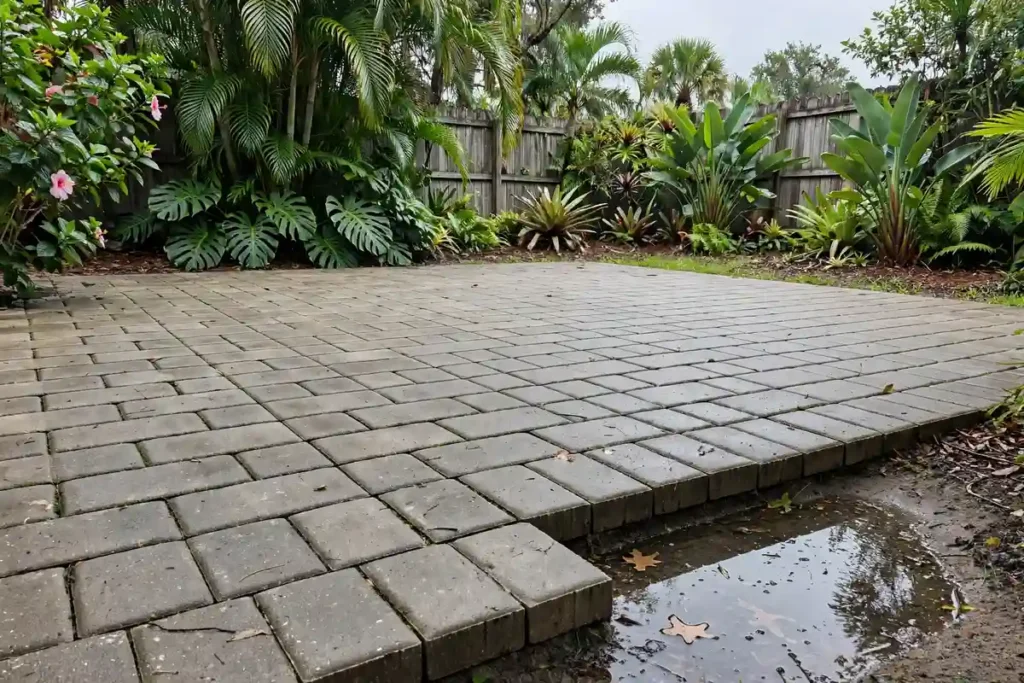
Walk the old patio before you plan anything. Look for cracks that run right through, corners that have dropped, and spots where water sits after rain. A sound slab is level, slopes away from the house, and has only hairline cracks.
If the slab is sound, you have two paths: extend beside it with pavers, or cover it with pavers first and then extend. Our pavers over concrete guide explains how an overlay works when the slab passes its tests.
Measure the height at every door. The new pavers must sit low enough that the door swings clear and rain cannot run inside. Note the slab height, the paver thickness, and the bedding sand. A tape measure now saves a rebuild later.
Match the Old Patio or Contrast It on Purpose
An exact match is hard. Concrete fades in the Florida sun, and dye lots change from batch to batch. New pavers that try to match often end up a shade off, and the line between old and new stays visible for years.
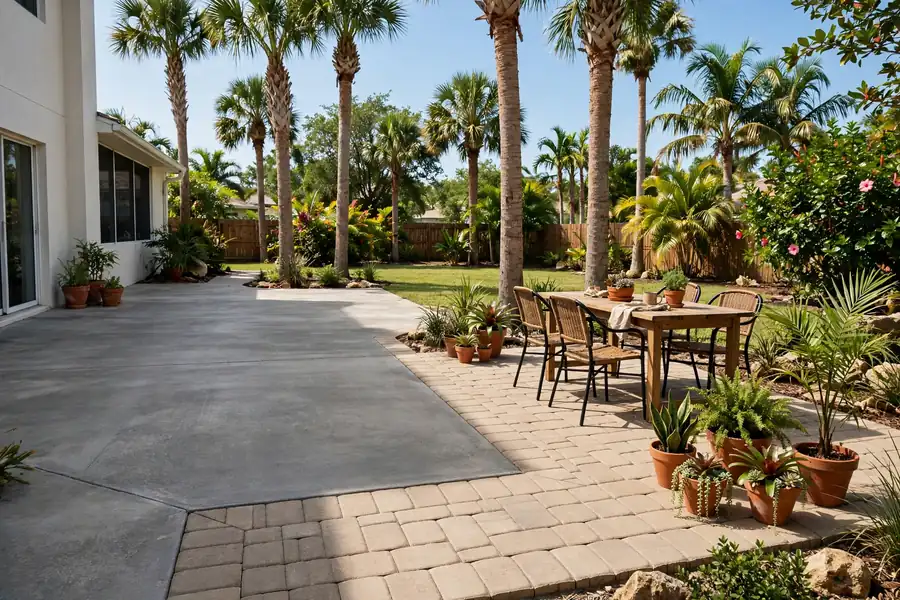
A border band solves this. Run a contrasting border around the old patio, then use the same color in the new section. The eye reads the two areas as one design, and the border hides the seam.
Or go the other way and contrast on purpose: warm tan pavers next to gray concrete, or a larger format paver next to a small one. A planned contrast looks like a choice. An almost-match looks like a mistake.
Pick the shape with the furniture in mind. A dining set needs a rectangle, and a fire pit wants a curve. Our custom patio ideas guide shows layouts that fit each use.
The Joint Is the Whole Job
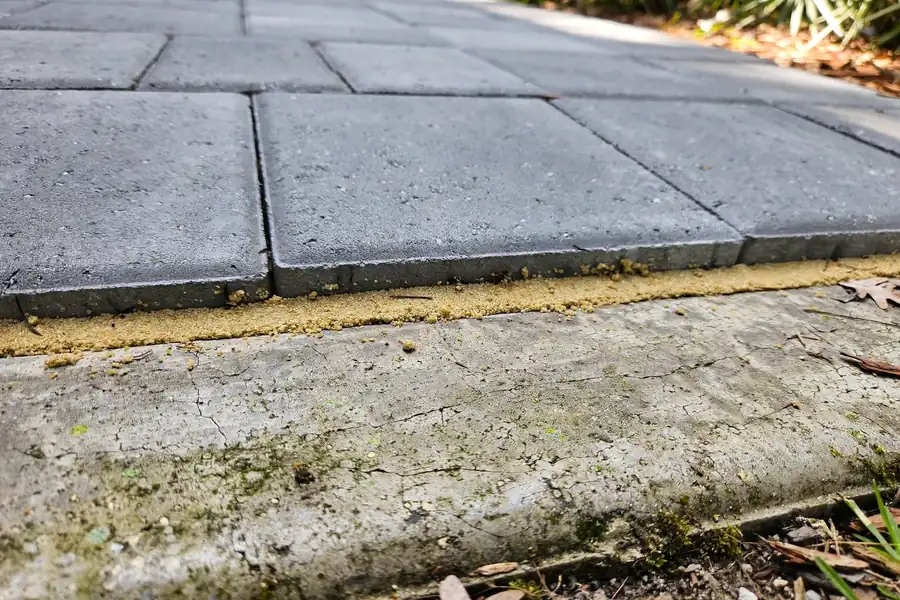
The old patio and the new section move at different rates. Florida heat, rain, and sandy soil shift each one a little, so a planned joint lets them move without cracking.
Leave a clean, straight joint between the old slab and the new pavers. Fill it with polymeric sand after the pavers are set. The sand hardens and holds the joint, yet it flexes enough to take small movement.
Put edge restraints on every open side of the new section. Without them, the outer pavers creep outward and the field loosens. Restraints sit below grade, so you never see them.
Never butt new concrete tight against old concrete. Fresh concrete shrinks as it cures, and the seam will crack. A joint with a filler strip costs almost nothing.
Height, Slope, and Water
Water decides whether a patio extension works. Every patio surface should slope away from the house at about one quarter inch per foot, which matches the 2 percent minimum slope set by the Concrete Masonry and Hardscapes Association.
Check the slope with a level and a string line before any pavers go down. Fixing a slope after the pavers are set means lifting them all out again.
Watch the doors. The finished patio must sit below the door threshold so wind-driven rain cannot run inside. In Palm Coast summer storms, that gap matters most.
Point downspouts away from the new section. A downspout that dumps beside the patio soaks the base from the edge and invites settling. Run the water to the lawn or a swale instead.
What Goes Under the New Section
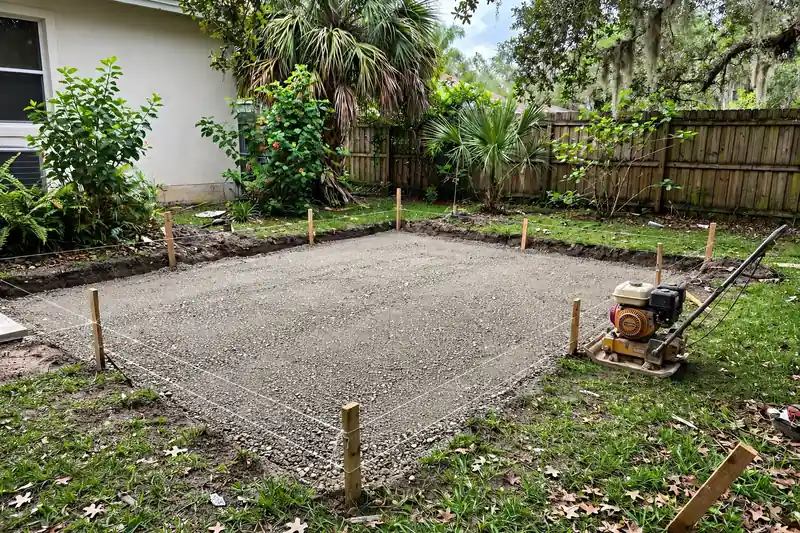
A paver patio is only as good as its base. Unilock’s technical guide calls for 6 to 8 inches of compacted gravel under patios and walkways, laid in layers 2 to 3 inches thick, with 1 inch of coarse sand bedding on top.
That means the dig runs about 9 to 11 inches below the finished surface: base, bedding, and paver thickness added together. Measure from the door height, not from the lawn.
Compact each layer with a plate compactor. Loose base settles, and settled base shows up as dips and rocking pavers within a year.
Florida sand drains fast, which helps, but it also shifts. A geotextile fabric between the soil and the gravel keeps the two from mixing.
Call 811 before you dig. In Florida, Sunshine 811 marks buried lines so a shovel never finds a gas or electric line by surprise. Our how to install pavers guide walks through the full base sequence step by step.
What a Patio Extension Costs in Florida
Most of the cost sits in the size and the material. The table below uses national averages from Angi, updated Oct 29, 2026, for a paver patio extension installed by a pro.
| Extension size | Installed cost |
|---|---|
| 100 square feet | $800 to $2,500 |
| 150 square feet | $1,200 to $3,750 |
| 200 square feet | $1,600 to $5,000 |
| 300 square feet | $2,400 to $7,500 |
For a full paver patio, Angi puts the national average at $3,800, with most projects from $2,400 to $7,000. These are national averages, not Dreamscapes pricing, and local quotes in Palm Coast will vary.
What moves the price most is the material. Concrete pavers run $8 to $15 per square foot installed, brick or clay pavers run $10 to $20, and natural stone runs $15 to $50, all from Angi in Oct 2026. Curves and borders add cuts and labor, and a tight side yard costs more to work in.
Demolition is the other big cost. If the old slab must go, concrete removal averages over $1,100 (Angi, Jul 2026). Keeping a sound slab saves that money.
If you are still weighing pavers against a fresh concrete slab, our pavers vs concrete comparison lays out cost, strength, and repair side by side. Get three quotes and compare the base spec in each one, not just the total.
Permits, Setbacks, and Your HOA
Permit rules change by city, so do not guess. A ground-level patio extension often needs no building permit, but zoning rules on setbacks, lot coverage, and drainage can still apply. Check with the City of Palm Coast before work starts.
Your HOA may need to approve the plan first. Many Palm Coast communities review hardscape changes for style and placement, and their rules can be stricter than the city’s.
A roof, a raised platform, or a built-in kitchen changes the job. Those add structure, and structure usually needs a permit. Keep the extension at grade if you want the simple path.
When to Replace the Old Slab Instead
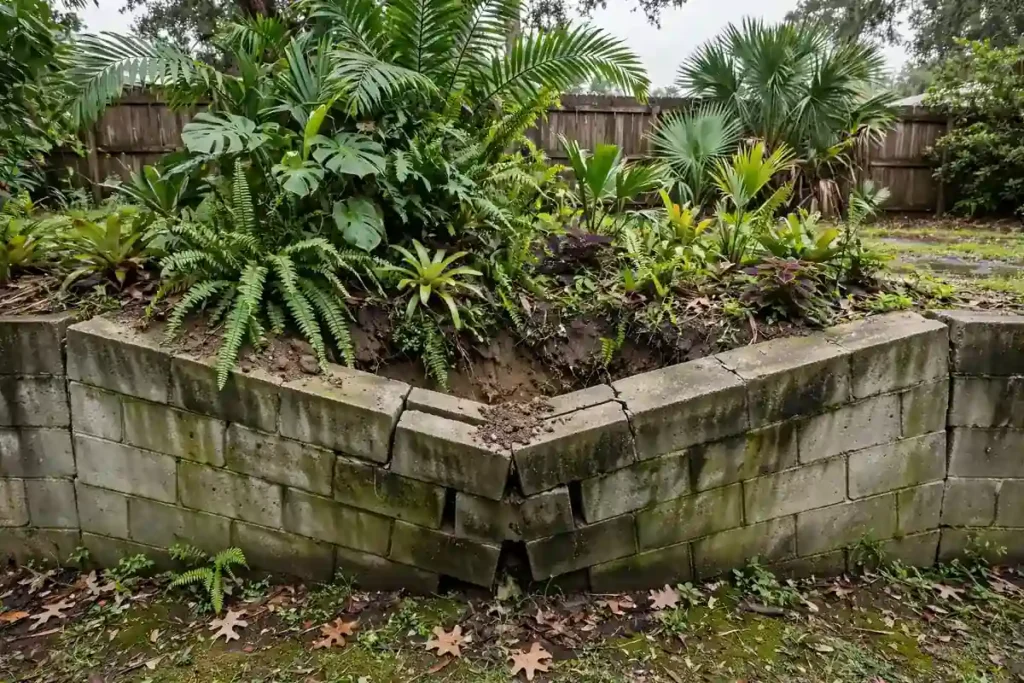
Extending is not always the right call. When the old slab is failing, a new section tied to it will fail too. Use the table below to decide.
| Keep the slab and extend | Replace the slab |
|---|---|
| Hairline cracks only | Cracks run right through |
| Level, no sunk corners | Corners have dropped or lifted |
| Slopes away from the house | Slopes toward the house |
| Surface is solid, not flaking | Surface spalls or crumbles |
| Doors clear the finished height | Height at the doors is already tight |
Replacing costs more up front, since removal averages over $1,100 (Angi, Jul 2026), but it gives one uniform base and one uniform look.
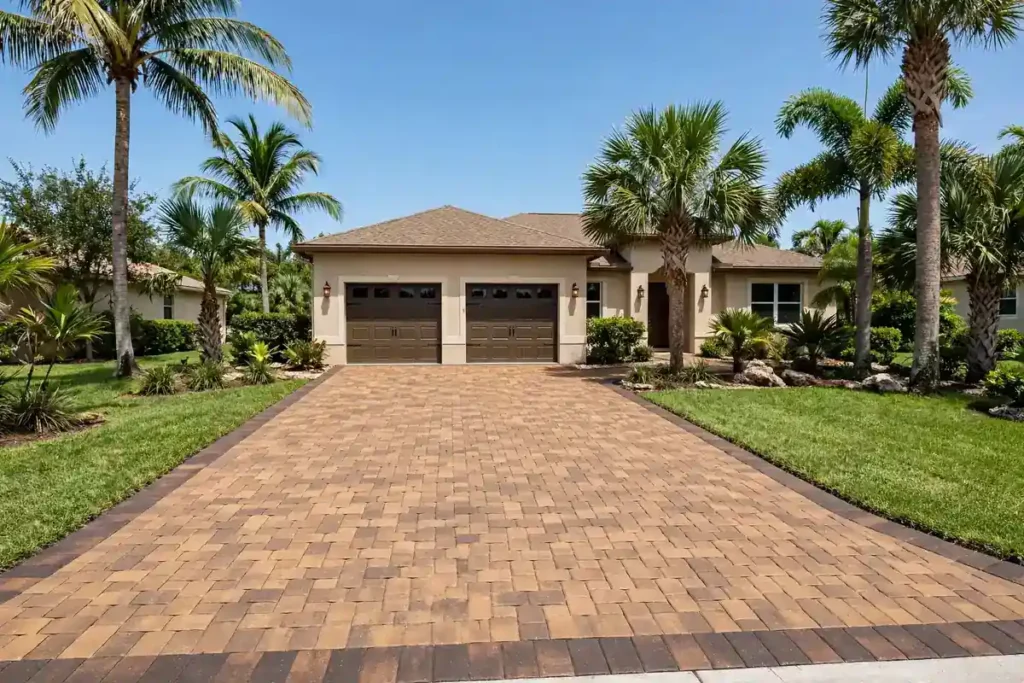
The same thinking applies to driveways. Our driveway extension guide covers widening a drive next to old concrete, with the same joint, base, and drainage rules.
Patio Extensions in Palm Coast
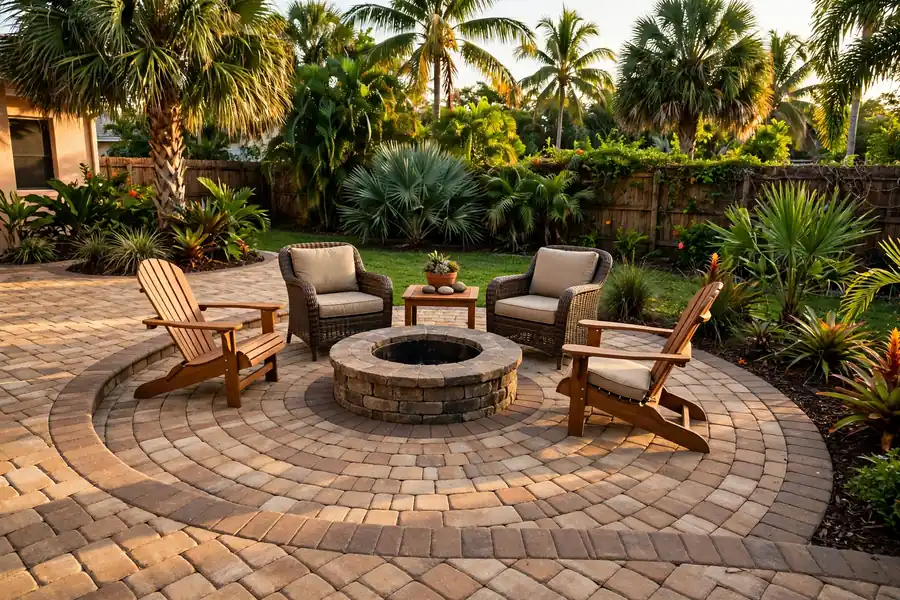
Palm Coast lots shape every extension. Sandy soil drains fast but shifts, summer storms test the grading, and salt air near the coast ages exposed concrete faster than inland. A deep, well-compacted base matters more here than in a mild climate.
Plan for afternoon rain. The slope and the outlet matter as much as the pavers. Water should run to the lawn or a swale, never to a neighbor’s yard.
We have built hardscape across Palm Coast since 2015. The smoothest patio extensions settle the joint, the base, and the drainage before the first paver arrives.
If you would like help planning a patio extension, contact Dreamscapes Florida or call (386) 237-2983. We serve Palm Coast, Flagler Beach, Bunnell, Ormond Beach, and St. Augustine.
Frequently Asked Questions
Yes. Pavers can sit beside a sound concrete slab, and they can also go over it as an overlay when the slab is level and slopes away from the house. The key is the joint between old and new: leave a planned joint, use edge restraints, and fill the joint with polymeric sand so the two sections can move without cracking.
As a national average, a paver patio extension costs $8 to $25 per square foot installed (Angi, updated Oct 29, 2026). A 200 square foot extension runs about $1,600 to $5,000. Material, curves, access, and demolition move the price. Local quotes in Palm Coast will vary, so compare the base spec in each quote, not just the total.
Permit rules change by city, so check with the City of Palm Coast before work starts. A ground-level patio extension often needs no building permit, but setbacks, lot coverage, and drainage rules can still apply. Your HOA may also need to approve the plan, and its rules can be stricter than the city’s.
Leave a clean, straight planned joint between the old slab and the new pavers, then fill it with polymeric sand. Put edge restraints on every open side so the outer pavers cannot creep. Never butt fresh concrete tight against old concrete: it shrinks as it cures, and the seam will crack.
An exact match is hard because concrete fades in the Florida sun and dye lots change. A border band around the old patio, repeated in the new section, makes the two read as one design. Or contrast on purpose with a different color or size. A planned contrast looks like a choice, while an almost-match looks like a mistake.
A small, rectangular extension under 120 square feet on flat ground is a fair weekend project if you can rent a plate compactor and keep the slope true. Larger areas, curves, poor drainage, or a slab that needs repair call for a pro. The base and the drainage decide whether the patio lasts, and both are hard to fix after the pavers are down.