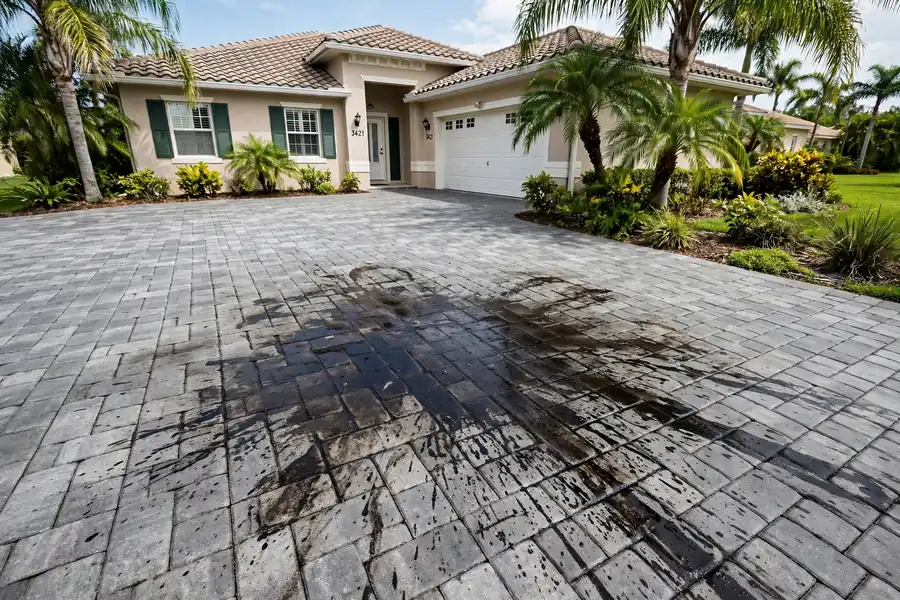
To remove oil stains from pavers, blot fresh oil at once and cover it with kitty litter for a day. Then scrub the mark with dish soap and hot water, or a paver-safe degreaser. Old stains need a poultice that dries and pulls the oil out. Never seal over a stain.
One dark spot on a driveway can make the whole front yard look tired. Most oil stains come out if you match the method to the age of the stain: fresh oil is an absorption job, old oil is a drawing-out job. This guide walks through both, so you stop at the gentlest method that works.
Why Oil Stains Pavers So Fast
Concrete pavers are porous. Motor oil, cooking grease, and barbecue drips soak into the tiny pores and spread sideways under the surface. That is why scrubbing the face alone leaves most of the stain behind.
Northeast Florida heat makes it worse. A driveway paver baking in full sun stays warm most of the year, and a warm paver draws oil in faster than a cool one. A drip can set in a few hours. The fix is the same in every case: pull the oil back out of the pores.
Act Fast: What to Do in the First Hour
Speed matters more than any product. Oil that is still wet has not soaked in yet, and you can still catch most of it.
Step 1: Blot It, Do Not Wipe It
Press rags or paper towels onto the spill and lift the oil off. Do not wipe or scrub it, because that spreads the oil into a wider stain and pushes it into the joints. Work from the outside edge toward the middle so the stain does not grow.
Step 2: Cover It With an Absorbent
Spread a dry absorbent over the spot: clay-based kitty litter, sawdust, baking soda, or diatomaceous earth. Press it down lightly with your shoe, then leave it alone for a full day. The Concrete Masonry and Hardscapes Association gives this same sequence: mop up the excess, cover the area with an absorbent, and leave it on the stain for a day.
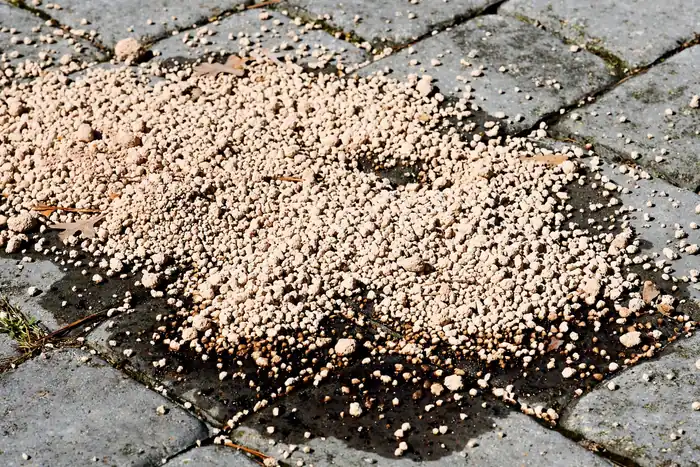
After a day, sweep up the absorbent and look at the paver. A light shadow often remains. That shadow is the next step, not a failure. Bag the used absorbent and throw it in the trash. Never pour used oil on the ground, down a drain, or into a storm sewer.
Method 1: Dish Soap and Hot Water
Dish soap is the right next step for a fresh stain or a light shadow after the absorbent. It breaks the oil into drops that water can carry away. Squirt it straight onto the stain, add a little hot water, and scrub hard with a stiff nylon brush. Work the joints too. Rinse with a garden hose and let the paver dry fully before you judge it.
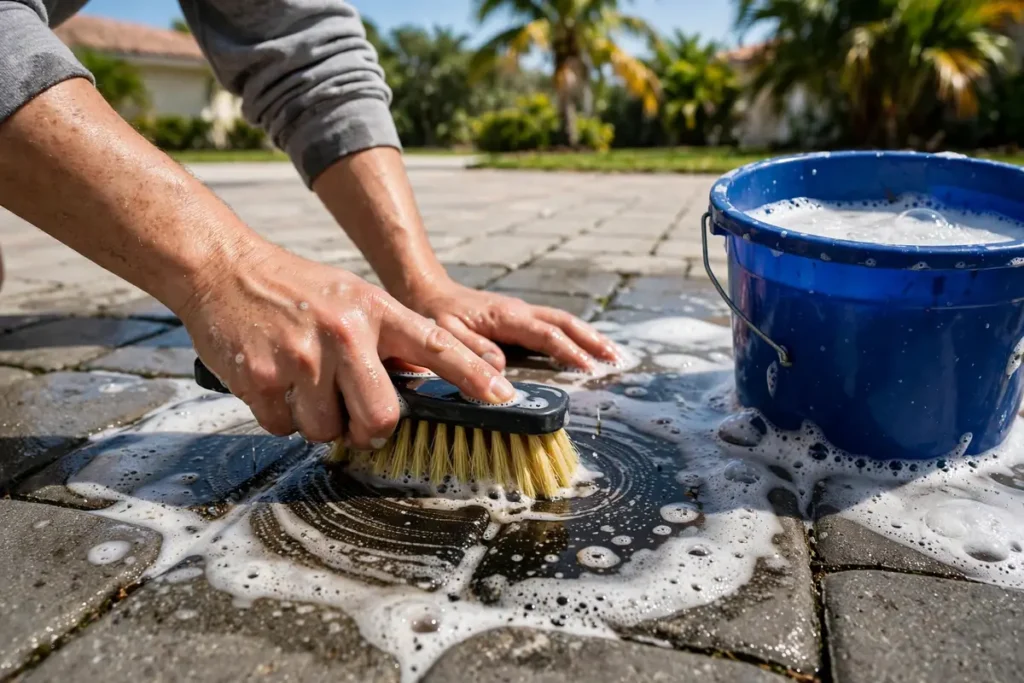
Soap has a limit. It cleans oil near the surface, and it is unlikely to pull out oil that has soaked below the surface. If the dark mark is still there after the paver dries, move on to a degreaser.
Method 2: A Paver-Safe Degreaser
An alkaline degreaser made for masonry is the workhorse for set-in stains. Pick one labeled safe for concrete pavers, and test it on a small hidden spot first. Some products can lighten colored pavers or strip sealer.
Apply the degreaser to dry pavers, not pre-wet ones, and let it dwell. PROSOCO, one of the trade’s best-known cleaner makers, calls for one part Cleaner/Degreaser to four parts water for heavy oil, up to one part to 50 parts water for light films, with a dwell of one to three minutes. Scrub hard, then rinse it all off. Most stains need two or three rounds, each one lighter than the last.
Method 3: The Poultice for Old Stains
An old stain that survives the degreaser needs a poultice: a paste that pulls absorbed oil out as it dries. PROSOCO Oil and Grease Stain Remover and Alliance Gator XP Oil and Grease Remover are made for this job. Gator XP goes on about 1/8 inch thick, spread an inch past the stain edge, and needs 12 to 24 hours to dry. PROSOCO puts drying time at 5 to 8 hours.
You can also mix your own: stir a degreaser or citrus cleaner into diatomaceous earth, kaolin clay, or talc until it holds the shape of thick peanut butter. Spread it over the stain, cover it with plastic sheeting taped at the edges, and leave it for 24 hours. Then remove the plastic and let the paste dry fully for another day. The drying is what pulls the oil up. Two or three rounds are common on stains older than a year. Note the limits: Gator XP can damage a sealer, and it is not made for synthetic oil or asphalt.
Which Method for Which Stain?
| Stain age | Best method | Time it takes |
|---|---|---|
| Fresh, still wet | Blot, then absorbent | One day |
| Fresh shadow after absorbent | Dish soap and hot water | 30 minutes |
| Days to weeks old | Paver-safe degreaser | Two or three rounds |
| Months to years old | Poultice | One to three rounds, days each |
What About Pressure Washing?
A pressure washer helps at the rinse stage, but it is not a stain remover on its own. Water alone cannot dissolve oil, and high pressure drives oil deeper instead of lifting it out. Pre-treat the stain first, then rinse at low pressure.
For pavers, keep the washer between 500 and 1,500 PSI with a wide 25-degree fan tip, and hold the nozzle at least 12 inches from the surface. Never use a zero-degree pencil tip on pavers. It can etch the face and cut the joints open. Never aim straight at the joint sand, because the spray blows the sand out. After any heavy rinse, check the joints and top up the polymeric sand. PROSOCO puts the safe rinse range for porous concrete pavers at 400 to 1,000 PSI with a flow of 6 to 8 gallons per minute.
5 Mistakes That Make Oil Stains Worse
Most permanent stains come from the first fix, not the spill.
- Hosing it first. Water before the absorbent spreads the oil into a wider, harder stain.
- Spraying WD-40 on it. WD-40 is itself an oil-based lubricant, so it adds to the problem instead of lifting it.
- Pouring on petrol, thinners, or paraffin. Solvents push the oil sideways and down, enlarge the stain, and create a fire hazard.
- Using acid cleaners. Hydrochloric or brick acid does not lift oil, and it can etch the paver face and strip sealer. Travertine and marble need an acid-free approach.
- Sealing over the stain. Sealer traps the oil under the coating, and the stain is then nearly impossible to remove without stripping the sealer.
When the Stain Will Not Come Out
Some stains are too deep. If a dark mark is still there after three full cleaning attempts and the paver is dry, the oil has soaked through the whole paver. Replacing the paver is then the cleanest fix. Pavers are individual units, so one stained paver can come out and a matching one can go in without redoing the driveway. That swap works best on a proper base, as our guide to how to install pavers explains.
Call a pro for a large stain, travertine or natural stone, or a pool deck. Our guide to general paver cleaning covers the wider routine that keeps a driveway or patio looking new between stain jobs. Not every dark mark is oil. A white chalky film is usually efflorescence, which needs a different fix, as our guide to white haze on pavers explains.
Seal After Cleaning So It Does Not Happen Again
Sealing is the last step, not the first one. A sealer forms a film on the surface and cannot pull oil out of the pores. Clean the stain completely first, then let the pavers dry fully for 24 to 48 hours.
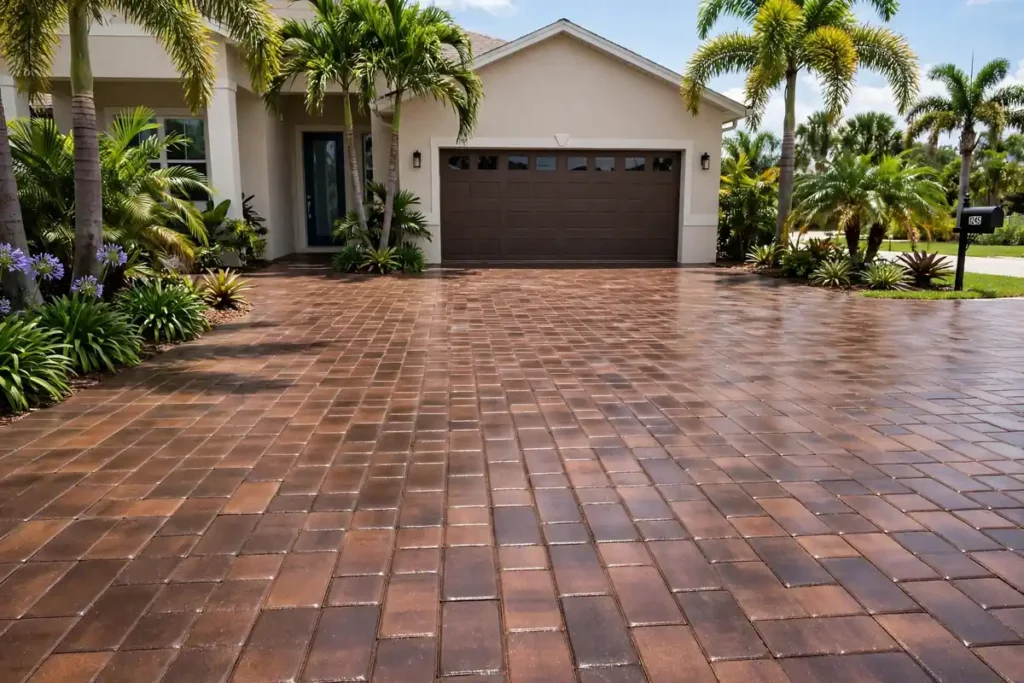
Once the pavers are clean and dry, a breathable sealer slows the next spill from soaking in. Follow our guide on how to seal pavers for the full steps. Driveways take the worst of it, so if yours is due for a refresh, our paver driveway cost guide covers what a new driveway or a full reset runs in Palm Coast. If the oil came from a leaking car, fix the leak first, or the next drip starts the whole job over again.
Conclusion
Oil stains on pavers come out when you match the method to the stain. Blot fresh oil and cover it with kitty litter for a day. Scrub the shadow with dish soap and hot water, then move to a paver-safe degreaser if the mark stays. Old stains need a poultice and patience, one round at a time. Keep the pressure washer low, never seal over a stain, and replace the paver if three tries leave the mark behind. We serve Palm Coast, Flagler Beach, Bunnell, Ormond Beach, and St. Augustine. Call Dreamscapes Florida at (386) 237-2983.
Frequently Asked Questions
Use a poultice. Spread a commercial oil and grease remover about 1/8 inch thick over the stain, let it dry to a powder over 12 to 24 hours, then sweep it up. Repeat on stains older than a year.
Not on its own. Water cannot dissolve oil, and high pressure drives it deeper. Pre-treat with a degreaser or poultice first, then rinse at 500 to 1,500 PSI with a 25-degree fan tip, nozzle at least 12 inches away.
Yes, on fresh spills and light shadows. Dish soap breaks oil into drops that water can carry away. It cannot pull out oil that has soaked below the surface, so set-in stains need a degreaser or a poultice.
No. Oil does not weather away the way a white haze does. Sun and rain may lighten the surface, but the oil stays in the pores until a cleaner or a poultice pulls it out.
No. Sealing over oil traps the stain under the coating. Clean the stain completely, let the pavers dry for 24 to 48 hours, then seal.
Leave it for a full day. The absorbent needs that time to draw the oil up before it soaks deeper. Sweep it up after 24 hours, bag it, and throw it in the trash.