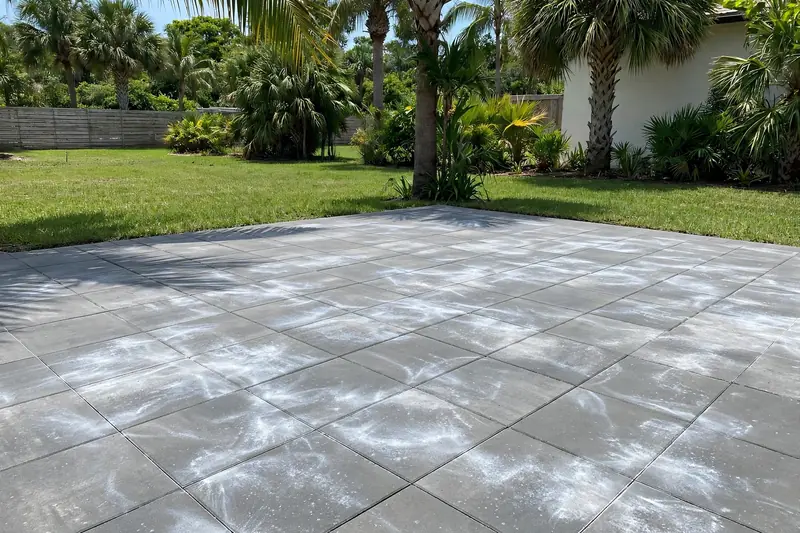
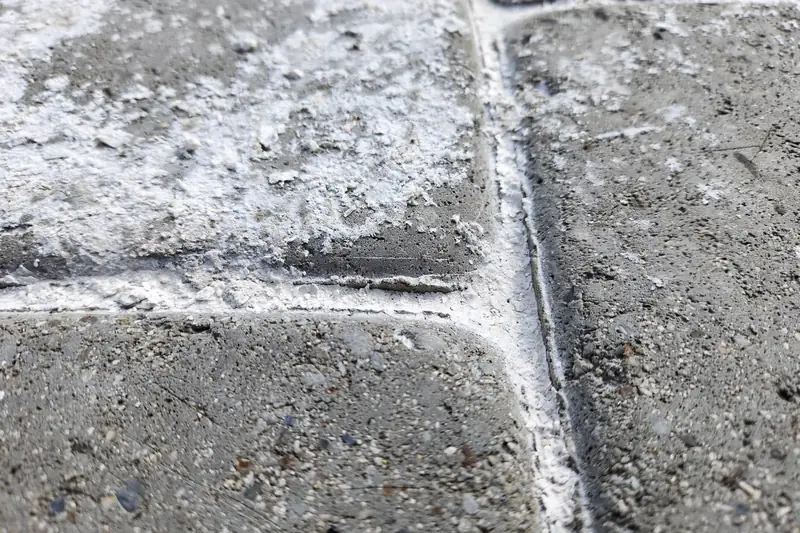
Efflorescence on pavers is a white, chalky haze left when water inside new concrete pavers carries calcium salts to the surface and dries. It is harmless, it is not mold, and in most cases it fades on its own within 6 to 12 months. Dry brushing or a paver-safe cleaner removes it. Never seal over it.
If your new patio looked perfect on install day and now looks dusty white, you are seeing the complaint we hear most in Palm Coast.
What That White Haze Really Is
Concrete pavers are made with Portland cement. As the cement cures, it produces calcium hydroxide inside the paver. That is normal chemistry in every concrete paver.
The haze needs three things: salts inside the paver, water to move them, and a surface where the water can dry. Rain, irrigation, or dew soaks in and dissolves the salts. The water rises, dries in the sun, and leaves the salt behind. The salt then reacts with carbon dioxide and hardens into calcium carbonate, the same mineral in limestone and chalk.
It is not mold, mildew, or algae, and it is purely cosmetic. The Interlocking Concrete Pavement Institute lists efflorescence as an inherent trait of Portland cement products. It does not weaken the paver, hurt the joints, or damage the base below.
Why New Pavers Get It Worst
A new paver holds the most soluble calcium it will ever hold. The haze shows up most often in the first few weeks to a few months after install, and it is heaviest during the first 6 to 12 months. Some keep pushing out salt for 12 to 18 months.
The supply runs out. There is only a set amount of salt inside each paver. Every rain cycle pulls a little more to the surface, and once it is gone, it is gone. The haze looks worse after a wet week, then fades and comes back weaker after the next rain.
Pavers installed with a proper base and drainage still show efflorescence, because the salts come from inside the paver, not from the ground below.
Why Palm Coast Pavers Show It More
Northeast Florida gives efflorescence everything it needs. Humidity here sits near 75 percent for much of the year, so pavers rarely dry all the way through. Our summer pattern of a hot day followed by a hard afternoon downpour is the perfect cycle: rain soaks the pavers, the sun dries them fast, and the salts stay on top.
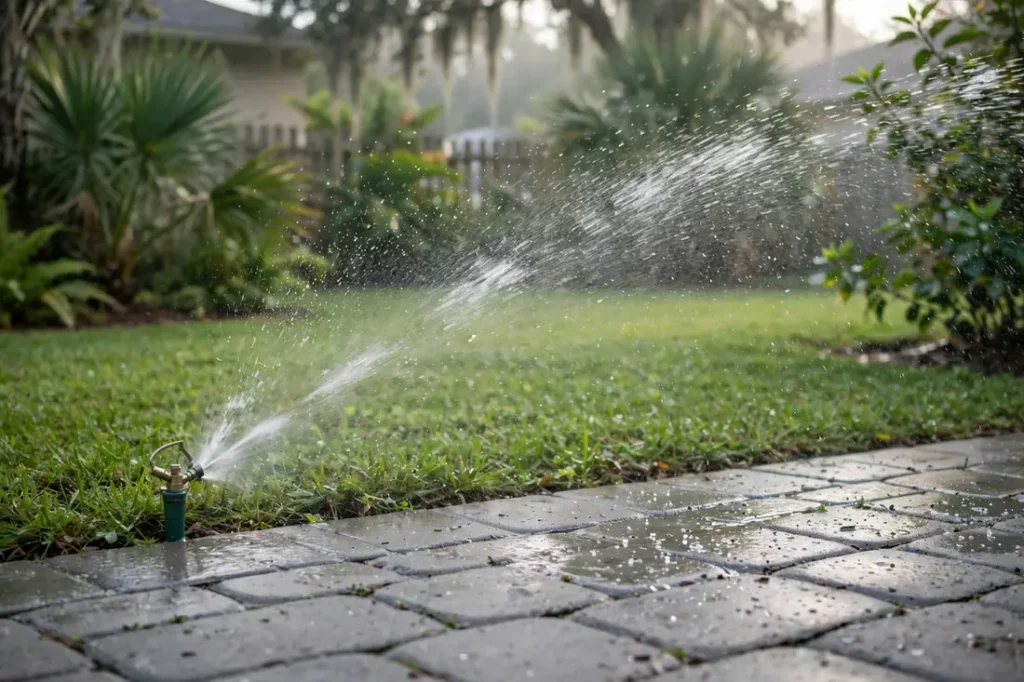
Sprinkler overspray adds to it. A sprinkler head that hits the patio every morning keeps the pavers damp, and Florida irrigation water often carries its own minerals too. Morning dew does the same on a smaller scale, and low spots where water pools make it worse.
Is It Efflorescence or Something Else?
White marks are not always efflorescence, and the fix depends on what you are looking at. This table sorts out the four things homeowners mix up most.
| What you see | What it likely is | How to tell |
|---|---|---|
| Powdery white film, worse after rain | Efflorescence | Fades when wet, returns as it dries |
| Green or black spots, often in shade | Mold or algae | Slimy feel, grows in damp shade |
| Hard white crust in bands near sprinklers | Hard water scale | Fan pattern where water sprays and dries |
| Even milky film after sealing | Sealer haze | Covers the sealed area evenly |
Try the water drop test: put a few drops of water on the white area. Efflorescence darkens and briefly disappears while it is wet, then comes back as the spot dries. Mold and sealer haze do not act that way.
Will It Go Away on Its Own?
In most cases, yes. Light haze on new pavers fades on its own over 6 to 12 months as the salts run out and rain rinses the surface. Give it one full wet season before spending money on cleaners. Brush it off now and then, and watch whether each round comes back lighter.
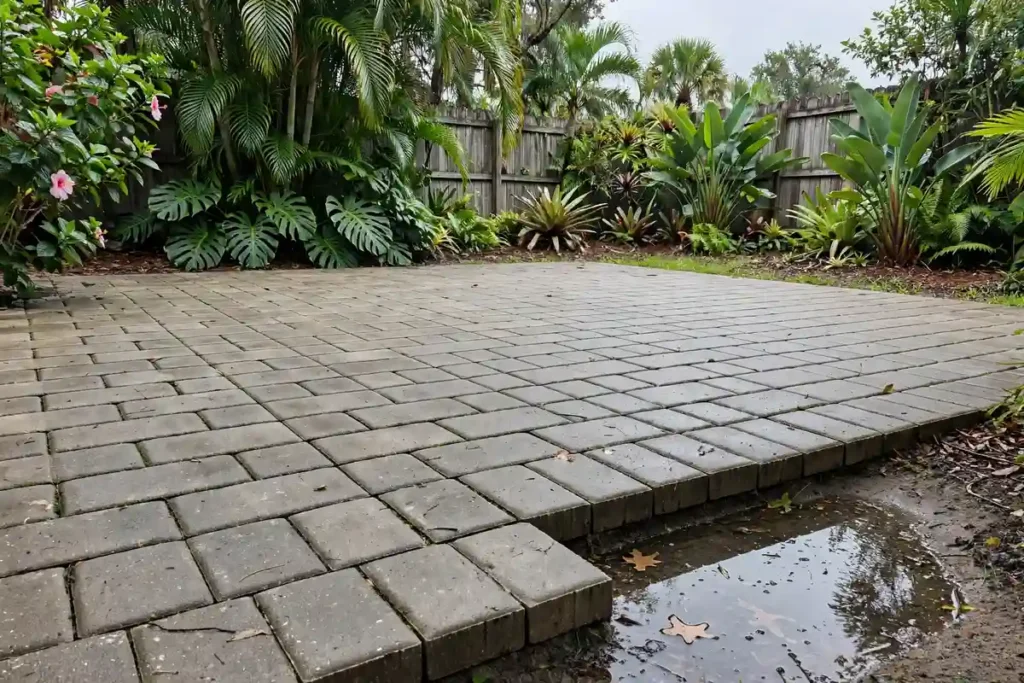
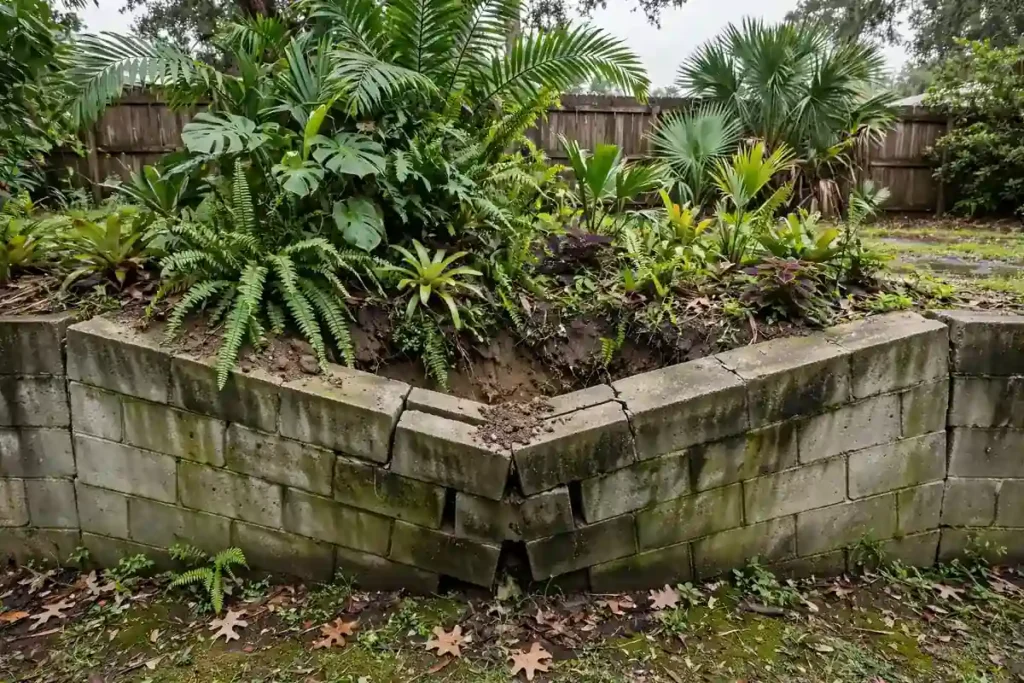
Waiting is the wrong call in a few cases. If the haze never fades, gets heavier every year, or shows up next to cracking or flaking pavers, the problem is likely water trapped under the pavers, not curing salts. Sunken pavers that hold water are a common cause. That haze needs the drainage or base fixed first.
How to Remove Efflorescence from Pavers
Work from the gentlest method up, in the order the Concrete Masonry and Hardscapes Association gives. Pick a warm, dry day so the surface dries fast after each step.
Step 1: Dry Brush It Off
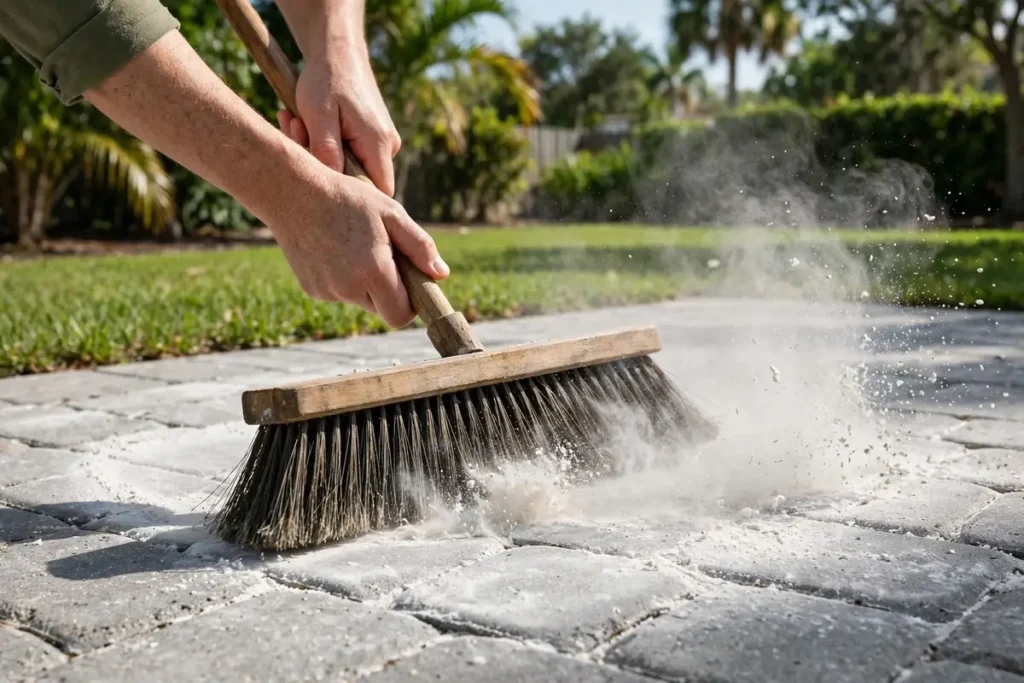
Start with a stiff-bristle broom and sweep the dry salts off. Do this before you add any water. Water dissolves the salts and can carry them back into the paver. Dry brushing works best on fresh haze, while it is still loose powder.
Step 2: Rinse With a Garden Hose
If brushing leaves a faint film, rinse with a garden hose at low pressure and keep the spray gentle. A hard blast drives water into the paver and pushes salts deeper, and high pressure can wash the joint sand out.
Step 3: Use a Cleaner Made for Pavers
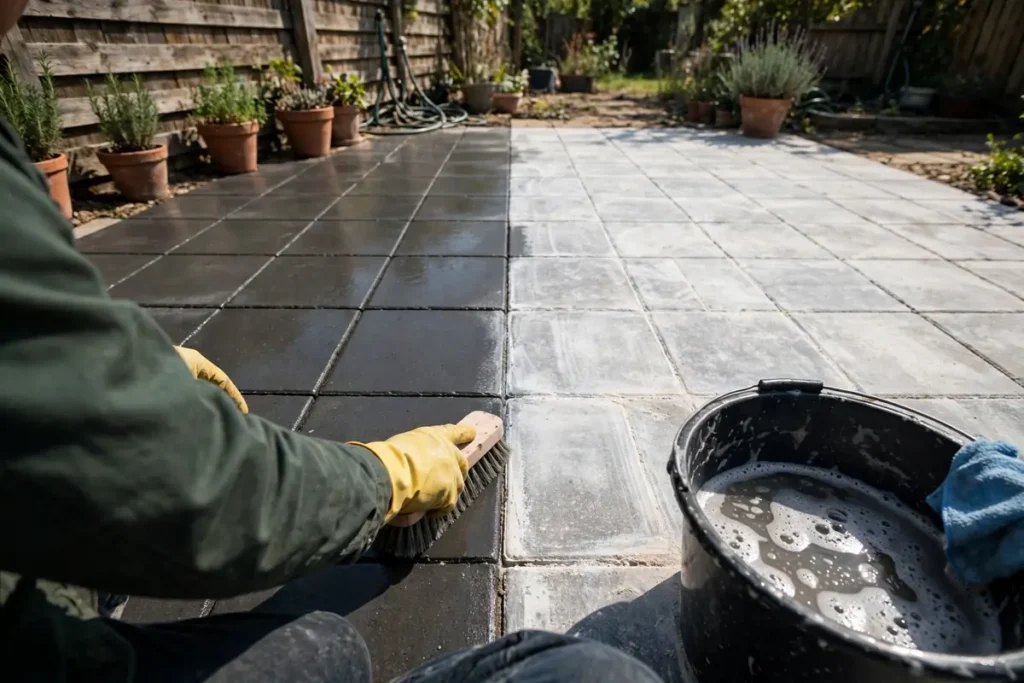
When brushing and water do not clear it, use a cleaner made for efflorescence on concrete pavers. These products are mild acids that dissolve calcium carbonate without eating the paver face. Test it on a hidden spot first. Wet the surface, work in small sections, give it the dwell time on the label, scrub with a stiff brush, and rinse it all off. Never let the cleaner dry on the pavers.
Step 4: When to Call a Pro Instead
Call a pro if the haze covers a large area, sits on travertine or natural stone, or keeps coming back after two cleanings. Strong acids are a last resort. Muriatic acid at hardware store strength can etch the paver face, pull the color out, and leave a rough surface that stains faster. Industry guidance allows a diluted mix, about 5 to 10 percent, and only 2 percent on colored pavers.
4 Mistakes That Make the Haze Worse
Most permanent damage comes from the fix, not the haze. These four mistakes turn a short-term cosmetic issue into a long-term one.
- Blasting it with a pressure washer. A pressure washer lifts loose dust, but it cannot dissolve the bonded carbonate underneath. It can wash out the polymeric sand between the pavers and force water deeper in.
- Pouring on straight muriatic acid. Full-strength acid burns the paver face and pulls color out in blotches. The haze often comes back worse, because the etched surface holds more water and salt.
- Using vinegar on stone that acid can etch. Vinegar is too weak to clear real efflorescence, and it is strong enough to dull travertine pavers and limestone for good.
- Sealing over the haze. Sealer does not stop salt from moving. It traps the salt under the coating, and you end up with a milky white film locked under a hard coat. The only fix is to strip the sealer off and start over.
What to Do Before You Seal
Sealing is the right last step, not the first one. Wait until the haze has stopped coming back on its own. Give it several dry weeks with no new haze after the last spot disappears. Some guides suggest waiting 60 days after the last appearance. If new white marks still show up after rain, they are not ready.
Once the haze has stopped, clean the surface once more and let it dry all the way through. After a wash, that takes 24 to 48 hours in our humidity, not just overnight. Re-sand joints that lost sand during cleaning. Then follow our guide on how to seal pavers, using a breathable sealer that blocks liquid water while letting vapor escape.
How to Keep It From Coming Back
You cannot remove every salt from a paver, but you can cut off the water that moves them. Fix low spots so water runs off instead of pooling. Aim sprinkler heads at the lawn, not at the pavers. After cleaning, a breathable penetrating sealer keeps rain and irrigation water out while letting trapped vapor escape.
Conclusion
White haze on new pavers looks alarming, but it is a normal part of how concrete pavers cure. The salts ride out on rain and irrigation water, dry into a chalky film, and run out on their own within 6 to 12 months. Brush it off dry, rinse gently, and use a paver-safe cleaner only if it stays. Skip the pressure washer, skip straight acid, and never seal over the haze. Wait until it stops coming back, let the pavers dry, then seal. If the haze never fades or keeps getting worse, the cause is likely water trapped below, and that is a drainage fix, not a cleaning fix. We serve Palm Coast, Flagler Beach, Bunnell, Ormond Beach, and St. Augustine. Call Dreamscapes Florida at (386) 237-2983 and tell us what you are seeing.
Frequently Asked Questions
Yes. It is a normal result of Portland cement curing, and the Interlocking Concrete Pavement Institute lists it as an inherent trait of concrete pavers. It is not a defect. It fades as the salts run out.
Most haze fades within 6 to 12 months. Some pavers keep showing light haze for up to 18 months. Each rain cycle usually brings back a weaker round than the one before.
In most cases, yes. Light haze weathers away on its own as rain rinses the surface and the salt supply runs out. Dry brushing speeds it up. If the haze never fades, water is likely trapped below the pavers.
Start with dry brushing, then a gentle hose rinse on a warm, dry day. If the haze stays, use a cleaner made for efflorescence on concrete pavers, applied to a pre-wet surface, then rinsed fully. Strong acids are a last resort.
A pressure washer alone will not remove it, because it cannot dissolve the bonded calcium carbonate. High pressure can wash out the joint sand and drive water deeper into the paver. Use low pressure only, after dry brushing.
No. Sealing over efflorescence traps the salt under the coating and leaves a milky white film you cannot wash off. The only fix is to strip the sealer. Clean the haze first, wait until no new haze appears for several weeks, then seal with a breathable product.