Yes, you can put pavers over concrete when the slab is sound, stable, and draining away from your house. An overlay skips demolition and a new gravel base, so it costs less and finishes faster than a full rebuild. It fails when the slab is sinking, heaving, or holding water.
If your patio looks tired but the slab under it is still solid, the question is simple: can you lay pavers over concrete instead of tearing it out? An overlay is one of the best upgrades for a Florida yard.
What a Paver Overlay Is
A paver overlay is a layer of pavers set on top of an existing concrete slab, which becomes the base. The crew cleans the concrete, adds a thin bedding or bonding layer, and sets the pavers.
That shortcut is the whole appeal, but it only works when the slab underneath can carry the job. An overlay hides a slab. It does not fix one.
Unilock, one of the largest paver makers in North America, says in its overlay guidance that hairline cracks and light wear are fine, but wide gaps, heaving, or rocking sections mean ground movement, and a full rebuild is the better path. We check every slab the same way.
The 5-Minute Slab Test
Walk your slab with these five checks. All you need is a broom, a garden hose, and a long level.
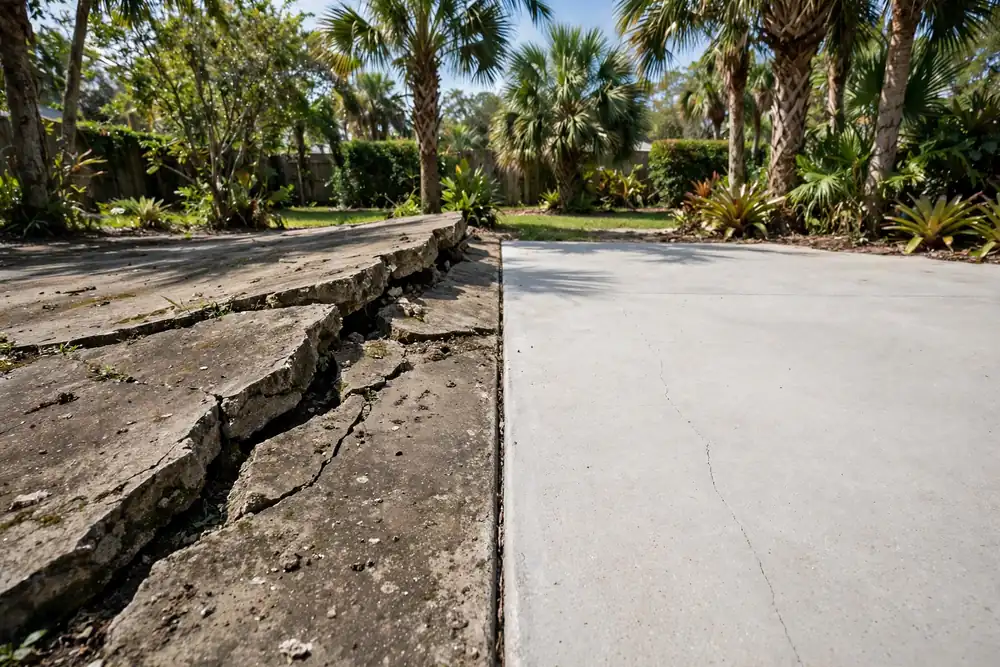
First, look at the cracks. Hairline cracks you can barely fit a fingernail into are normal wear. Cracks wider than about 1/4 inch, especially where one side sits higher, are a warning sign. A crack that moves will show up again through the pavers above it.
Second, test for rocking. Stand on each section and shift your weight. A section that rocks or sounds hollow has lost support underneath, and no overlay will hold it still.
Third, check the slope. Pour a bucket of water on the slab. It should run away from the house and off the edge. Angi recommends about 1 inch of slope for every 8 feet of run. Water that pools against the house means a drainage problem pavers will not solve.
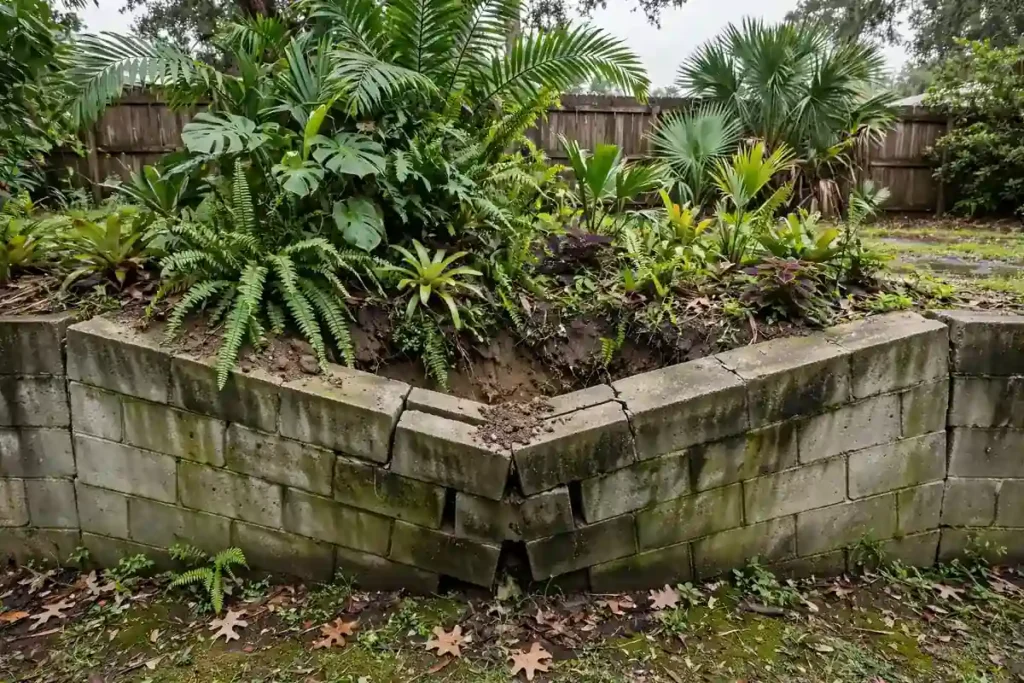
Fourth, look for heaving and settling. A corner lifted by tree roots, or a section that has sunk, means the ground under the slab is still moving. Fifth, check the surface. Spalling or crumbling concrete will not hold adhesive or a bedding layer, and a painted or sealed slab needs the coating removed first. Pass all five, and your slab is a good candidate.
When an Overlay Works and When It Fails
An overlay is the right call when the problem is the surface, not the slab.
| What you see | Overlay? | Why |
|---|---|---|
| Stains or fading | Yes | Only the look needs help. |
| Hairline cracks | Yes | They do not move. |
| Cracks wider than 1/4 inch, one side higher | No | It will telegraph through. |
| Sinking or heaving sections | No | The ground is the problem. |
| Water pooling on the slab | No | Trapped water works pavers loose. |
If your slab falls in the “no” rows, the honest fix is removal and a fresh build. See our guide to how to fix sunken pavers for what happens when pavers sit on a moving base.
Most failures come from four causes, all visible before the first paver is laid. The first is a live crack with vertical offset: bonded pavers crack along the same line, and sand-set pavers settle into it. The second is poor drainage, covered below. The third is height: a finished surface above a door threshold lets rain run into the house. The fourth is the wrong use. Thin overlay pavers suit patios, walkways, and pool decks, not cars, and a driveway overlay needs an assembly rated for vehicle loads.
How Much Height Will Pavers Add?
Height is the detail homeowners forget. Every overlay raises the finished surface, and how much depends on the paver and the setting method.
| Overlay type | Added height | Best for |
|---|---|---|
| Thin paver, about 30 mm, on a bonding bed | About 1.5 inches | Tight doors and pool decks |
| Thin paver, 3/4 to 1-1/2 inches, bonded | About 1.25 to 2 inches | Patios with low thresholds |
| Standard paver, 2-3/8 inches, on a sand bed | About 2 to 3 inches | Patios with room at doors |
| Standard 60 mm paver, sand-set | About 3.25 to 4 inches | Patios with room |
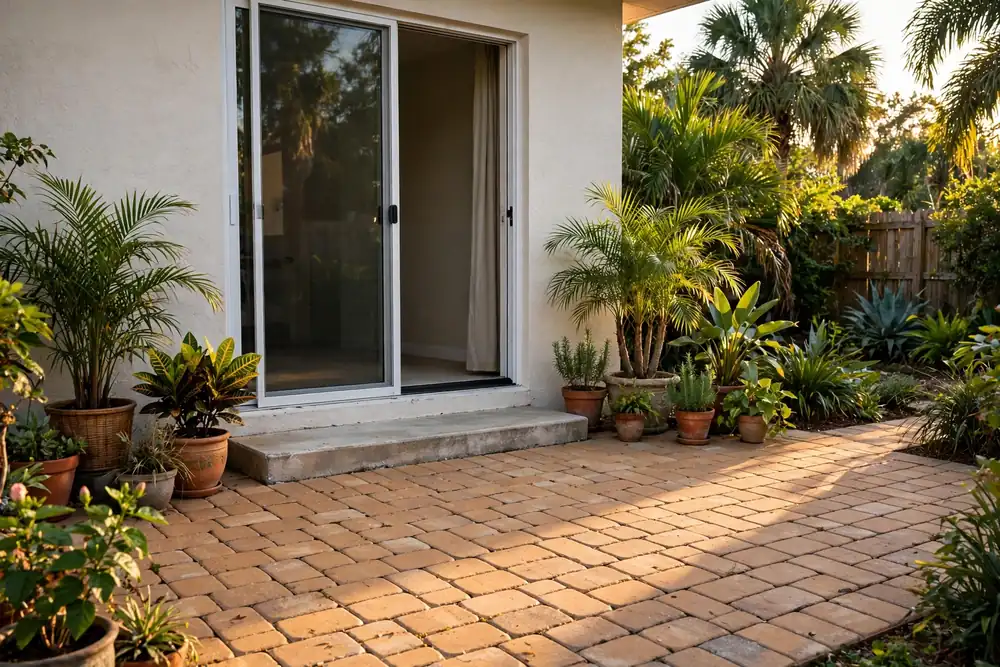
Thin pavers over concrete are the usual answer when a sliding door sits close to the slab. A 30 mm thin paver on a thin dry bonding bed can add as little as about 1.5 inches, often enough to save a tight threshold. Standard pavers look more substantial but need more clearance.
Measure from the top of the slab to the bottom of each door threshold before you choose. You want at least 1.5 to 2 inches of clearance left below the threshold after the overlay is done. Check the steps too: a new step height that is too tall or too short becomes a trip hazard.
Three Ways to Set Pavers Over Concrete
Belgard, another major paver maker, lists three overlay methods: sand set, bituminous set, and mortar set. In practice, Florida crews use three approaches, and the slab and the height budget decide which fits. Here is how to install pavers over concrete with each method.
1. Sand-set overlay
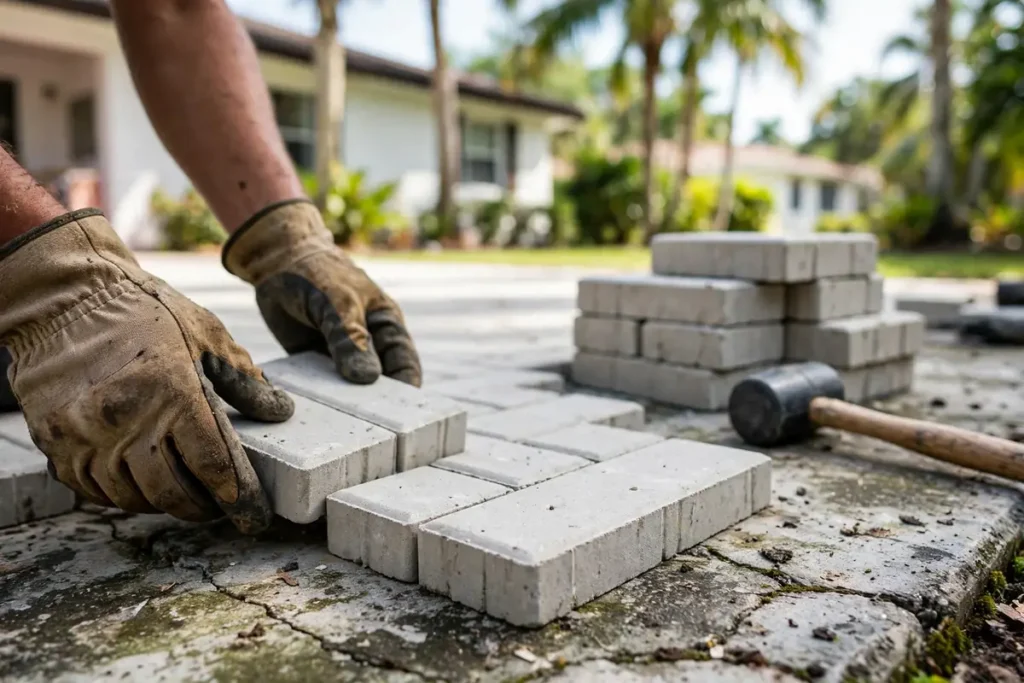
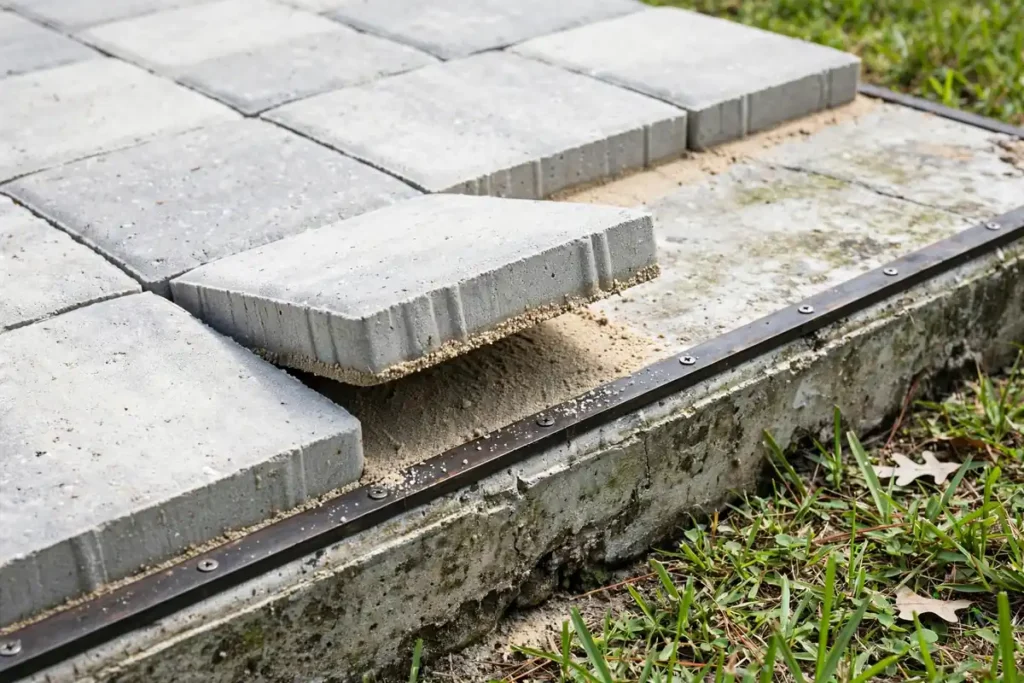
Sand-set is the most forgiving method. A layer of washed bedding sand, about 1 inch thick, is screeded level over the slab, and standard pavers are laid on it. The border pavers are glued to the slab with polyurethane adhesive. Repairs are easy, because one paver can be lifted and reset. It adds the most height, so it needs the most door clearance, and water in the joints needs weep holes or a drain to escape.
2. Mortar-set or bonded overlay
In a bonded overlay, thin pavers are set in mortar or a polymer-modified adhesive straight onto the cleaned slab. The slab must be sound, clean, and free of paint or sealer, or the bond will fail. Bonded overlays add the least height, so they suit sliding doors and pool coping best. A loose bonded paver must be chipped out and re-bonded. It does not suit driveways unless the product and assembly are rated for vehicles.
3. Dry mudset bed
A dry mudset bed sits between the two. A thin layer of dry sand and cement mix is spread over the slab, the pavers are set on it, and moisture slowly cures the mix into a firm bed. It adds little height and holds pavers tighter than loose sand, but it needs the same drainage plan.
Joints are usually filled with polymeric sand, which locks the pavers together and keeps weeds and ants out. Our guide to polymeric sand for pavers covers how it works. For the full ground-up method instead, read our guide to how to install pavers.
Florida Rain: The Drainage Problem Under the Pavers
In Palm Coast, drainage decides whether an overlay lasts. Our summer storms are short and heavy, and a flat slab with new pavers on top traps a lot of water.
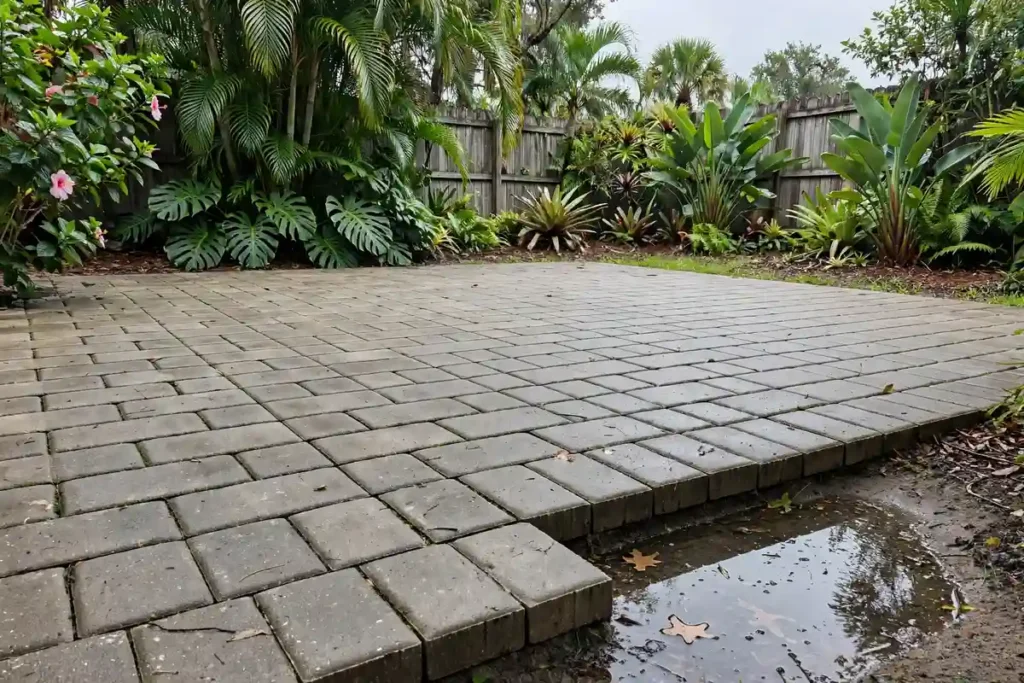
A concrete slab is waterproof. Rain runs through the joints, hits the slab, and has nowhere to go. Without an exit, it sits in the bedding layer, washing sand out from under sand-set pavers or working at the bond of a bonded overlay. Either way, the patio starts to shift, stain, or grow mildew.
A good Florida overlay plan has three parts. First, the slab must already slope away from the house, about 1 inch for every 8 feet. Second, the crew leaves weep holes or a drainage gap at the low edge, so water under the pavers can escape instead of pooling. Third, the patio edge must drain into a bed, not into a low spot that floods in a storm.
Pool decks deserve extra care. The coping sets the height, and the deck must drain away from the pool, not toward it. Thin travertine pavers are popular on pool decks because they stay cool underfoot and match existing coping, but the same slab rules apply: sound, sloped, and dry.
What Does a Paver Overlay Cost?
Prices below are national averages from published 2026 guides, not Dreamscapes pricing, and local quotes will vary.
HomeGuide reports that a standard paver installation runs about $10 to $30 per square foot installed, and replacing a concrete driveway with pavers runs about $12 to $35 per square foot, including demolition. Concrete removal alone runs about $2 to $6 per square foot, and skipping it is the main saving an overlay offers.
A thin-set overlay itself runs about $8 to $15 per square foot, according to QuotrPro’s 2026 paver cost guide. Angi, updated in July 2026, notes that keeping the slab can save about $4 to $11 per square foot in labor, and that concrete removal averages over $1,100. On a 400 square foot patio, a thin overlay runs roughly $3,200 to $6,000 before extras.
Overlay or Tear-Out? A Side-by-Side Look
| Paver overlay | Tear-out and rebuild | |
|---|---|---|
| Old slab | Stays in place | Removed |
| Base | The slab is the base | New gravel base |
| Typical time | 1 to 3 days | 3 to 7 days |
| Mess in the yard | Low | High |
| Height change | Adds 1.5 to 4 inches | Same as before |
| Fixes a bad slab | No | Yes |
If you are weighing the two materials themselves, our pavers vs concrete patio comparison covers how they differ in cost, repair, and lifespan.
Pavers Over Concrete in Palm Coast
Most overlays we see in Palm Coast and Flagler County sit on patios poured 10 to 30 years ago. The concrete is often stained by oak leaves and irrigation water, but the slab itself is still solid.
Two local details come up on almost every job: the sliding door and the lanai. Many Palm Coast homes have the patio slab poured nearly level with the interior floor, which leaves little room for height. Thin bonded pavers are usually the answer, because they add about 1.5 inches instead of 3 or 4. Screened patios trap humidity, and joints that stay damp grow mildew fast. A bonded overlay with tight joints holds up better there.
Sealing is a light job after an overlay: one thin coat protects the color and keeps the joints clean. Our guide to how to seal pavers explains when to seal and how often to repeat it. Near the coast, choose a paver and a joint sand rated for coastal use.
We build paver overlays, patios, walkways, and pool decks across Palm Coast, Flagler Beach, Bunnell, Ormond Beach, and St. Augustine. See our hardscape services for what we build, or contact us to have your slab checked. Call us at (386) 237-2983 and we will tell you honestly whether an overlay fits your patio.
Frequently Asked Questions
Yes, when the slab is sound, stable, and sloping away from the house. The pavers sit on a thin sand bed or a bonding layer instead of a new gravel base. Hairline cracks and faded color are fine. A slab that is sinking, heaving, or holding water is not a candidate, and covering it will fail.
Standard pavers are 2-3/8 inches thick and add about 2 to 3 inches with the bedding layer. Thin pavers, about 30 mm thick, add as little as about 1.5 inches on a thin bonding bed. Thin pavers are the better choice where a sliding door sits close to the slab and clearance is tight.
Most sand-set overlays use about a 1 inch layer of washed bedding sand, screeded level over the slab. Mortar-set and dry mudset methods use a bonding layer instead of loose sand. Either way, water that seeps through the joints needs weep holes or a drain to escape, because the slab below does not drain.
A live crack will show up again through the pavers above it. Bonded pavers can crack along the same line, and sand-set pavers can settle into it. Hairline cracks that have not moved in years are not a problem. A crack wider than about 1/4 inch with one side higher than the other means the slab is still moving.
A thin-set overlay runs about $8 to $15 per square foot, according to QuotrPro’s 2026 paver cost guide. Those are national averages, and local quotes in Palm Coast will vary. Keeping the slab saves the demolition cost, which HomeGuide puts at about $2 to $6 per square foot, plus the cost of a new base.
Yes, if the deck slab is sound, sloped away from the pool, and low enough at the coping. Thin pavers are the usual choice because they add little height and keep the step at the pool edge safe. Travertine is popular on pool decks because it stays cool underfoot and matches existing travertine coping.