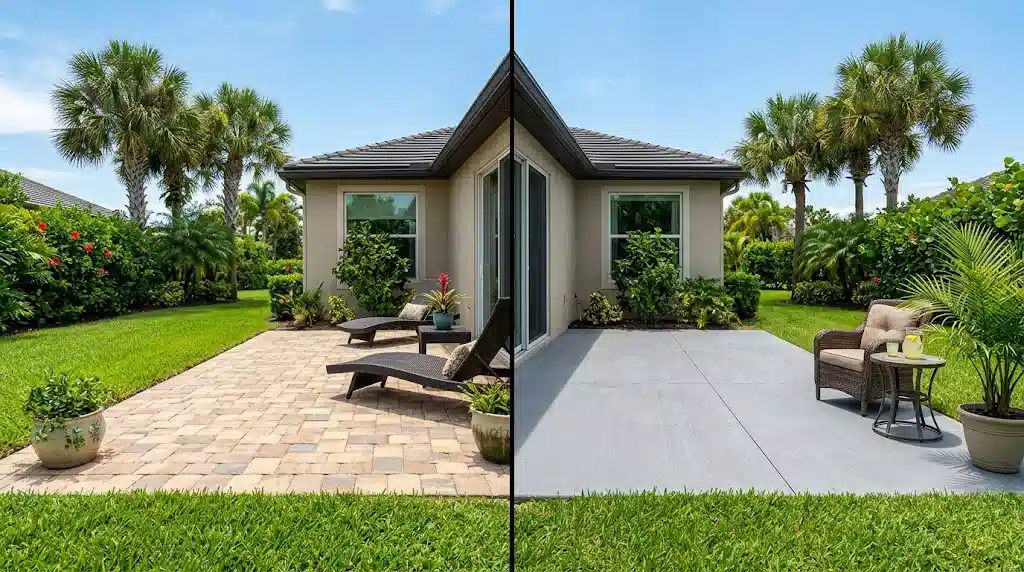
If you’re planning a backyard patio in Palm Coast, the decision usually comes down to two materials: paver stones or poured concrete. Here’s the short version. Pavers cost more upfront but hold up better in Florida’s sandy soil, stay cooler under bare feet, and can be repaired one stone at a time. Concrete costs less to install and works fine for simple, shaded spaces, but it cracks as the ground shifts, and those cracks are almost impossible to hide.
We’ve been installing patios, pool decks, and walkways across Flagler and Volusia County since 2015. The material that looks great on paper doesn’t always survive our summers, our storms, or the sand under your yard. So instead of a generic pros-and-cons list, here’s what actually happens to each one after a few Florida years.
Pavers vs Concrete at a Glance
Both materials will give you a usable patio. The difference shows up in years three, five, and ten. Concrete is a single rigid slab, so when the soil underneath moves, the slab has nowhere to go but crack. Pavers are individual units sitting on a compacted base, so they flex with ground movement instead of fighting it. That one structural difference explains most of what follows.
Upfront Cost
Concrete is the cheaper option to install, and there’s no point pretending otherwise. In the Palm Coast and Ormond Beach area, a basic broom-finish concrete patio usually runs somewhere in the range of $8 to $15 per square foot. Paver patios typically land between $14 and $25 per square foot depending on the stone you pick and how much prep the site needs. Stamped concrete sits in the middle and tries to imitate the paver look. If you want to see how those numbers break down by material and labor before you call anyone, our hardscape cost breakdown walks through it in detail.
Durability in Sandy Soil
This is where Florida changes the math. Our soil is mostly sand, which drains fast but also shifts, settles, and washes out under heavy rain. A concrete slab poured over sand that later settles will crack, usually within the first five to seven years. Pavers set on a properly compacted crushed-base layer move with the ground. A section might settle slightly over time, but the patio doesn’t fail. The base prep matters more than the stone you choose, which is why a cheap paver install can perform worse than good concrete.
Maintenance and Cleaning
Neither one is maintenance-free in this humidity. Concrete grows algae and mildew in shaded spots and stains easily from grill grease, leaf tannins, and iron in well water. Pavers stay cleaner overall but need joint sand topped up every few years and an occasional weed pulled from the seams. Both benefit from a pressure wash once a year and a sealer every three to five years. Our guide to keeping pavers and hardscapes clean covers the products that work in coastal conditions and the ones that just strip your color.
Appearance and Design Options
Concrete gives you gray, tinted gray, or stamped patterns that look convincing for a while and then fade unevenly as the color coat wears. Pavers come in dozens of shapes, tones, and layouts, and the color runs through the whole stone instead of sitting on top. You can run a contrasting border, curve the edges around a pool, or match the tone of your roof and trim. Pavers also transition cleanly into planting beds, which matters if you’re thinking about how hardscape and softscape work together in the finished yard.
Heat Underfoot
In July, this stops being a small detail. Standard gray concrete absorbs and holds heat, and a wide unshaded slab can get genuinely painful to walk on barefoot by mid-afternoon. Lighter-colored pavers, especially in tan, sand, or shell tones, run noticeably cooler because they reflect more light and the joints between them release some heat. For pool decks in Palm Coast and Flagler Beach, that difference alone sends most homeowners toward pavers.
Repairs
A cracked concrete slab has three options: live with it, patch it and see the patch forever, or tear out the section and repour. Color-matching new concrete to old concrete almost never works. With pavers, you lift the affected stones, fix whatever’s underneath, and set them back down. Utility work under a paver patio is the same story. Plumbers can pull up a two-foot square, do their job, and the patio looks untouched afterward.
Lifespan
A well-poured concrete patio in North Florida realistically gives you 15 to 25 years before cracking and surface wear make it look tired. Pavers over a proper base commonly last 25 to 40 years or more, because individual stones can be swapped and the base can be relaid without starting over. Spread across that lifespan, the higher paver price often ends up cheaper per year.
Florida Climate and Hurricane Season
Heavy rain is the real test. During a tropical system, a solid concrete slab sheds every drop toward whatever is downhill, which is often your foundation or your neighbor’s yard. Paver joints let some water pass through, and permeable paver systems are built specifically for that. Near the water in Flagler Beach and St. Augustine, salt air also matters. Salt spray accelerates surface scaling on concrete, while quality pavers handle it better and hide any wear that does show.
When Concrete Still Makes Sense
Concrete isn’t the wrong answer every time, and any contractor telling you otherwise is selling something. It’s the practical choice for a covered lanai where the roof protects the slab, for a small utility pad behind the house, for an AC or generator base, or when you’re preparing a property for sale and need a clean surface without a big spend. It also suits homeowners who want a smooth, modern, uninterrupted look with no seam lines at all.
Our Recommendation for Palm Coast Homeowners
For open patios, pool decks, and driveways in Flagler and Volusia County, we recommend pavers in most situations. The sandy soil, the summer heat, the storm-season rainfall, and the coastal air all favor a flexible surface that can be repaired instead of replaced. Concrete makes sense when the space is covered, small, or short-term, or when budget is the deciding factor and you understand the tradeoff. If you’re weighing a patio alongside other yard work, it’s worth looking at the full range of landscaping and hardscaping services so the whole project gets planned as one job rather than three separate ones.
One more thing worth saying plainly: the base is the patio. We’ve been called out to fix two-year-old paver patios in Bunnell and Daytona Beach that failed because someone skipped compaction or laid stone over four inches of loose fill. Ask any contractor how deep their base goes and how they compact it. If the answer is vague, keep calling. You can see how we approach base prep, drainage, and layout on our hardscape design and installation page.
Get a Free Patio Quote in Palm Coast
Every yard is different, and the right answer depends on your drainage, your sun exposure, and how you actually plan to use the space. If you’d like a straight recommendation with real numbers, reach out for a free hardscaping estimate or call us at (386) 237-2983. We serve Palm Coast, Flagler Beach, Bunnell, Ormond Beach, Daytona Beach, St. Augustine, and the surrounding Flagler and Volusia County areas.
Frequently Asked Questions
Concrete is cheaper upfront. A concrete patio generally costs $8 to $15 per square foot installed in the Palm Coast area, while pavers run about $14 to $25 per square foot. Over a 25-year span, though, pavers often cost less per year because they rarely need full replacement.
For most Florida yards, yes. Sandy soil shifts, and pavers move with it instead of cracking. They also stay cooler in summer sun and let you replace a single damaged stone instead of repouring a slab. The exception is a covered or very small patio, where concrete performs well enough to justify the savings.
Generally no. Light-colored pavers in tan or sand tones stay cooler than standard gray concrete because they reflect more sunlight and the joints help release heat. Dark charcoal pavers can get just as hot as concrete, so color choice matters more than material when heat is your main concern.
With a properly compacted base and normal upkeep, a paver patio in North Florida lasts 25 to 40 years or longer. Individual stones can be lifted and reset, and the base can be repaired in sections, so the patio rarely needs to be torn out completely.
Sometimes. If the existing slab is structurally sound with only minor hairline cracks and there’s enough height clearance at doors and thresholds, pavers can be laid over it. If the slab is heaving, badly cracked, or sitting low enough to trap water, it should come out first. We check this during the site visit before quoting.
Sealing isn’t required, but it helps in Florida. A good sealer slows algae growth, locks joint sand in place, and keeps colors from fading in UV. Most homeowners here reseal every three to five years, and more often on pool decks that see constant splash and chlorine.