Crabgrass in St. Augustine grass comes with a catch most homeowners find out too late. The majority of products sold as “crabgrass killer” at big-box stores will damage or outright kill St. Augustine. Quinclorac, the active ingredient in the most popular bottles on the shelf, is one of them. Spray it on a Florida lawn and you trade a weed problem for dead patches.
That one detail separates a lawn that recovers from a lawn that needs re-sodding. Here in Palm Coast, Flagler Beach, Bunnell, Ormond Beach, Daytona Beach, and St. Augustine, our sandy soil and long warm season give crabgrass roughly nine months of runway every year. The upside is that thick St. Augustine crowds crabgrass out on its own. Most of this guide is about getting your lawn to that point.
What Crabgrass Looks Like in a Florida Lawn
Crabgrass grows as a flat, sprawling clump. Stems radiate out from a single center point and lie close to the ground, which is where the name comes from. The blades sit lighter green than St. Augustine, run narrower, and taper to a sharper point. When it goes to seed, it pushes up thin stalks topped with three to seven finger-like spikes.
It is an annual weed. A single plant can drop tens of thousands of seeds before winter knocks it back, and those seeds wait in your soil for the next warm spell. That is why three clumps in July turn into a wide patch the following spring if nothing changes.
Crabgrass vs. St. Augustine Grass: Side by Side
| Feature | Crabgrass | St. Augustine Grass |
| Growth habit | Low clump spreading out from one center | Runners creeping across the soil surface |
| Blade shape | Narrow, pointed, light green | Wide, flat, rounded boat-shaped tip |
| Color | Pale to yellow-green | Deeper blue-green |
| Seedhead | Finger-like spikes on a thin stalk | Short spike, rarely noticeable in mowed turf |
| Lifespan | One season, dies back after frost | Perennial, returns every year |
| Where it starts | Bare soil, hot edges, thin turf | Fills in from established runners |
Here is a quick field test. Grab a handful and pull straight up. Crabgrass lifts out as one clump with a shallow, fibrous root ball. St. Augustine fights back because it is anchored by runners heading in several directions at once.
Weeds People Mistake for Crabgrass
Identifying crabgrass in Florida lawns gets tricky because three other weeds look similar at a glance:
- Goosegrass sits darker green with a distinctive white or silvery flattened center. Its seedhead looks like a zipper. It thrives in compacted soil along driveways and walk paths.
- Bermudagrass has much finer blades and spreads by both surface runners and underground stems. It returns year after year, which makes it a far harder invader than crabgrass and one that needs a completely different plan.
- Torpedograss shows stiff, sharply pointed tips and deep underground rhizomes. Pulling it does almost nothing.
Getting the ID right matters, because the treatment changes with each one. Guessing wrong usually means spraying something that either does nothing or hurts the lawn.
Why Crabgrass Invades St. Augustine Grass
Healthy St. Augustine is one of the densest turf grasses grown in Florida. When the canopy is thick, crabgrass seed never gets the sunlight it needs to sprout. Crabgrass is not strong enough to punch through good turf, so it only moves in where the lawn has already given up ground. Every cause below comes down to that same idea.
Mowing Too Short
Scalping is the number one reason crabgrass shows up. Standard St. Augustine cultivars such as Floratam belong at 3.5 to 4 inches. Dwarf types like Seville and Captiva do better around 2.5 inches. Cut lower than that and sunlight reaches bare soil between the runners, which is exactly the signal crabgrass seed is waiting for.
Two habits fix this. Never take off more than a third of the blade height in one pass, and sharpen your mower blade at least twice a season. A dull blade tears the leaf tips and thins the canopy even when your cut height is correct.
Shallow, Frequent Watering
Crabgrass seed germinates in the top quarter inch of soil. Short daily sprinkles keep that exact layer damp, which favors the weed while doing nothing useful for St. Augustine roots that sit much deeper. Watering deeply and less often is one of the cheapest crabgrass prevention tools you have, and it helps to know how much water your lawn really needs before you set the timer.
The target is roughly half an inch to three quarters of an inch per session, applied only when the lawn tells you it is thirsty. Watch for folded blades, footprints that stay visible, and a blue-gray cast across the turf.
Coverage matters just as much as volume. A clogged head, a tilted nozzle, or zones that were never balanced will leave one strip soggy and another bone dry, and crabgrass takes both. If parts of your yard look consistently different from the rest, an irrigation system inspection usually finds the cause faster than more guessing.
Thin Spots, Sandy Soil, and Hot Edges
Flagler and Volusia County sand drains fast and holds very little moisture, so weak areas open up quickly. Strips along driveways, sidewalks, and curbs absorb reflected heat and dry out first, which is why crabgrass so often lines the edges of a yard before it reaches the middle. Chinch bug damage, heavy shade under live oaks, dog traffic, and compacted soil create the same openings, so it pays to fix dry patches on your lawn while they are still small.
New sod deserves a mention too. The seams between pieces stay open for weeks before the runners knit together, and crabgrass will use that window.
Crabgrass Prevention: Pre-Emergent Timing for North Florida
A pre-emergent herbicide is the highest-value step in crabgrass control in St. Augustine grass. It builds a thin barrier in the top layer of soil that stops seedlings as they germinate. It does nothing to crabgrass you can already see, which is why timing decides whether the application was worth the money.
Timing keys to soil temperature, not the calendar. Crabgrass starts germinating once soil holds near 55°F at a two-inch depth for several consecutive days. Along the Flagler and Volusia coast, that usually lands in early to mid February. National articles that tell you to apply in April are written for the Midwest and Northeast, and following them here means you are treating a lawn where crabgrass has already sprouted.
| Window | What to do |
| Early to mid February | First pre-emergent application |
| Late April to early May | Second application, since heat and rain break the barrier down in 8 to 10 weeks |
| June through September | Spot treat, mow high, and keep watering deep |
| October | Optional fall application for cool-season weeds |
Active ingredients labeled for established St. Augustine include prodiamine, dithiopyr, and pendimethalin. Dithiopyr has a useful bonus: it also takes out very young crabgrass that has already come up, up to about the three-leaf stage. Water any pre-emergent in with roughly a quarter inch of irrigation so it settles into the soil instead of sitting on the blades.
One warning. Do not apply pre-emergent to areas where you plan to lay sod or plugs, and check the label for its replanting interval. Skipping that step is a common way to stall a repair you just paid for.
How to Get Rid of Crabgrass That Is Already Growing
Pull It by Hand First
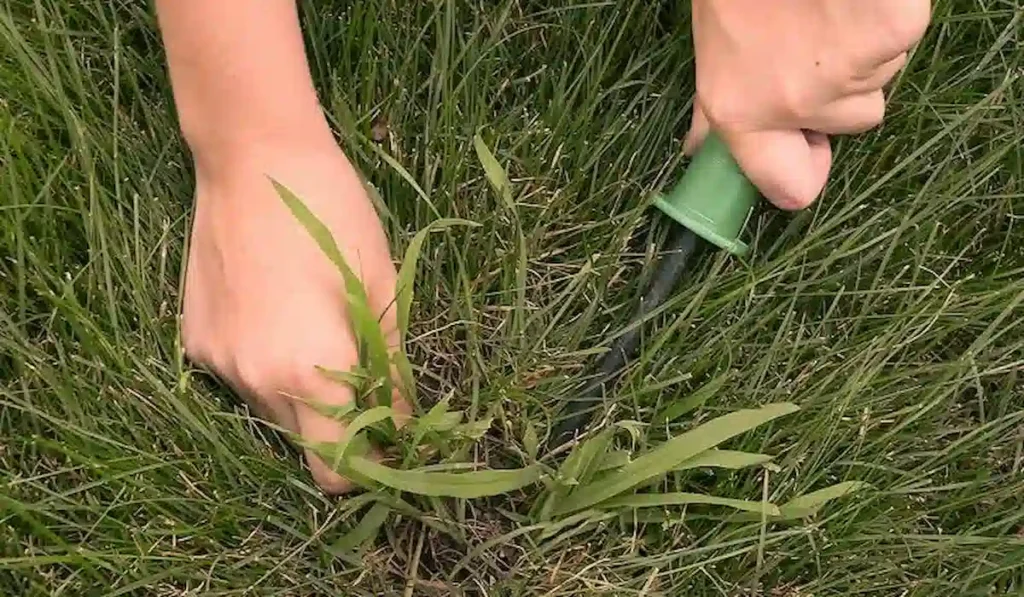
For a dozen clumps or fewer, hand pulling beats spraying every time. Do it the morning after rain while the soil is soft, and work down to the crown so the whole plant lifts. Pull before seedheads form and you stop thousands of seeds from reaching the soil. Fill the gap with topsoil so nearby runners can close it.
Crabgrass Killers to Avoid on St. Augustine Grass
This is where most Florida lawns get damaged. The retail shelf is stocked for northern turf, and several of the most common active ingredients are unsafe here:
- Quinclorac is the standard crabgrass ingredient nationwide and is not labeled for St. Augustine. It causes serious injury.
- Fenoxaprop-p-ethyl also injures St. Augustine and should stay off the lawn.
- MSMA and DSMA are no longer permitted on residential lawns and are hard on St. Augustine besides.
- Anything labeled for bluegrass, fescue, or ryegrass without St. Augustine listed should be treated as unsafe by default.
Atrazine sits in a gray zone. It is labeled for St. Augustine and does prevent crabgrass, but it is weak on clumps that are already up, it carries strict Florida limits on rate, temperature, and number of applications per year, and it can injure the roots of nearby shrubs and trees. It is not the easy answer people assume it is.
The rule that keeps you out of trouble is simple. Read the label and look for the words “St. Augustinegrass” in the list of tolerant grasses. If it is not printed there, it does not go on your lawn. In Florida the label is a legal document, not a suggestion.
What Actually Works on Established Crabgrass
The honest answer is that post-emergent options for St. Augustine are limited. The selective products that are cleared for this grass work best on young seedlings, not on mature clumps that have rooted in. Once crabgrass is well established, mechanical removal followed by a turf repair usually gives a better result than repeated spraying.
When a section of lawn is more crabgrass than grass, spot renovation is the practical route: clear the area, wait out the label interval, and re-sod. Licensed applicators also carry products homeowners cannot buy at retail, which is one reason a plan from a local crew often costs less than the trial and error it replaces.
Long-Term Crabgrass Control in St. Augustine Grass
Everything that thickens the turf works against crabgrass at the same time. Mow at the right height with a sharp blade, water deeply and less often, fertilize on a sensible schedule rather than as early as possible in spring, repair thin spots quickly, and check for chinch bugs during the hot months. Those habits are the same ones behind keeping a lawn green all year round in this climate.
Local watering rules shape the schedule too. Most of Flagler and St. Johns County falls under St. Johns River Water Management District restrictions, which generally allow two watering days per week during daylight saving time and one day in winter, with no irrigation between 10 a.m. and 4 p.m. Homeowners around St. Augustine and the surrounding coast should confirm current days with their city, since local ordinances can be tighter than the district rule.
Dreamscapes has maintained St. Augustine lawns across Flagler and Volusia County since 2015, and crabgrass calls arrive in the same order every year: a thin spot in spring, clumps by June, a full patch by August. Getting your Palm Coast irrigation system dialed in before February does more for crabgrass prevention than anything you can spray in July.
Frequently Asked Questions
Not directly. Crabgrass does not poison or strangle St. Augustine, but it competes hard for water, light, and nutrients in spots where the turf is already weak. It also dies back after the first frost, leaving bare soil behind that fills with more crabgrass the following spring. The damage comes from that cycle, not from the plant itself.
Early to mid February for the first application, with a second one in late April or early May. Crabgrass germinates once soil temperatures near 55°F hold for several days, which happens far earlier on the Flagler coast than in most of the country.
No. Quinclorac is not labeled for St. Augustine and causes serious injury to it. Check the product label for St. Augustinegrass in the list of tolerant grasses before anything goes on your lawn.
The plants die back after the first hard frost in North Florida, but the seed they dropped survives in the soil and germinates the following spring. Winter dieback is a pause, not a solution.
Look at the center of the clump. Goosegrass has a distinct white or silvery flattened base and darker green blades, and its seedhead looks like a zipper. Crabgrass is lighter green with a normal green center and a seedhead that spreads into finger-like spikes.
Mowing at the correct height helps a great deal, but mowing more often at a low height makes the problem worse. Cutting St. Augustine at 3.5 to 4 inches shades the soil and blocks germination. Frequent short cuts do the opposite.