Walk any older neighborhood in Flagler County after a summer storm and you’ll see the same problem repeat itself — a low spot in the yard holding water for two days, a bare muddy trench where runoff cuts its own path, a flower bed that drowns every June. After twenty-plus years building outdoor spaces around Palm Coast, we’ve fixed that same spot dozens of times with the same solution: a dry creek bed.
This guide covers what a dry creek bed actually does, how it’s built, which rock works best in Florida soil, and what the project costs around here.
What Is a Dry Creek Bed?
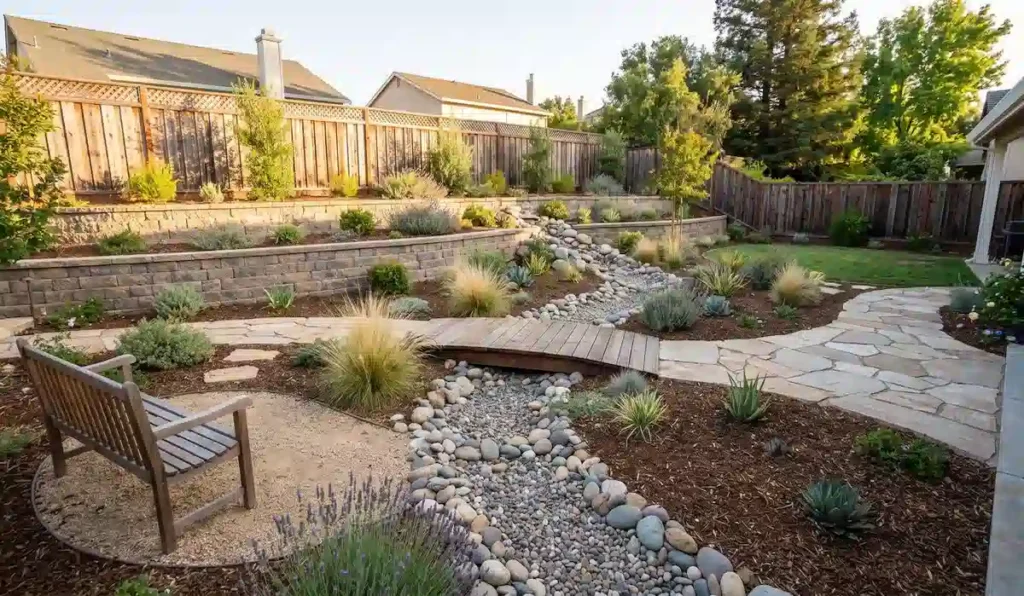
A dry creek bed is a shallow, sloped channel lined with river rock and boulders, built to look like a natural streambed even though no water runs through it most of the year. The rock replaces grass or bare dirt in the path water already wants to take, so instead of fighting the runoff, the yard works with it.
The term covers a few names for the same idea — dry river bed, dry stream bed, rock swale. All of them describe the same build: a graded trench, a layer of landscape fabric, and rock sized to match a real creek, from pea gravel at the edges to boulders anchoring the turns.
Why This Works So Well in Florida Yards
Florida sits on sand, and sand doesn’t hold a slope the way clay soil does. A heavy afternoon storm dumps two inches of rain in twenty minutes, and that water has to go somewhere. Left alone, it usually finds the lowest point in the yard and sits there, which is exactly the kind of standing water that kills grass roots and draws mosquitoes.
A dry creek bed gives that water an intentional path instead of an accidental one. The rock slows the flow enough to prevent erosion but still lets water move through and drain into the surrounding soil, which matters in a county that can pick up several inches of rain in a single afternoon. It also solves the same shaded, soggy strip that never grows grass — the kind of spot where lawn care becomes a losing weekly battle. If you’re weighing this against a fully buried solution, our breakdown of what a French drain actually does covers the difference between visible and hidden drainage.
Where a Dry Creek Bed Makes Sense on Your Property
The best candidates are the spots that already show you where the water goes:
- The gap between two downspouts where the ground stays soft
- A side yard drainage swale that currently just erodes bare dirt
- The low point where a sloped backyard collects runoff from higher ground
- A transition zone between a patio and a planting bed
- An unused strip along a fence line with poor grass coverage
If your yard slopes toward the house instead of away from it, a dry creek bed can redirect that flow before it reaches the foundation. Homeowners dealing with a sloped lot often combine this with broader grading work — our guide to landscaping a sloped backyard walks through how the two fit together.
Choosing the Right Rock
A convincing dry creek bed uses more than one size of stone, the same way a real streambed does.
River rock (1 to 3 inches) fills most of the channel floor. It’s rounded, not sharp, which is what sells the natural look and keeps the base from shifting underfoot.
Cobblestones (4 to 8 inches) sit along the edges and inside bends, mimicking where a real current would deposit larger stones.
Boulders anchor turning points and the start or end of the run. Two or three placed well do more visual work than a dozen scattered randomly.
Pea gravel works at the shallow tail end, where the “creek” fades into the surrounding bed. If you want a lower-cost option for a smaller accent area, our guide on pea gravel landscaping covers where it holds up and where it doesn’t.
Skip crushed or angular gravel for the main channel — it reads as a driveway material, not a streambed, and the sharp edges don’t sit naturally against each other.
Building It Right: Depth, Slope, and Base
This is the part that determines whether the creek bed still looks right in five years or needs to be rebuilt.
Dig the channel 6 to 12 inches deep, widening it at any bend the way a real stream widens on the outside curve. The trench needs a continuous downward slope from start to finish — roughly one inch of drop for every ten feet — so water keeps moving instead of pooling halfway through.
Line the trench with landscape fabric before adding rock. This keeps sand from working its way up into the stone over time and cuts down on weeds pushing through the joints. Skip this step and you’ll be pulling weeds out of the rock bed within a season.
Set the boulders first, then backfill around them with the smaller rock sizes. Working large to small keeps the boulders from looking dropped in after the fact.
Adding Plants Along the Edges
A dry creek bed on its own can look stark. Planting along both banks is what makes it read as a landscape feature instead of a drainage ditch.
Ornamental grasses, dwarf fountain grass, and clumping natives soften the rock line without crowding the channel. Keep true water-lovers like most ferns out of the immediate bank — the soil there drains fast and dries out between storms, so drought-tolerant selections do better long-term. A stepping-stone path crossing the creek bed at one point also gives the eye somewhere to land. Our guide to garden pathway and walkway designs covers spacing if you’re adding a crossing point.
What It Costs Around Flagler County
Installed pricing for a dry creek bed in this area generally runs $15 to $30 per linear foot, depending on rock size, boulder count, and how much excavation the slope requires.
A typical 40-foot run handling a downspout-to-street drainage path lands somewhere in the $800 to $2,000 range for most homes. Adding large feature boulders, a stepping-stone crossing, or extensive plant borders moves that number up. Projects that tie into broader hardscape work — patios, walls, or French drains — get priced together, since the excavation and drainage planning overlap. Our team can walk your property and scope the full picture through our hardscape services.
Mistakes We Get Called In to Fix
- No landscape fabric, so weeds and grass push straight through the rock
- Flat grading with no continuous slope, so water pools halfway down the channel
- Single-size rock that reads as a gravel path instead of a creek
- A channel too narrow or shallow for the actual volume of runoff it receives
- No boulders or anchor points, leaving the whole bed looking like scattered stone
- Rock laid directly on bare sand, which lets the bed sink and shift within a year
Ready to Add a Dry Creek Bed to Your Yard?
Dreamscapes Florida designs and builds dry creek beds, French drains, and full drainage systems across Palm Coast, Bunnell, Flagler Beach, Ormond Beach, and St. Augustine. We grade the slope, handle the excavation, and set the stone as one job, so the drainage actually works and the finished bed looks like it belongs there. Call us to walk the yard and talk through what fits your drainage problem and your budget.
Dry Creek Bed FAQs
Most residential dry creek beds run 6 to 12 inches deep, widened at any bends. Deeper channels handle heavier runoff volume, like a downspout carrying roof drainage from a large home.
Yes, when they’re graded correctly. The rock slows and directs water along a built slope instead of letting it pool or cut its own erosion path across the yard.
A mix of river rock, cobblestones, and a few boulders looks most natural. Rounded stone reads as a real streambed; angular crushed gravel does not.
A small decorative accent, yes. A functional drainage channel needs correct slope calculation and proper base prep — get the grade wrong and the water pools instead of draining.
Very little. Occasional weeding if fabric wasn’t installed correctly, and clearing leaves or debris after storms so the channel stays open.
No. A French drain is a buried perforated pipe hidden underground. A dry creek bed is a visible surface feature. Some properties use both together for different parts of the same drainage problem.
Fall and winter, same as most hardscape work here. Drier ground is easier to grade accurately, and the crew isn’t racing afternoon thunderstorms.
It won’t add value the way a patio does, but it removes a visible drainage problem and improves curb appeal, both of which matter to buyers touring a Florida home during rainy season.