After a heavy summer storm, walk through any Palm Coast neighborhood and you’ll see the same scene: a low spot in someone’s yard holding water like a small pond, a muddy trench where runoff carved its own path, a flower bed drowning for the third time this month. Florida gives us a lot of rain in a short time, and sandy soil can only absorb so much before the excess has to go somewhere.
When homeowners start researching solutions, two names come up again and again: the French drain and the dry creek bed. Both move water away from where it causes problems. Both work well in Florida. But they solve the problem in completely different ways — and choosing the wrong one means spending thousands on a system that doesn’t fix your actual issue.
This guide compares the two head-to-head so you can make the right call for your yard. If you want the deep technical dive on either system, see our complete guides to what a French drain is and dry creek bed landscaping in Florida.
The Short Answer
Choose a French drain when you need to move a large volume of water invisibly — groundwater seeping toward your foundation, a chronically soggy lawn, or drainage that must work without changing how your yard looks.
Choose a dry creek bed when your problem is surface runoff you can see — downspouts dumping water in one spot, a slope channeling rain across the yard — and you want the solution to look like intentional landscaping, not infrastructure.
Many Florida properties actually benefit from both, handling different parts of the same drainage problem. More on that below.
French Drain in 60 Seconds
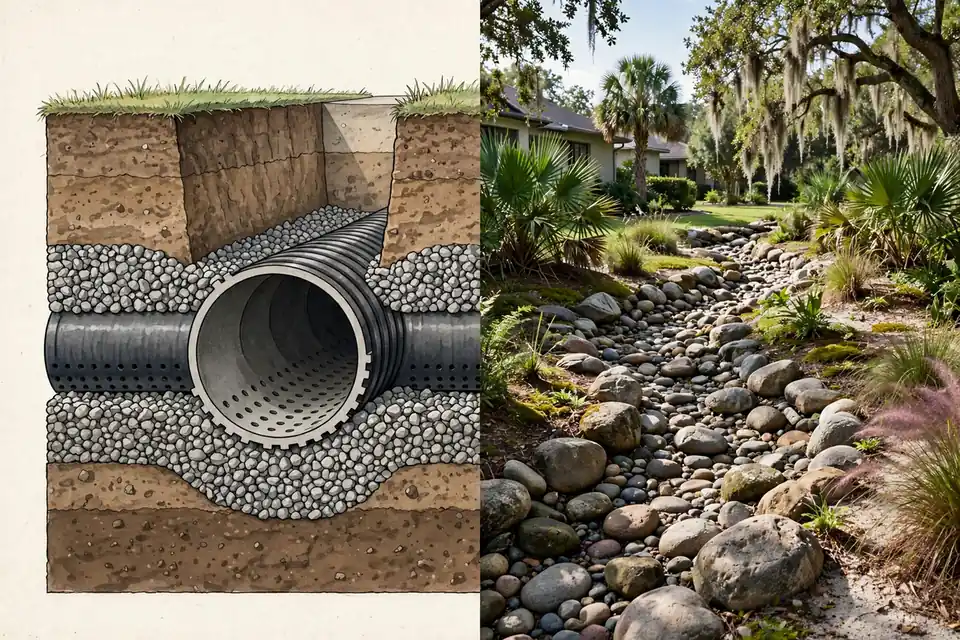
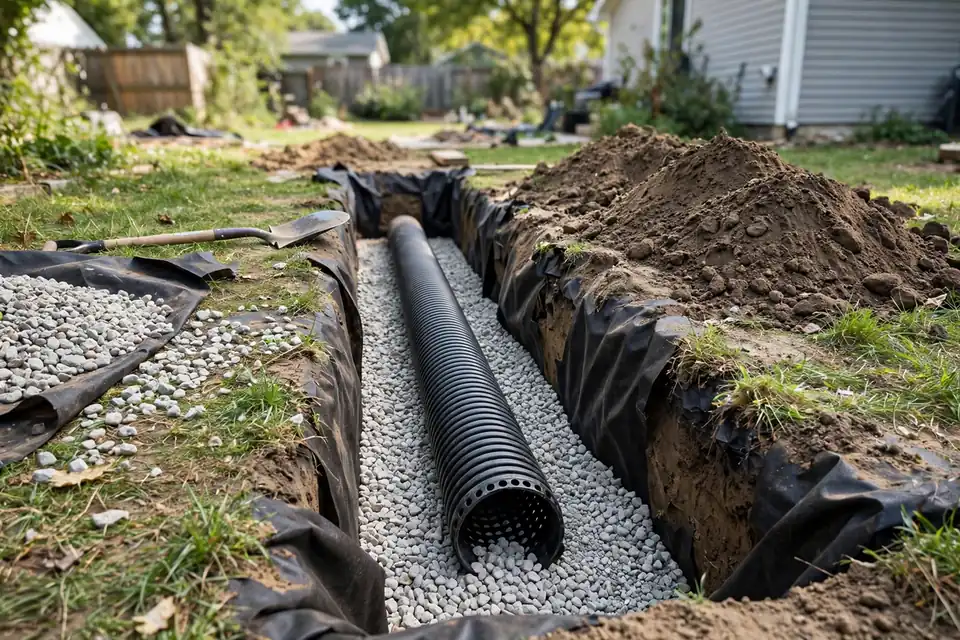
A French drain is a buried drainage system a sloped trench lined with landscape fabric, filled with gravel, with a perforated pipe at the bottom that collects groundwater and carries it to a safe outlet — a storm drain, dry well, or lower area of the property. Once installed and covered, it’s invisible. The grass grows back over it and nobody knows it’s there.
It excels at problems you can’t see: water saturating the soil, hydrostatic pressure against a foundation, a lawn that stays spongy days after rain. Because it works below ground, it handles both surface water that soaks in and groundwater moving through the soil. Our French drain guide covers types, depth, and installation in full detail.
Dry Creek Bed in 60 Seconds
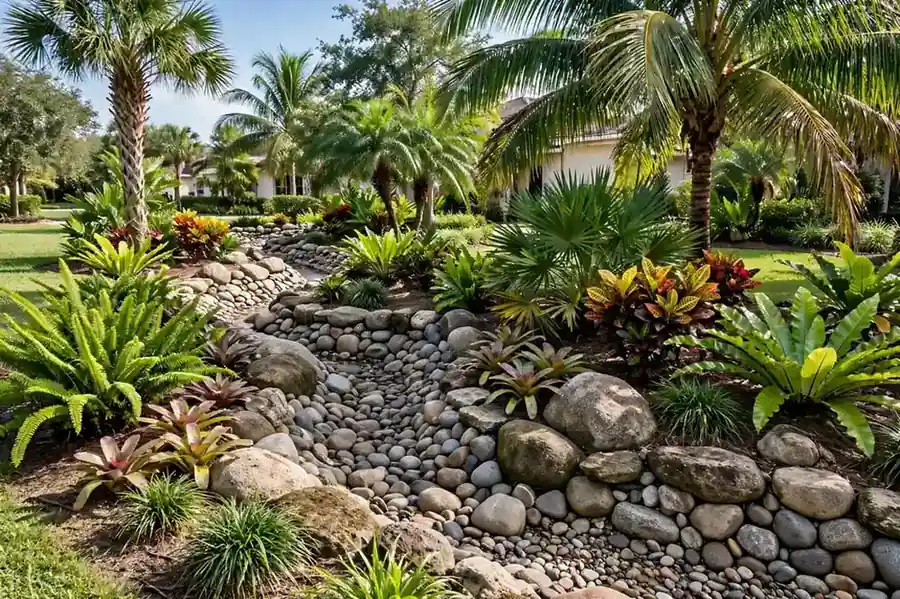
A dry creek bed is a shallow, sloped surface channel lined with river rock and boulders, designed to look like a natural streambed. It gives visible surface runoff an intentional path — instead of water cutting its own muddy trench across your yard, it flows through an attractive rock channel that drains into the surrounding soil or a designated outlet.
It’s drainage that doubles as a landscape feature. Where a French drain hides, a dry creek bed shows off. Our dry creek bed guide for Florida yards covers rock selection, proper slope, and what these cost around Flagler County.
Head-to-Head Comparison
French drain: handles groundwater + surface water, high volume; completely hidden underground; $20–$35 per linear foot installed; best for foundation protection and soggy lawns; minimal maintenance; 30–40 year lifespan.
Dry creek bed: handles surface runoff, moderate volume; visible landscape feature; $15–$30 per linear foot installed; best for downspout runoff and curb appeal; minimal maintenance; rock lasts decades.
When a French Drain Wins
A French drain is the right call when the water problem is underground or needs to disappear entirely: water pooling against your foundation (the number one use case — a buried drain intercepts groundwater before it reaches the foundation wall); a lawn that stays soggy for days (saturated soil needs subsurface collection); HOAs with strict appearance rules (invisible once grass grows back); high water volume (a 4-inch perforated pipe moves far more water than a shallow rock channel).
The key detail most guides skip: a French drain is only as good as its outlet. The pipe must daylight somewhere — a storm drain, a dry well, or a lower grade. Before committing, confirm you have a legal place for the water to go.
When a Dry Creek Bed Wins
A dry creek bed is the right call when the water is visible and you want the fix to look intentional: downspout discharge (the classic use case — carries roof runoff away gracefully); slope runoff (intercepts rain before it erodes soil); landscaping value (a well-built creek bed is a genuine landscape feature); tighter budget (typically slightly less per linear foot, and small runs are DIY-friendly).
Can You Use Both Together?
Yes — and on larger Florida properties, this is often the best answer. A French drain along the foundation handles groundwater and keeps the house dry, while a dry creek bed across the yard handles visible surface runoff. The creek bed can even serve as the French drain’s outlet — the buried pipe daylights into the rock channel. Properties with serious grading issues sometimes need regrading or a retaining wall too — our guide to retaining wall drainage in Florida covers how those systems tie in.
What They Cost in Flagler County (2026)
French drain: $20–$35 per linear foot. A 50-foot run along a foundation typically lands between $1,200 and $2,500 depending on depth, soil conditions, and outlet complexity.
Dry creek bed: $15–$30 per linear foot. A 40-foot decorative drainage run usually costs $800–$2,000, with boulder selection and excavation difficulty driving the range.
Combination projects are usually quoted as one job since excavation overlaps — typically saving 10–15% versus doing them separately. Using quality landscape fabric in a French drain adds small material cost but prevents the number one cause of premature failure.
Florida-Specific Factors to Consider
Sandy soil cuts both ways. Florida sand drains fast, which helps both systems — but sand also collapses into trenches during installation and migrates into rock beds over time. Proper fabric lining isn’t optional here.
Afternoon downpours are the real test. Size for the August cloudburst that drops two inches in twenty minutes, not the average rainfall.
HOAs have opinions. Many Palm Coast HOAs restrict visible landscape changes. A French drain is usually safer where approval is uncertain, since it’s invisible once grass grows back.
Mosquitoes love standing water. Whichever system you choose, it must drain fully between rains — a system holding water for days becomes a mosquito nursery.
Frequently Asked Questions
For surface runoff, yes. For groundwater, foundation seepage, or saturated soil, no — only a buried system collects water below the surface.
30–40 years when built correctly with landscape fabric, clean gravel, and a clear outlet.
It needs at least a slight slope — roughly one inch of drop per ten feet. On a truly flat yard, a French drain or regrading is usually better.
Dry creek beds typically cost slightly less per linear foot, but the right question is which one solves your actual water problem.
Minor landscape drainage usually doesn’t need one, but work redirecting water onto neighboring properties or tying into storm systems can. Check with the City of Palm Coast first.
A small decorative creek bed, yes. A drainage-grade build needs correct slope, base prep, and a legal outlet — most homeowners benefit from a professional assessment first.
Not Sure Which Your Yard Needs? We’ll Tell You Straight.
Drainage is one of those things where the right answer depends on your specific yard. We’ve been solving drainage problems across Palm Coast, Flagler Beach, Bunnell, and Ormond Beach for over a decade. See our drainage solutions for Palm Coast or call (386) 237-2983 — we’ll walk your property and recommend the system that actually fixes it.