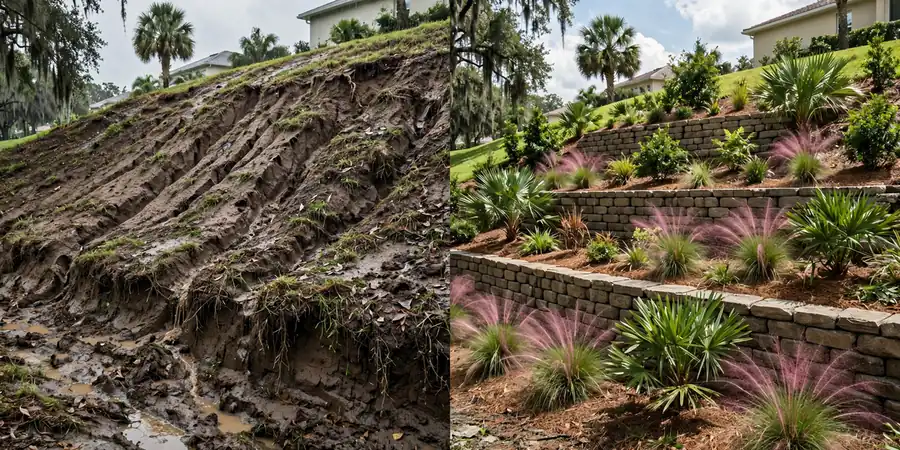
After a typical August downpour in Palm Coast, the evidence is hard to miss: a gully carved through the side yard, mulch washed into the street, a slope behind the house that’s a little thinner than it was last month. Florida’s combination of sandy soil and intense, fast rainfall makes erosion a slow-motion problem for thousands of homeowners — the kind that gets expensive if you ignore it.
The good news: erosion is one of the most solvable landscape problems there is, and you have more options than most guides admit. This guide covers all seven proven methods — from regrading to retaining walls to planting — so you can match the right fix to your specific situation. If your main interest is the planting side, our deep guide to the best plants for erosion control in Florida covers native species in full detail.
Why Erosion Hits Florida Yards Harder
Florida sand drains fast but holds poorly — it has almost no clay to bind it together. Add a two-inch cloudburst in twenty minutes (routine here from June through September), and water moves across the surface with enough force to carry soil, mulch, and even small plants with it. Slopes, downspout discharge points, and bare areas near retention ponds are the usual victims.
The damage compounds: each storm removes a little more topsoil, which makes the next storm worse. Catch it early and the fix is often simple grading or planting. Wait two seasons and you’re looking at walls and drainage work.
First Step: Find Where the Water Comes From
Here’s what most guides get backwards — they start with solutions before diagnosing the cause. Almost all yard erosion is a water management problem wearing an erosion costume. Before spending a dollar, watch your yard during the next heavy rain (or run a hose) and answer three questions:
- Where does the water enter? Roof downspouts, a neighbor’s higher lot, a street draining toward you, or just rainfall on the slope itself?
- Where does it concentrate? Water spreads harmlessly until something funnels it — a swale, a driveway edge, a low spot. The erosion always starts where flow concentrates.
- Where does it leave? Every fix needs an outlet. A solution with nowhere for water to go just moves the problem.
Once you know the water’s path, the right method usually picks itself.
7 Erosion Control Methods That Work
Listed roughly from simplest/cheapest to most structural. Most real projects combine two or three.
1. Regrading
Regrading reshapes the ground so water leaves at a speed grass can survive instead of concentrating into channels. On lots that never drained right from construction day, grading is the repair and everything else is decoration. A gentle, even slope (about 2% grade away from the house) handles most residential runoff.
Best for: yards with poor original grading, low spots, water pooling near the foundation. Typical Flagler County cost: $500–$1,500 for targeted regrading of a problem area.
2. Retaining Walls
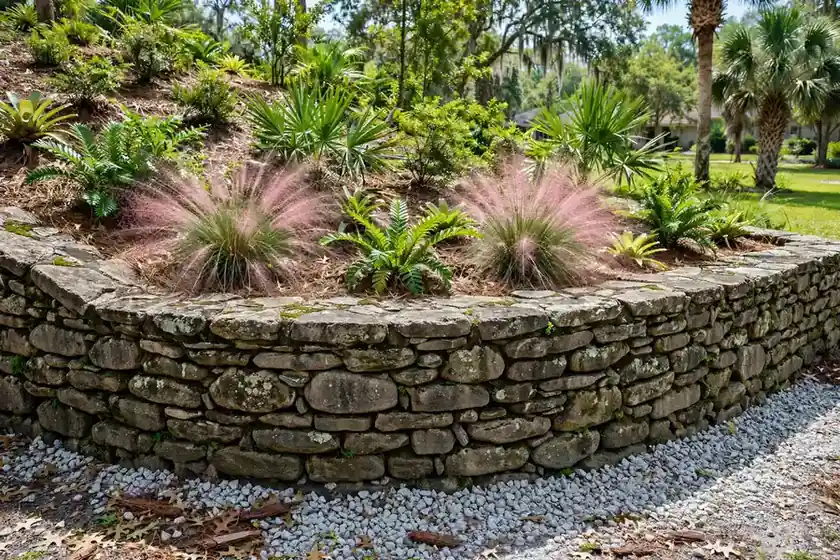
A retaining wall earns its cost when a slope is too steep to hold grass, or when you want flat, usable yard out of a bank. What makes a wall last is what’s behind it: clean gravel and a drain pipe so water passes through instead of pushing. Skip the drainage and the wall becomes a dam — and water behind a dam always wins eventually.
Best for: steep banks, creating level terraces, holding back slopes near patios and pools. Our guide to retaining wall drainage in Florida covers the behind-the-wall details that determine whether yours lasts 30 years or 5. Typical cost: $25–$50 per square foot of wall face.
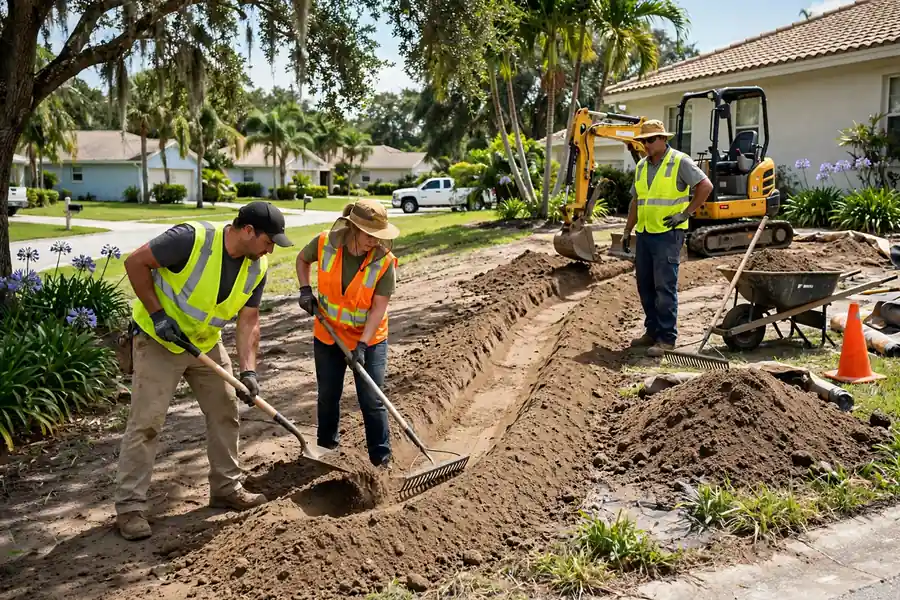
3. French Drains & Subsurface Drainage
When water arrives from somewhere you don’t control — an uphill neighbor, a high water table — a buried drain intercepts it before it can erode the surface. A French drain (perforated pipe in gravel, buried in a sloped trench) quietly moves subsurface water to a safe outlet. It’s the invisible fix for erosion caused by groundwater and seepage rather than surface runoff.
Best for: soggy slopes, water seeping from uphill, erosion at the base of banks. See what a French drain is and how it works for the full breakdown. Typical cost: $20–$35 per linear foot installed.
4. Terracing
Terracing breaks one long slope into a series of short, level steps — each step slows water and gives it a chance to soak in instead of gaining destructive speed downhill. Terraces can be held with small walls, boulders, or even dense plantings on gentler grades. As a bonus, terraces turn an unusable bank into plantable garden space.
Best for: long, uniform slopes; homeowners who want the fix to look like intentional landscaping. For design ideas, see our ideas for landscaping a sloped backyard. Typical cost: $1,500–$5,000 depending on size and wall materials.
5. Riprap & Rock Armor
Riprap — large, angular stone placed on a slope or shoreline — absorbs and deflects the energy of flowing water. It’s the workhorse for spots where water moves fast: drainage outfalls, pond banks, swale bottoms. In Florida it doubles as a landscape feature when mixed with boulders and plantings, similar in spirit to a dry creek bed.
Best for: high-velocity spots, pond and canal banks, drainage outlets. Typical cost: $15–$30 per linear foot for installed rock lining.
6. Erosion Blankets & Geotextiles
On fresh slopes — new grading, new walls, newly planted banks — biodegradable erosion blankets hold soil in place while vegetation establishes. They buy the critical first season: without protection, one good storm can undo new plantings before roots take hold. Synthetic geotextiles serve the same role permanently under rock and walls.
Best for: new construction slopes, freshly planted banks, under riprap and walls. Typical cost: $1–$3 per square yard for blanket material; usually bundled into the larger project.
7. Deep-Rooted Plants & Groundcovers
The long-term answer for mild to moderate slopes: vegetation whose roots bind the soil year after year. In Florida that means natives built for sand and storms — sea oats and railroad vine on coastal banks, sunshine mimosa and perennial peanut as spreading groundcovers, muhly grass and saw palmetto for structure. Plants are the cheapest method per square foot and the only one that gets stronger over time.
Best for: mild slopes, large areas, finishing any structural fix with living armor. Our erosion control plants guide lists the top Florida performers with planting tips from real local projects. Typical cost: $3–$8 per square foot planted.
Which Method for Your Situation?
Gentle slope, mulch washing away: plants + mulch + maybe regrading. Start here.
Steep bank losing soil every storm: terracing or retaining wall, finished with plantings.
Water seeping from uphill / soggy base of slope: French drain first, then surface treatment.
Downspout carving a gully: extend the downspout, add rock armor or a small swale at the outlet.
Pond or canal bank eroding: riprap at the waterline, native plants above it.
New construction, bare dirt everywhere: erosion blankets immediately, then grade, then plant.
What Erosion Control Costs in Flagler County (2026)
Typical local ranges for professional installation:
- Regrading a problem area: $500–$1,500
- Retaining wall: $25–$50 per sq. ft. of wall face
- French drain: $20–$35 per linear foot
- Terracing: $1,500–$5,000 per project
- Riprap / rock lining: $15–$30 per linear foot
- Planting for erosion: $3–$8 per sq. ft.
Combined projects (drainage + wall + planting) are usually quoted as one job — the excavation and grading overlap, which typically saves 10–15% versus phasing them separately.
Mistakes That Make Erosion Worse
- Armoring the symptom, ignoring the water. A wall at the bottom of a slope does nothing if the real problem is a downspout dumping at the top. Fix the water source first.
- Skipping drainage behind walls. The number one cause of wall failure in Florida — water builds up behind the wall until it pushes through or over.
- Planting without protection. New plants on a bare slope need an erosion blanket for the first season, or the first storm takes them with the soil.
- Directing water at the neighbor. Florida law and basic decency both apply — your drainage fix can’t become their flooding problem. Check Palm Coast stormwater rules before redirecting significant flow.
- Waiting. Erosion never stays the same size. A $800 grading fix this year is a $4,000 wall-and-drainage project next year.
Frequently Asked Questions
Regrading plus planting is usually cheapest ($500–$1,500 for a targeted area). But “cheapest” only counts if it matches the cause — a cheap fix for the wrong problem is the most expensive mistake.
On gentle slopes, yes — dense turf with deep roots holds well. On steep slopes, standard lawn grasses have shallow roots and fail; you need terracing, walls, or deep-rooted natives instead.
Extend the downspout away from the foundation, then armor the outlet with rock or a small catch basin tied into a drain. The gully forms because concentrated roof water hits bare soil — spread it or pipe it.
Planting and minor grading usually don’t. Retaining walls over a certain height and any work redirecting water toward neighbors or storm systems can. Check with the City of Palm Coast before structural work.
Yes. Water pooling near the foundation from eroded grading can cause settling, cracks, and moisture intrusion. If you see soil pulling away from the foundation, treat it as urgent.
Structural fixes (walls, drains, proper grading) last decades. Plantings get stronger over time once established. The combination — structure plus vegetation — is what makes Florida yards hold through storm seasons year after year.
Stop the Erosion Before It Gets Expensive
Every eroding yard we’ve fixed in Palm Coast, Flagler Beach, and Ormond Beach had one thing in common: the homeowner wished they’d called a season earlier. Erosion only grows.
See our drainage and erosion solutions for Palm Coast or call (386) 237-2983 — we’ll walk your property, find where the water is actually coming from, and recommend the fix that stops it. If that’s grading and plants, we’ll say so. If you need a wall, we’ll tell you straight.