To landscape a long, narrow backyard, split it into zones instead of one corridor, cross it with offset or crosswise paths, and place a focal point past the middle. Start with a patio or dining area near the house, keep open lawn or garden in the middle, and finish the far end with a bench, fire pit, or garden nook. In Florida, size every zone for sun, afternoon storms, and drainage, and use permeable surfaces so water moves away from the house.
A long, narrow backyard usually reads as a corridor. Your eye runs from the back door straight to the rear fence, and the space feels smaller than its square footage. Many Florida homes have this shape: a rear yard that is much longer than it is wide, often 20 to 30 feet across and 60 to 100 feet deep. That proportion is workable, but only if you stop treating the yard as one long strip.
The fix is to break the sightline and give each part of the yard a job. Zones, crosswise paths, layered edges, and one strong focal point can make a narrow lot feel generous. This guide covers practical long narrow backyard landscaping ideas for Florida homes, from zoning and patios to plants, drainage, and the mistakes that make a tight yard feel tighter.
Why Long, Narrow Backyards Can Feel Like a Corridor
Most narrow yards fail for the same reasons. One straight path runs down the middle, the eye follows it to the fence, and there is nothing to stop and look at along the way. Planting is often a thin, even border on both sides, which frames the corridor instead of breaking it. The result is a yard that looks long and thin from every window.
Florida conditions add their own pressure. Afternoon sun hits the west-facing fence hard, summer storms dump inches of rain in an hour, and sandy soil drains fast but can still pond where the grade is flat. A narrow yard leaves little room for error: water has fewer places to go, and a patio that traps heat can make the whole space uncomfortable by mid-afternoon.
The way out is to design across the yard, not along it. Every idea below works by interrupting the long view: zones that change the surface underfoot, paths that cross or offset instead of running center, planting that varies in height, and a destination at the far end that pulls you forward. None of this needs a big budget. It needs a plan that treats width as the design tool and length as the journey.
Divide the Backyard Into Functional Outdoor Zones
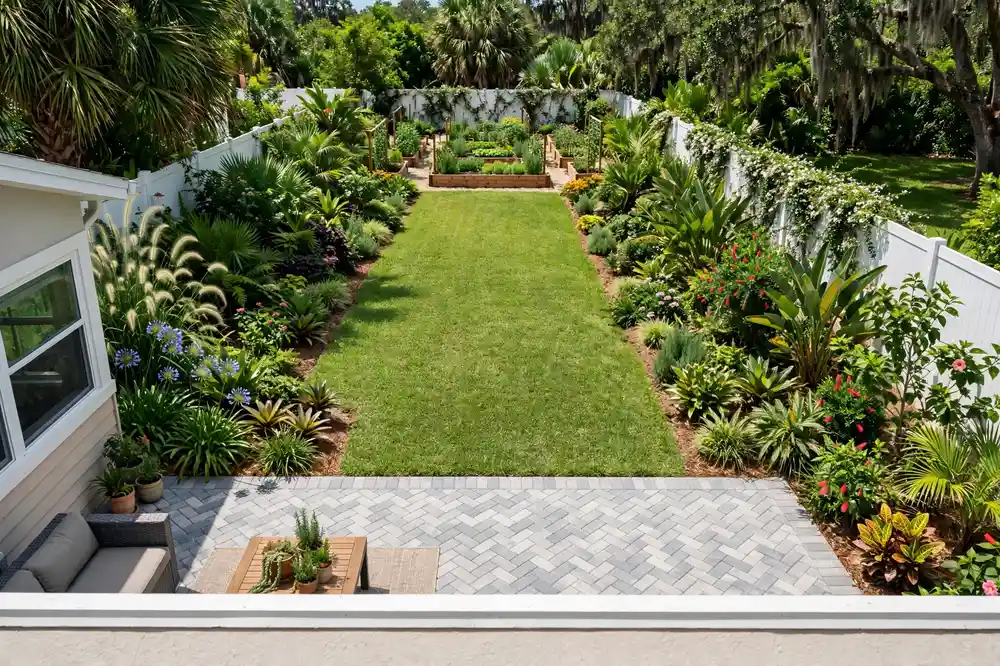
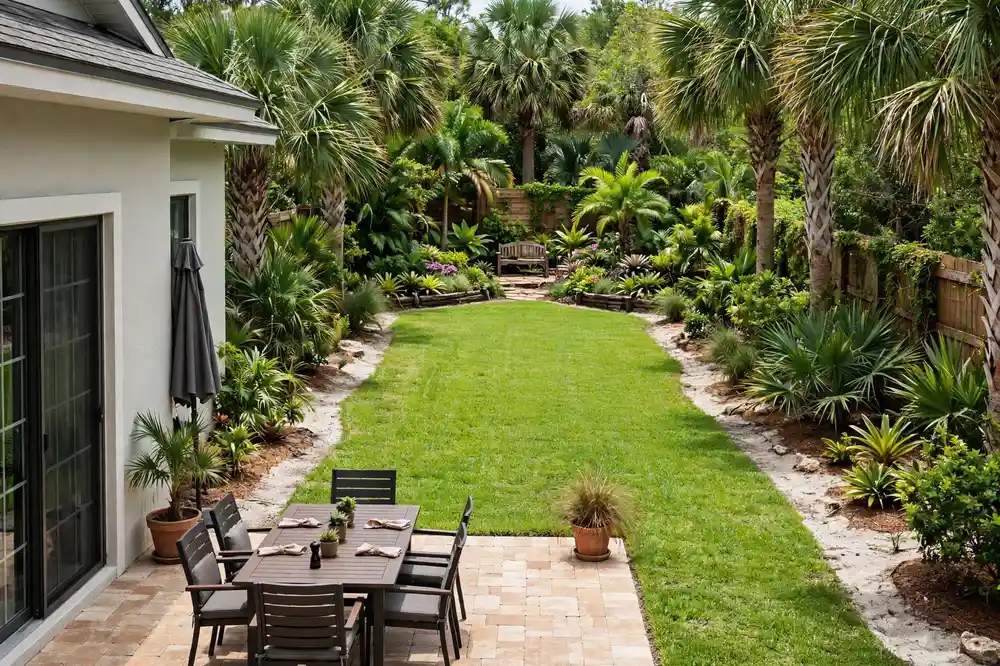
Zoning is the single most effective move for a long, narrow rear yard. Instead of one undifferentiated strip, split the length into two or three outdoor rooms: a patio or dining area near the house, an open middle for lawn, play, or garden, and a destination at the far end. Each zone gets its own surface and purpose, and the change from one to the next breaks the corridor feeling.
Keep the zone count low. Two zones suit a shorter yard; three suit a longer one. More than three, and each room gets too small to use. Mark the boundaries with a change you can feel underfoot: pavers to lawn, lawn to mulch, or a low planting bed that edges one zone without walling it off. A low edge reads as a threshold, not a barrier, which matters in a tight space.
This zoning approach is the backbone of our guide to that narrow strip beside the house as well, but the rear yard has more room to work with, so give each zone enough depth to hold furniture or planting. A patio needs 10 to 12 feet of depth for a table and chairs; a far-end destination needs at least 8 feet so a bench or fire pit does not crowd the fence.
Plan circulation before you plant. You need one clear route from the house to the far end, but it does not have to be straight. An offset or gently angled path that touches each zone gives you the journey without the bowling-alley effect. We detail that routing in the path section below.
Use Crosswise or Offset Paths Instead of One Long Center Line
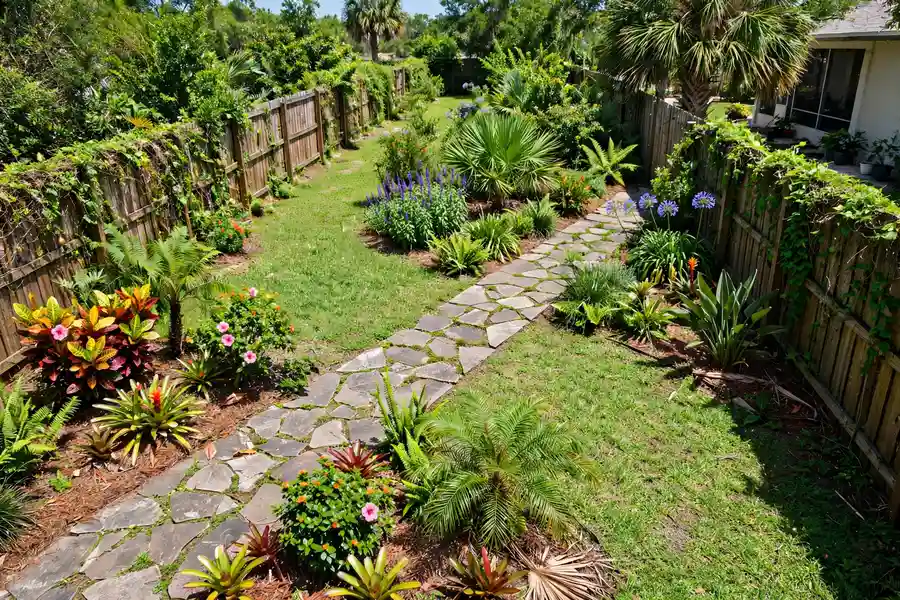
A single straight path down the middle is what makes a narrow yard feel like a runway. It lines up with the fences, speeds the eye to the back, and wastes the center of the yard on circulation. Crosswise or offset paths do the opposite: they move you across the width, slow you down, and make the yard feel wider with every step.
A crosswise path runs from one side of the yard to the other, usually where two zones meet. It can be as simple as large stepping stones set in lawn or mulch, and it doubles as the threshold between zones. An offset path zigzags gently: it leaves the patio at an angle, crosses the lawn, and arrives at the far-end destination from the side. Both keep you from staring straight down the lot.
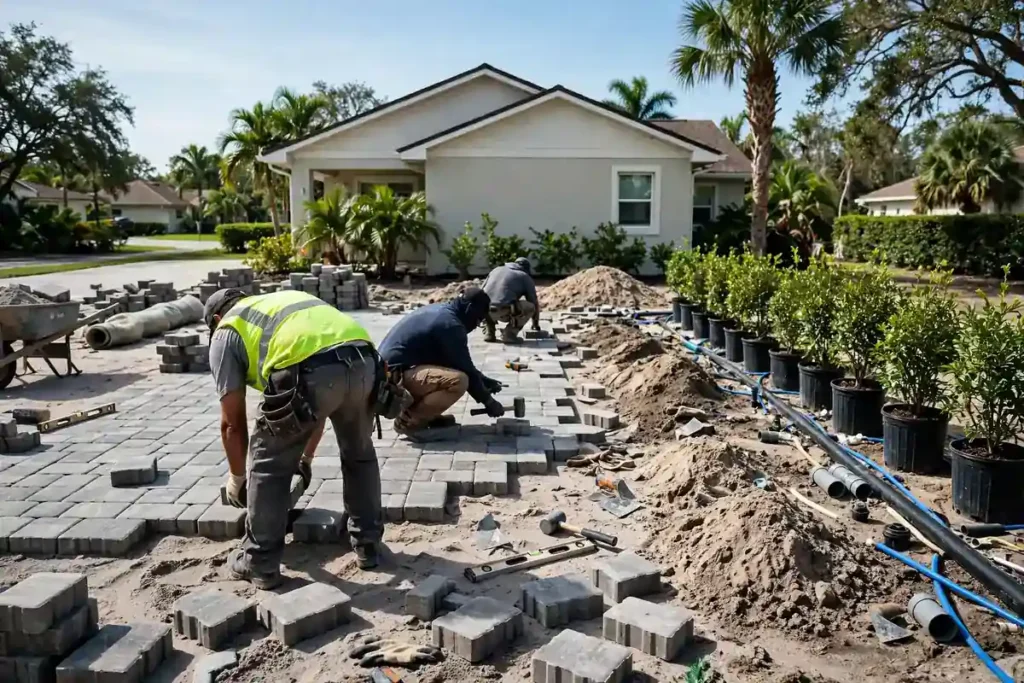
Size paths for comfort. A main route needs 3 to 4 feet of clear width; secondary stepping-stone crossings can be 2 feet. In Florida, set stones or pavers on a compacted base with a slight crown so stormwater sheets off instead of pooling. Avoid smooth, sealed surfaces that turn slick in a downpour, and leave planting pockets along the edges so the path feels set into the garden, not dropped on top of it.
Create a Patio or Dining Area Near the House
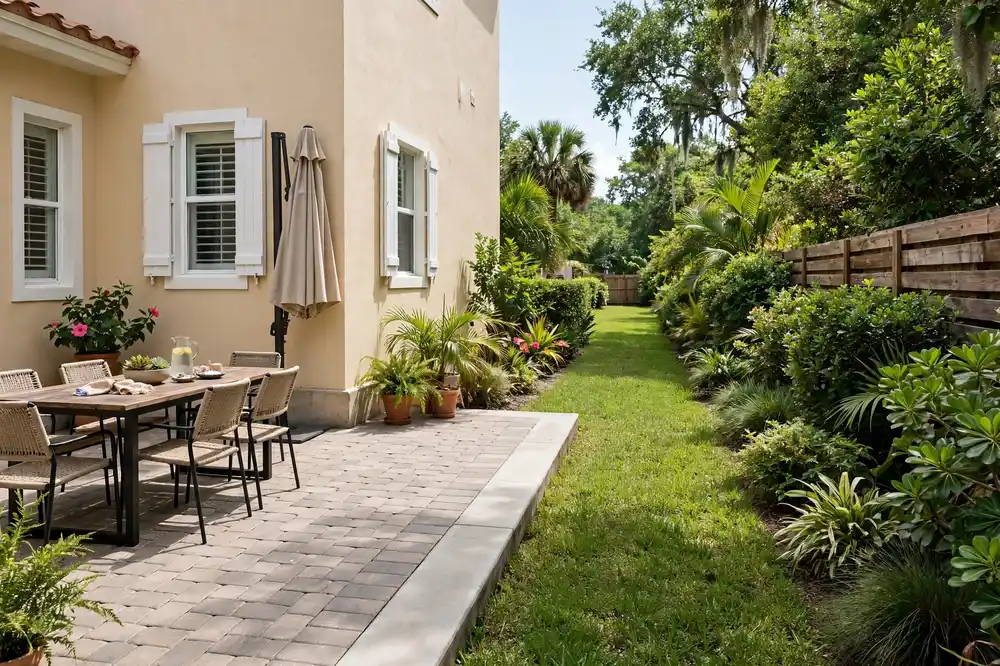
Put the patio where life already happens: right outside the doors you use most. A patio near the house becomes an outdoor room you actually use, while one stranded at the far end sits empty. In a narrow yard, the patio also anchors the first zone and sets the tone for everything beyond it.
Size it for the furniture plus circulation. A dining table for six needs roughly a 12-by-14-foot patio once you count chair pull-out and a walking lane. In a yard only 20 feet wide, that leaves a slim planting bed on each side, which is fine: the beds soften the patio edges and keep the space from feeling paved wall to wall. Shade the patio for afternoon use, since a west-facing slab in a Florida July can be brutal by 3 p.m.
Handle the step from patio to lawn with care. A single low step or a wide landing reads as an invitation; a tall, abrupt drop reads as a barrier. Set the patio a few inches above the lawn grade so stormwater runs off the pavers and away from the house, and choose a paver color that does not glare in full sun. Our hardscape services team sizes patios, steps, and landings so the transition feels planned, not improvised.
Add a Lawn, Play or Garden Zone Without Blocking Circulation
The middle of a long yard earns its keep as open space. Lawn, a play area, or a simple garden gives the eye a rest between the patio and the far end, and it keeps the yard feeling open instead of overbuilt. Resist the urge to fill the middle with beds and features; in a narrow yard, open middle ground is what makes the whole space breathe.
Protect that openness by keeping one clear path through it. The route can angle or offset, but it should never dead-end into planting or force a detour around furniture. If kids or pets use the middle, choose turf or groundcover that takes traffic and skip delicate specimens there. Save the fussy plants for the edges, where they get admired without getting trampled.
Match the middle zone to sun and shade. A full-sun middle suits turf or a sunny perennial bed; a shaded middle suits mulch, groundcover, and shade-tolerant planting. Either way, keep the surface simple and the edges clean. A crisp edge between lawn and bed, held by steel or stone edging, does more for a narrow yard than any ornament.
Place a Focal Point Beyond the Middle of the Yard
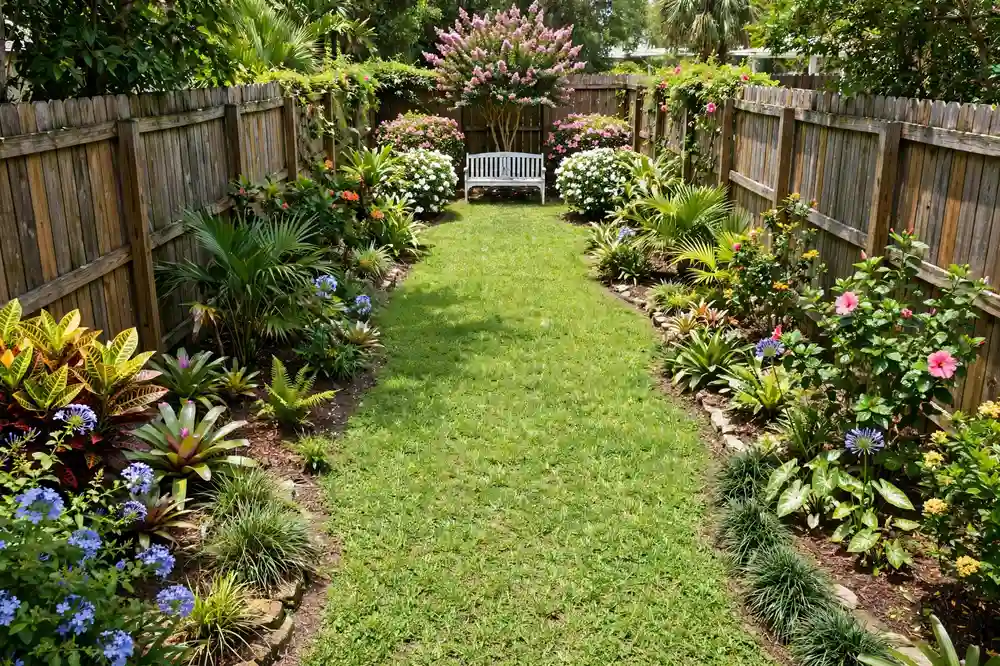
A focal point past the middle gives the eye somewhere to land besides the fence. It can be an ornamental tree, a bench under a small arbor, a fire pit, a water feature, or a planted vignette with a sculptural container. The point is to create a destination that pulls you down the yard and rewards the walk.
Place it off-center. A focal point dead-center at the far end just underlines the corridor; one set slightly to the side breaks the axis and feels discovered rather than displayed. Frame it with planting that is taller behind and lower in front, so it reads as a composed scene from the patio. Light it if you use the yard at night: one well-placed fixture does more than a string of dim ones.
Keep the destination usable, not just visible. A bench needs a stable, level pad and a few feet of clear space around it. A fire pit needs code-compliant clearances and a non-combustible base. If the far end is the shadiest or wettest spot, choose the feature to suit: a garden nook loves shade, while a fire pit wants open air and dry footing.
Use Layered Planting and Selective Privacy Screening
In a narrow yard, planting should vary the edges, not wall them in. Layer beds with groundcover in front, low shrubs behind, and the occasional taller accent: a small tree, a clump of ornamental grass, or a trellis with vine. Varying heights along the fence breaks the parallel lines that make the yard feel like a corridor.
Screen only where you need privacy. A full hedge down both fences eats 3 to 4 feet of width and turns the yard into a green hallway. Instead, screen the spots that matter: behind the patio seating, beside a neighbor’s second-story window, or around the far-end destination. Leave the rest open so light and air move through.
Use the vertical plane where floor space is tight. A trellis, a wall-mounted planter, or a narrow tree gives height without taking ground. Containers work too: a large pot with a small tree or a bold tropical can anchor a corner that is too tight to plant. Just keep containers out of the main circulation route, where they become obstacles.
Choose Florida-Friendly Plants for the Yard’s Sun and Soil Conditions
Florida’s heat, humidity, salt, and sandy soil narrow the plant list fast, so choose for the conditions you have. Match every plant to its sun exposure, mature size, and water needs, and group plants with similar needs on the same irrigation zone. A plant that wants daily water next to one that wants it weekly means one of them suffers.
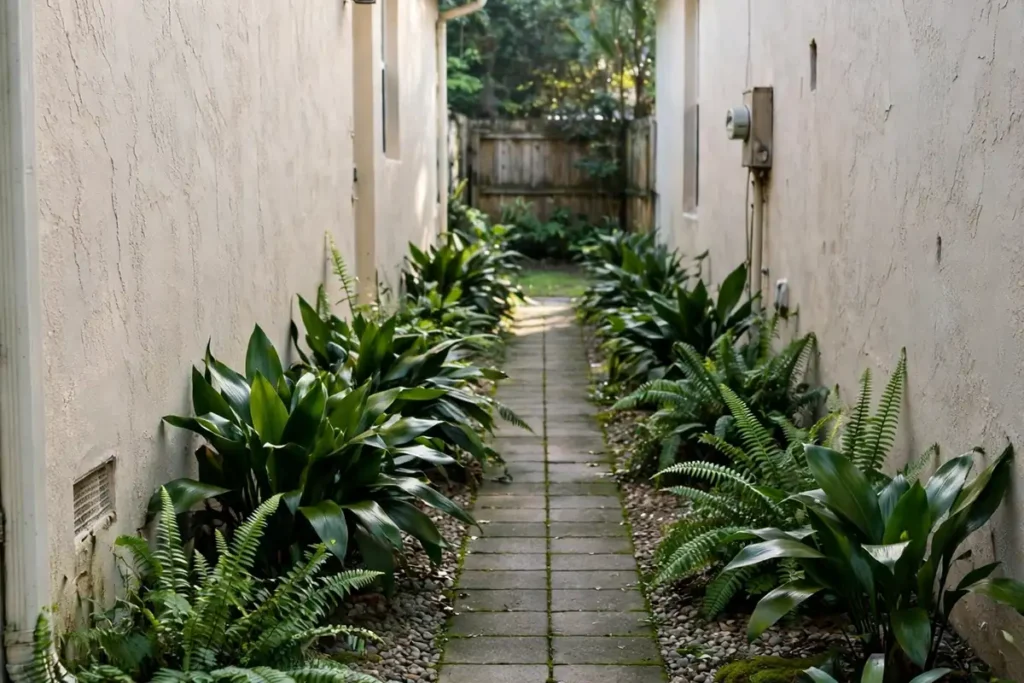
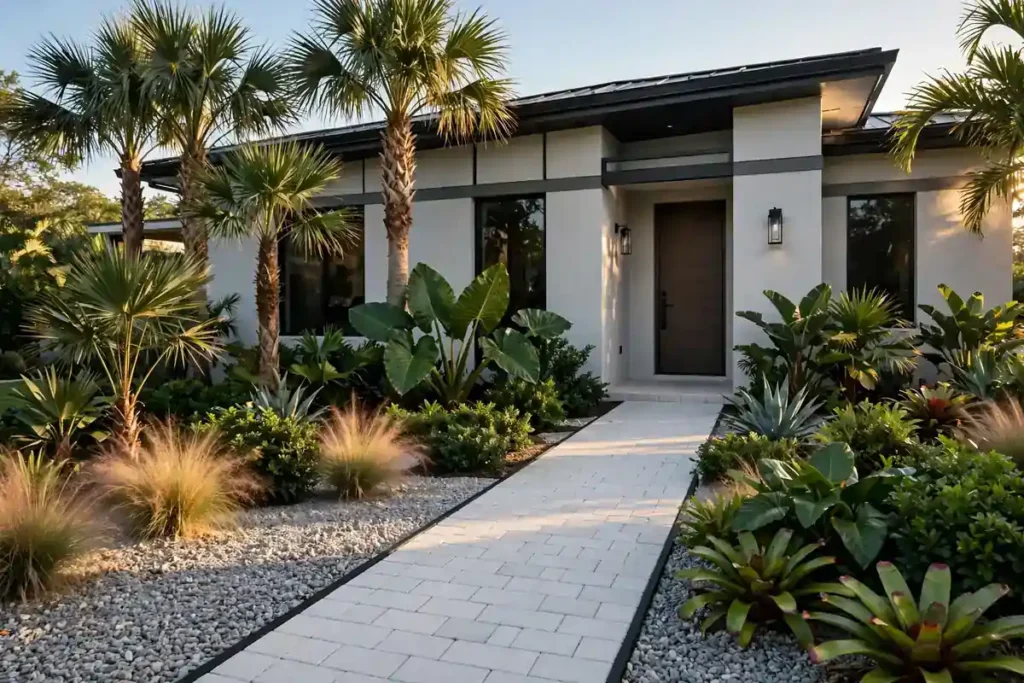
For structure along the edges, consider clumping palms for height without much width, ornamental grasses for movement, and broadleaf evergreens for year-round screening where you need it. Groundcovers like perennial peanut or beach sunflower hold sandy soil, cut weeds, and take foot traffic better than bare mulch. In shadier stretches, ferns, gingers, and shade-tolerant shrubs keep the edges lush without constant pruning.
Size plants for the width you have. A shrub that wants to be 6 feet wide will swallow a 3-foot bed and lean into the path. Check mature spread, not just height, and give aggressive growers room or skip them. Native and Florida-friendly choices usually need less water and fertilizer once established, which matters when every square foot is working hard.
Plan Drainage, Irrigation and Permeable Hardscape
A narrow yard concentrates water. Roofs, patios, and paths all shed onto a small footprint, and there is less lawn to absorb it. Walk the yard in a heavy rain before you design: note where water sheets off the patio, where it ponds, and which way it runs at the fence lines. That one observation prevents more failures than any product.
Grade every surface away from the house, even slightly. Patios and paths should fall 1 to 2 percent away from the foundation; planting beds should not dam water against the slab. Where water collects, give it a path: a shallow swale tucked along a bed edge, a French drain under the main route, or a rain garden at the low end. Permeable pavers or gravel joints let stormwater sink in instead of racing to the fence.
Zone irrigation the way you zone the yard. Turf, shrubs, and groundcover want different amounts on different schedules, and one zone for everything guarantees waste. Drip lines suit beds and containers; rotors or sprays suit turf. A rain sensor or smart controller keeps the system from watering through a thunderstorm, which in Florida is half the summer. Our landscape installation service sets up zoned irrigation and drainage together, so water goes where it should and nowhere else.
Common Long-Narrow Backyard Design Mistakes
The center-line path. One straight walk down the middle underlines the corridor and wastes the center of the yard. Offset it, angle it, or break it into crosswise segments.
The full-length hedge. Screening both fences end to end eats width and light. Screen only the spots that need it and vary the heights.
The far-end patio. A dining set stranded at the back fence gets used twice a year. Keep daily-use seating near the house and make the far end a destination, not a dining room.
Ignoring drainage until it rains. Flat grades, dammed beds, and sealed surfaces turn the first storm into a pond. Plan the water’s path before you place a single paver.
Long Narrow Backyard Design in Palm Coast
Dreamscapes builds long narrow backyard landscapes across Palm Coast, Flagler Beach, Bunnell, Ormond Beach, and St. Augustine. We start with how you live: where you eat outside, where kids or pets play, and what you want to see from the windows you look through most. Then we zone the yard, route the paths, and choose plants for your sun, soil, and salt exposure.
If your rear yard feels like a corridor, our landscape design services can redraw it as a series of outdoor rooms, and our landscape installation service builds it to handle Florida storms. Call (386) 237-2983 or request a free estimate to start.
Frequently Asked Questions
Split the yard into zones: a patio near the house, a lawn or garden in the middle, and a focal point past the center. Run paths across the yard or offset them, instead of one straight center line. Layer plants along the edges, screen only where you need privacy, and plan drainage so water moves away from the house.
Break the long sightline. Use crosswise or offset paths, change surfaces between zones, and vary plant heights along the edges. Put a focal point past the middle so the eye stops there instead of racing to the fence. Leave open lawn in the middle and screen only in spots, so light and air keep the yard feeling open.
Start with a patio or dining area beside the house, since that is where life happens. Give the middle to lawn, play, or garden space, and finish the far end with a destination such as a bench, fire pit, or garden nook. Mark each zone with a change in surface, edging, or planting, and keep one route through them all.
Put the patio right outside the doors you use most, so it joins life instead of sitting unused at the far end. Size it for your table and chairs plus room to walk around them. Shade it for afternoon use, and add a step or landing where it meets the lawn so the change in surface feels safe and planned.
Use layered planting: groundcover at the front, low shrubs behind it, and a taller accent here and there. Pick plants rated for your sun, soil, salt exposure, and mature size, and group plants with similar water needs together. Palms add height, ornamental grasses add movement, and groundcovers hold sandy soil and cut weeds.
Screen only where you need it, such as behind a seating area or beside a neighbor window, and leave the rest open. Mix plant heights instead of one tall hedge, and use a trellis, tree, or container plant for height without taking floor space. Gaps for air and light keep the yard feeling open while giving privacy where it counts.