Step onto your lawn and it feels like walking across a mattress. Water runs off instead of soaking in. You fertilize and almost nothing happens. That spongy layer between the green blades and the dirt is thatch, and St. Augustine lawns in Palm Coast, Daytona Beach, and St. Augustine build it faster than almost any other grass. Here is how to tell whether you have a real thatch problem, when to fix it, and how to dethatch without wrecking the lawn.
What Is Dethatching and Why It Matters for St. Augustine Grass
Thatch is a layer of dead and living stems, runners, and roots that collects between the green grass and the soil. Think of it like felt. A thin layer is normal and even useful, since it holds moisture and softens foot traffic.
Trouble starts once that layer passes three quarters of an inch. Past that point it acts like a roof over your soil, and rain, irrigation, and fertilizer sit on top instead of reaching the roots.
Dethatching is the mechanical removal of that layer. A machine with vertical blades or stiff tines cuts through the mat and lifts the dead material to the surface to be raked up and hauled off.
Why St. Augustine Builds Thatch So Fast
St. Augustine spreads by stolons, thick runners that crawl along the top of the soil instead of underground. They stack on each other season after season, and they are coarser than what you see on bahia or bermuda. Among the grass types that do well in Florida lawns, St. Augustine is the one most likely to mat up over time.
Florida’s humid subtropical climate makes it worse. Grass here grows nine or ten months a year with no hard freeze to shut it down, so new runners layer over old ones long before the old ones break down.
Sandy Flagler County soil holds fewer of the microbes that break organic matter down, which is the same reason soil choice matters so much in Florida yards. Heavy nitrogen, daily shallow watering, and mowing too low speed things along.
Signs Your St. Augustine Lawn Has a Thatch Problem
Most homeowners feel the problem before they see it. The lawn turns bouncy underfoot and the mower starts scalping flat spots.
- The turf springs back under your shoes like carpet padding
- Water pools or runs off instead of soaking in
- Brown patches appear even though you water plenty
- Fertilizer seems to have no effect at all
- Runners root into the thatch layer instead of the soil
- The mower scalps easily, leaving yellow streaks
- Chinch bug and fungus problems keep returning to the same spots
Spongy turf and unexplained brown patches sit near the top of the list of warning signs that a lawn needs repair, and thatch is behind more of them than most homeowners expect.
The Five Minute Plug Test
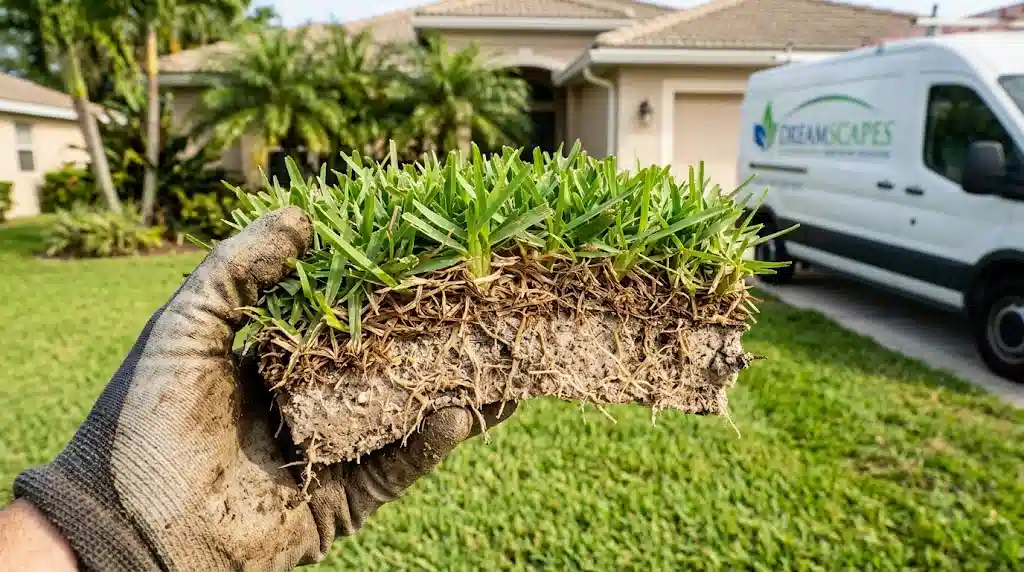
Check it yourself in five minutes. Cut a wedge out of the lawn three inches deep and look at the side of the plug. Green blades on top, a brown fibrous band in the middle, soil below. Measure that band. Under half an inch is healthy. Three quarters of an inch or more means it is time to act.
Not every brown patch is thatch. A thick mat gives chinch bugs and grubs a protected place to feed on roots, so rule out insect damage before running a machine across the yard.
Best Time to Dethatch St. Augustine Grass in Florida
Late spring into early summer. For Flagler and Volusia County, that usually lands between mid April and June.
The reason is recovery. Dethatching is a controlled injury, and you want the grass growing hard so it fills the gaps back in within a month. Wait for full green-up, two mowings, and soil temperatures holding in the seventies. Along the coast that comes a little later than inland around Bunnell.
Times to avoid:
- Fall and winter, when growth slows and the lawn cannot recover
- Drought stress or watering restrictions
- Lawns already fighting fungus or insect damage
- Peak August heat, which stacks stress on top of injury
Most St. Augustine lawns here need dethatching every two or three years at most. Plenty never need it when mowing height and feeding are handled well.
How to Dethatch St. Augustine Grass the Right Way
St. Augustine has shallow roots and grows from surface runners. Cut those runners apart aggressively and you are not dethatching anymore, you are tearing the lawn out. This job is about restraint.
- Water two days ahead. Slightly moist soil lets the tines pull material out cleanly. Dry soil rips runners loose, and soggy soil smears and compacts.
- Mow low, but do not scalp. Drop the mower one notch below your usual height and bag the clippings so the machine can reach the thatch instead of chewing green blades.
- Flag everything shallow. Mark sprinkler heads, valve boxes, and any shallow wire. Vertical blades will find them.
- Set blade spacing wide. Use blades about three inches apart. Tight spacing is built for bermuda and will shred St. Augustine.
- Keep the depth shallow. Blades should barely nick the soil surface. Start on the lightest setting in a back corner, check the result, then adjust before doing the rest of the yard.
- Make one pass only. Go in a single direction and skip the crosshatch pattern used up north. If one pass does not clear enough, wait a season and repeat.
- Rake and haul the same day. Debris left on top blocks light and traps moisture against the crowns, inviting fungus.
If compaction is part of the picture, core aeration alongside dethatching does more for the root zone than either job alone. Aerate first, dethatch a week or two later, then leave the lawn alone for a full season before judging results.
Very heavy thatch, an inch and a half or more, often cannot be fixed by machine, because pulling that much material takes most of the living grass with it. At that point, stripping the old turf and laying fresh St. Augustine sod costs less than two or three failed seasons of repair.
DIY Dethatching vs Hiring a Professional
Rental dethatchers run sixty to a hundred dollars a day locally. The price is not the issue. The settings are.
Most rental machines arrive set up for cool season grass, with narrow blade spacing and too much depth for St. Augustine. Almost nobody changes either. The lawn looks wrecked for a week, and often never fully recovers.
DIY makes sense on a small lot with borderline thatch, if you are comfortable adjusting equipment first. Hire it out if the yard is over a quarter acre, the thatch is past an inch, or you have irrigation lines you would rather not chop into.
A crew that handles lawn care and maintenance in St. Augustine, FL works on these lawns every spring and knows what this grass tolerates. Those jobs usually include cleanup, hauling, and a follow up feeding, which is where much of the recovery comes from.
Lawn Care After Dethatching
The first three weeks decide the outcome.
Watering. Run irrigation lightly every day for the first week, just enough to keep the surface damp, then shift back to deeper soakings two or three times a week. Exposed crowns dry out fast under Florida sun, and a properly tuned north Florida irrigation setup makes that switch far easier to manage.
Fertilizing. Put down a balanced slow release fertilizer within a few days and go easy on nitrogen. Pushing top growth now is how the next thatch layer starts.
Mowing. Wait until the grass grows an inch past your normal height, then mow at three and a half to four inches with a sharp blade. Leave the clippings, since they break down fast and do not add to thatch.
Traffic. Keep kids and pets off thin areas for two to three weeks while runners knit back together.
Weeds. Open soil invites weeds. Wait about a month, then use a pre emergent labeled safe for St. Augustine.
Keeping Thatch From Coming Back
A spongy St. Augustine lawn is fixable, and in most yards it never has to get that far. Mowing tall, watering deeply but less often, and easing off nitrogen keep the layer thin without machine work.
Not sure whether your lawn needs dethatching, aeration, or something else? Have someone look before you rent equipment. Dreamscapes handles full service lawn care and landscaping across Palm Coast, Flagler Beach, Bunnell, Ormond Beach, Daytona Beach, and St. Augustine. Call (386) 237-2983 and we will tell you straight whether it is worth doing this year.
Frequently Asked Questions
Every two to three years is typical for Florida lawns. Check the layer each spring with a plug test and dethatch only when it measures three quarters of an inch or more.
Not if it is done during active growth with shallow depth and wide blade spacing. Lawns die when people go too deep, use bermuda settings, or run the machine in fall or winter when the grass cannot regrow.
Aerate first, then dethatch a week or two later. Aeration opens the soil and speeds recovery from the second pass.
Three to five weeks when the job is done in late spring, with new runners usually showing around day ten. Recovery takes far longer outside the growing season.
No. Sand smooths minor grade problems, but it buries thatch instead of removing it and often makes the layer thicker.