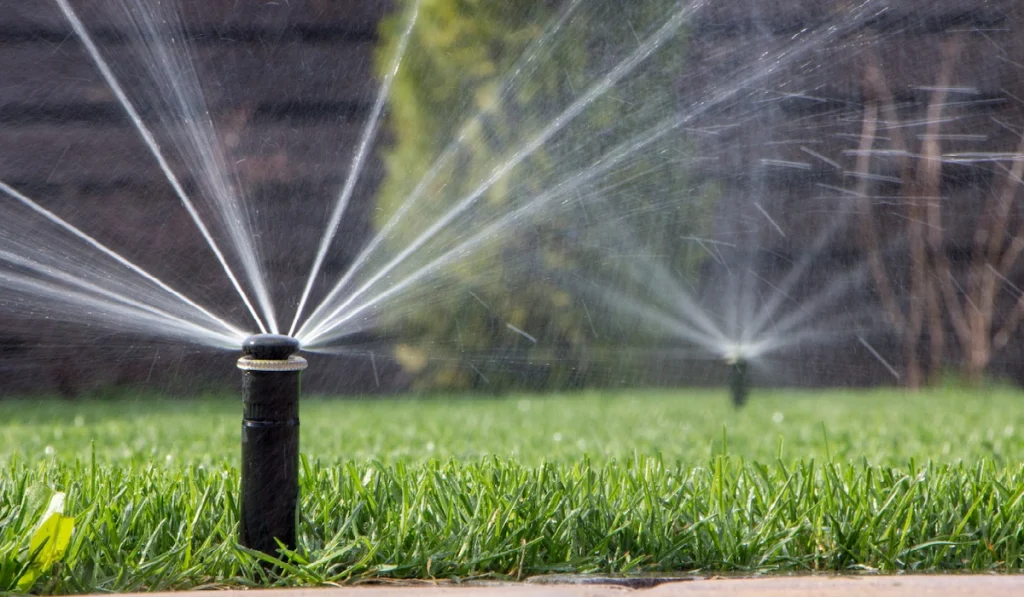
Walk down almost any street in Palm Coast and you will find three houses running three different irrigation setups, and at least one is doing a fantastic job of watering the sidewalk. From above, sprinkler heads all look the same. They are not. The head in your turf decides how fast water lands, how evenly it spreads, and whether it lasts five years in our sand or five months.
Here is every type you are likely to find in Flagler County, what each is good at, and how to match it to sandy soil, coastal wind, and Florida heat.
The Six Sprinkler Head Types You Will Find in Flagler County Yards
Spray Heads
Spray heads throw a fixed fan of water in a set pattern, usually 3 to 15 feet. No moving parts, which is why they are cheap and everywhere. They shine in small or awkward spaces: the strip between a driveway and a property line, tight side yards, foundation beds hugging the house.
The catch is the application rate. A typical spray head puts down 1.5 to 2 inches per hour in fine droplets, and fine droplets are exactly what an afternoon sea breeze carries into the street. If one section of turf seems permanently thirsty despite a working system, spray drift is a common culprit, which is really a question of how much water your lawn actually needs versus how much reaches the roots.
Rotor Heads
Rotor heads send rotating streams sweeping back and forth across a wide arc, covering 18 to 45 feet. Their precipitation rate is low, roughly 0.4 to 0.6 inches per hour, so they water slowly and let sand absorb moisture at a sensible pace. For the big open front lawns around Grand Haven or the wide corner lots in Bunnell, rotors are usually the right call.
Two things to watch. Rotors need roughly 30 psi or more at the head; if your well pump or municipal supply is marginal, they stall partway through the arc and leave a dry wedge. They also need longer run times than most homeowners expect.
Rotary Nozzles
Rotary nozzles are the sleeper pick for Florida lawns. They screw into a standard spray body but deliver several slow rotating streams instead of a fan, giving you a rotor’s gentle application rate with a spray head’s simple installation and no trenching to retrofit an existing zone.
The heavier streams resist wind far better than fine mist, which matters in Flagler Beach and Ormond Beach where onshore breeze runs most of the year. They also hold matched precipitation across radii, so a 12-foot and an 18-foot nozzle on the same zone apply water at the same rate. The trade-off is patience: they need two to three times the run time of a spray head, and homeowners used to eight-minute cycles often assume something is broken.
Pop-Up Heads
Here is where most articles muddy the water. A pop-up is not a spray pattern, it is a body style. It means the head sits flush with the turf, rises under pressure, and retracts when the zone shuts off. Sprays, rotary nozzles, and rotors all come in pop-up bodies.
What matters is riser height. Four-inch pop-ups are the default at most home improvement stores, and in a healthy Floratam St. Augustine lawn they get swallowed by thatch within a couple of seasons. Six inches is the smarter baseline here. For shrub borders, a fixed riser above the mulch line usually beats a pop-up entirely.
Bubbler Heads
Bubblers do not spray at all. They release a low flow that pools and soaks straight down into a basin around the plant, which makes them ideal for palms, newly planted oaks, raised planters, and tight courtyards where overspray onto a wall would be a nuisance. They are outstanding for deep root establishment and useless for turf, so never let one end up in the middle of a lawn zone.
Drip and Micro-Irrigation Heads
Drip emitters, micro-sprays, and inline tubing deliver water at the soil surface with efficiency north of 90 percent, since almost nothing is lost to evaporation or wind. Landscape beds, hedges, and foundation plantings are where drip earns its keep, especially under a restricted watering schedule.
The caveat is clogging. Micro emitters have tiny openings, and iron-heavy well water or reclaimed supply will plug them over time. A filter and an annual line flush solve it; skipping that maintenance means dead shrubs before you notice anything is wrong.
The Mistake That Ruins More Sprinkler Systems Than Any Other
Mixing head types on a single zone is the most common and most damaging error we find on service calls, and almost no online guide mentions it.
Picture a zone with three spray heads and two rotors. The sprays lay down about 1.5 inches per hour; the rotors do 0.5. Whatever run time you program, the spray section gets soaked and the rotor section stays parched. No controller setting fixes this, because the problem is hardware, not scheduling.
This rarely happens by design. It builds up over years, as heads get run over by mowers and replaced one at a time with whatever the store had in stock. If your lawn has a stubborn thin area that survives every treatment, check zone consistency before fixing dry patches in your lawn with fertilizer or new sod.
Best Sprinkler Heads for Florida Lawns: Matching Heads to Sandy Soil
Most national irrigation advice is written for clay soil, where the enemy is runoff. Our sand is the opposite. Water disappears into Flagler County sand almost instantly and keeps going. The problem is not water sitting on the surface, it is water sliding straight past the root zone.
That changes the priority. On sand, uniformity beats volume. A zone that applies half an inch evenly across every square foot outperforms one that applies a full inch unevenly, because the excess in the wet spots is simply gone. Rotors and rotary nozzles win on this measure, which is why they anchor most well-designed Florida turf zones.
Watering restrictions reinforce the same logic. With the St. Johns River Water Management District limiting residential irrigation to a set number of days per week, every cycle has to count. Efficient, evenly distributed heads are also your best defense when conditions turn dry, alongside the practices that help your lawn survive a drought.
Head Problems That Are Specific to Sandy, Coastal Florida
Four failures show up here far more than they do inland or up north:
- Heads that will not retract. Fine sand works past the wiper seal and jams the riser up, where the next mower blade finds it.
- Sunken heads. Sand settles, so a head installed flush drops below grade within a season or two and sprays into the turf canopy instead of over it.
- Corrosion. Salt air near Flagler Beach and coastal Ormond Beach chews through brass fittings faster than most people budget for.
- Nozzle clogging. Iron and minerals in shallow well water build up inside nozzle screens and distort the pattern long before it fails outright.
None of these are exotic. They are the everyday reality of running irrigation in sand near salt water, and they make up the bulk of the irrigation repair work we handle in Palm Coast in any given month.
Sprinkler Head Comparison at a Glance
| Head Type | Coverage | Application Rate | Best Use in Florida |
|---|---|---|---|
| Spray head | 3 to 15 ft | 1.5 to 2 in/hr | Small or oddly shaped turf areas, side yards |
| Rotor head | 18 to 45 ft | 0.4 to 0.6 in/hr | Large open lawns, wide corner lots |
| Rotary nozzle | 8 to 24 ft | 0.4 to 0.6 in/hr | Windy coastal yards, efficiency retrofits |
| Pop-up body | Varies by nozzle | Varies by nozzle | Any turf area; 6 in risers for St. Augustine grass |
| Bubbler | 1 to 3 ft | High, localized | Palms, new trees, planters, courtyards |
| Drip / micro | At the emitter | Very low | Shrub beds, hedges, foundation plantings |
Adjust, Replace, or Redesign?
Not every coverage problem calls for new hardware. A tilted head, a clogged screen, or an arc that drifted out of adjustment takes minutes to correct. But when a zone mixes head types, when pressure cannot support the heads installed, or when the layout leaves triangles of turf nobody planned for, adjustment only buys time.
That is where an evaluation pays for itself. A technician can run each zone, catch-cup the output, and tell you in one visit whether you need three nozzles or a redesigned zone. Homeowners from Daytona Beach up through St. Augustine face the same sandy profile and the same seasonal wind, and the fix is usually simpler than expected.
Getting the Heads Right the First Time
Sprinkler heads are cheap individually and expensive collectively, because the wrong ones quietly waste water every cycle while the lawn slowly declines. Getting selection and layout right at the start is the least expensive part of the whole system.
Dreamscapes has been designing and servicing systems across Flagler County since 2015, and head selection is the detail that most often separates a lawn that thrives from one that never quite fills in. Whether you need a full irrigation installation and repair evaluation or targeted irrigation services in St. Augustine, our team can tell you what is in your yard and what belongs there instead. Call (386) 237-2983 to set up an assessment.
Frequently Asked Questions About Sprinkler Head Types
The six common types are spray heads, rotor heads, rotary nozzles, pop-up bodies, bubblers, and drip or micro heads. Sprays and rotors cover turf, rotary nozzles are the efficient middle ground, bubblers water trees and planters, and drip serves landscape beds.
Rotary nozzles or rotor heads are the best choice for most Florida lawns. Their low application rate suits fast-draining sandy soil, and their heavier streams resist coastal wind drift far better than fine spray mist.
No. Spray heads apply water roughly three times faster than rotors, so any run time will overwater one section and underwater the other. Every head on a zone should share the same application rate.
Sand lodged in the wiper seal is the usual reason, though a weak spring or debris under the riser can also cause it. Heads stuck up are the ones most likely to be destroyed by a mower.
Six-inch pop-up bodies are the safer choice for St. Augustine lawns. Four-inch heads get buried by thick thatch and runner growth, which blocks the pattern and creates dry rings around each head.
Run every zone and inspect each head at least twice a year, ideally before summer heat and again heading into the dry spring months. Catching a clogged nozzle early costs far less than replacing dead turf.