In Northeast Florida, St. Augustine, Zoysia, and Bahia lawns slow down in winter and may turn partly tan. Mow only when the grass grows, water less as rain and growth fall off, and skip quick-release nitrogen until spring. Watch for weeds, large patch, and frost, then pick up active care when growth returns.
If you live in Palm Coast, you know the pattern. Your lawn looks thick and green in July, then November arrives and the color fades and growth slows. Most of the time, nothing is wrong. Warm-season grass in Northeast Florida simply rests in winter. The job now is light care and good timing.
What Northeast Florida Lawns Do in Winter
St. Augustine, Zoysia, and Bahia are warm-season grasses that grow best in heat and slow down as days shorten and nights cool. In Palm Coast and Flagler County, it usually starts in November. Growth may stop during a cold spell, then pick up a little during a warm week.
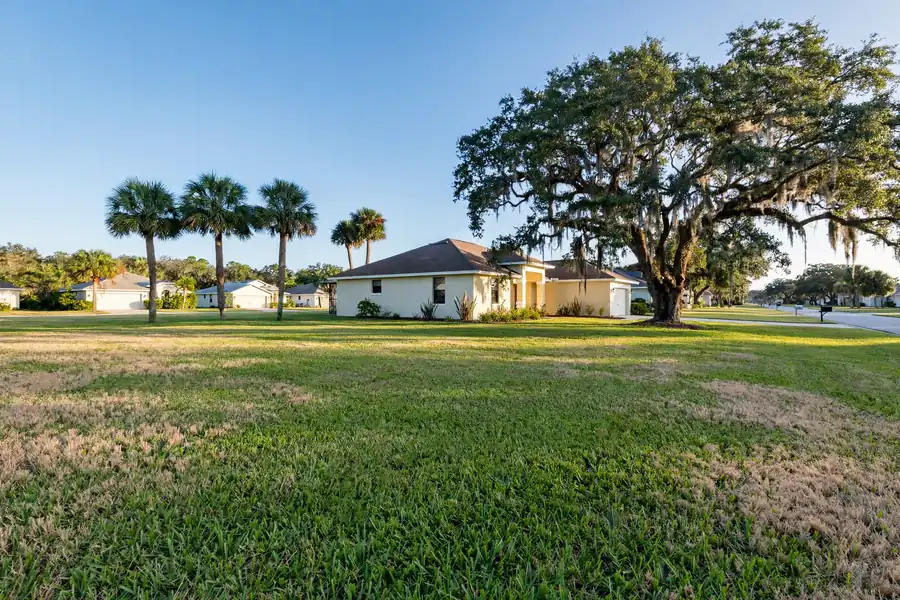
Color change is part of the same shift. A lawn can turn pale green or tan in patches and still be alive. Shade, soil moisture, and grass type all change how much color a lawn keeps.
Winter color is not a report card. A tan lawn in January can green up well in spring if the crowns and roots are healthy. For the full picture of how these grasses behave across the year, read our guide on how warm-season grasses differ from cool-season grasses.
Dormant or Dead? How to Tell the Difference
A dormant lawn and a dead lawn can look alike from the street, so check before you act. Look for living crowns and runners at the base, and check whether blades near the soil still show some green. Gently tug a few blades. If they hold firm, the plant is likely alive. If whole patches pull up with no roots, that area may be dead.
Give the lawn time before you judge it. A dormant area should respond as temperatures warm in spring. If a patch keeps spreading, or if it stays bare and lifeless well into spring growth, the cause may be disease, insects, or another problem. For help sorting that out, see our guide on how to tell a dead lawn from a dormant one and bring it back.
Mowing: How Often and How High?
Winter mowing runs on growth, not on the calendar. If the grass has not grown enough to need a cut, leave the mower parked. In a mild winter, St. Augustine may need a cut every two or three weeks. In a cold stretch, it may need none for a month. Watch the lawn, not the week.
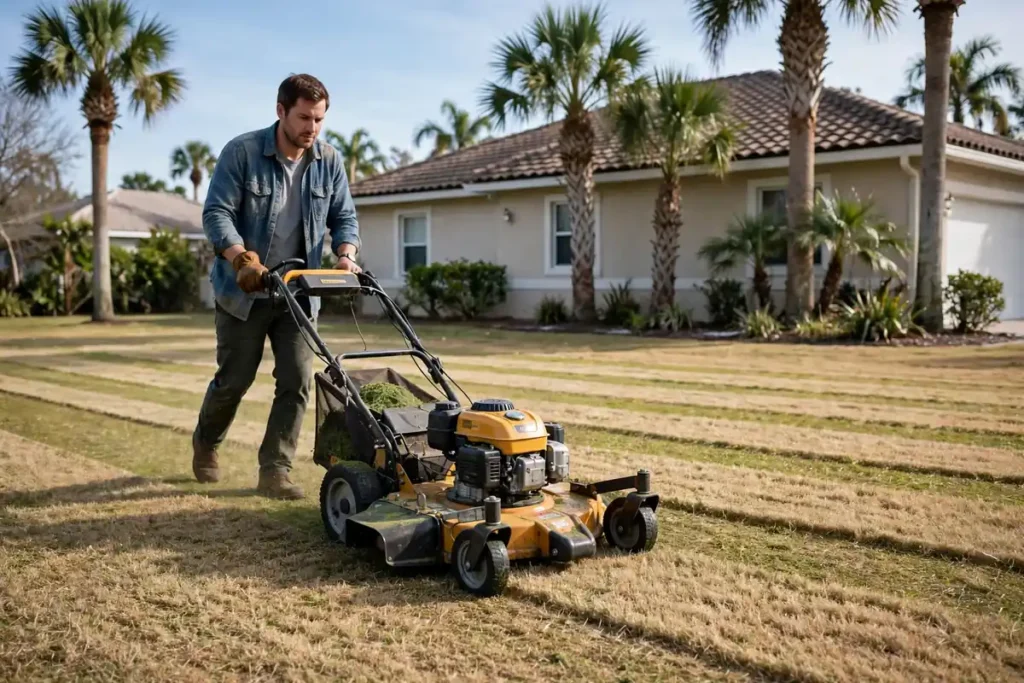
Keep the height your grass type needs. UF/IFAS guidance puts standard St. Augustine at 3.5 to 4 inches, dwarf St. Augustine near 2.5 inches, Bahia at 3 to 4 inches, and coarse Zoysia at 2 to 2.5 inches. Check the guidance for your exact cultivar, since some types sit lower. Never take off more than one-third of the leaf blade in a single mow.
Do not scalp dormant grass. Cutting it short exposes the crowns to cold and dries the soil faster. Keep blades sharp, and mow only when the grass is dry. Wet or frosted turf tears instead of cutting, and it leaves ruts and bruised blades behind.
Watering Less During Cool Months
Cool weather and slower growth cut water demand, and rain often covers more of the need in winter. Check soil moisture before you run the sprinklers. Push a screwdriver into the soil. If it slides in with ease and the soil feels damp a few inches down, the lawn does not need water yet.
When you do water, give the lawn a real drink, not a light sprinkle. UF/IFAS guidance suggests about one-half to three-quarters of an inch per watering, applied in the early morning. That depth reaches the roots and gives the blades time to dry during the day. Sandy soils in Palm Coast drain fast, but that alone is not a reason to water on a fixed schedule.
Check your local watering rules too. Many Florida communities limit watering days or hours, and those rules still apply in winter. If your sprinkler system needs seasonal attention, read our sister guide on how to winterize a sprinkler system in Florida rather than changing controller settings by guesswork.
Fertilizer: What to Skip Until Spring
Skip quick-release nitrogen while your lawn is cool or dormant. The grass cannot use it well, and the extra nitrogen can feed disease instead of growth. UF/IFAS notes that late nitrogen on St. Augustine is linked to more large patch, a cool-weather fungal disease, and that it is best not to fertilize a North Florida lawn after mid-September.
A tan lawn in winter is not a sign that it needs food. Color loss in cool weather is normal for warm-season grass, and fertilizer will not bring back summer green. Wait until the lawn is fully green and growing again, even if that is not until April or May.
Fertilizer rules also vary by place, so check Flagler County and city ordinances before you buy anything. For the full seasonal plan, see our Florida lawn fertilizer schedule.
Weed Control: Get the Timing Right
Winter weeds move in while warm-season turf rests. Annual bluegrass, chickweed, henbit, lawn burweed, and wild geranium are the usual cold-season weeds in Northeast Florida. They sprout in fall, grow through winter, and set seed in spring. A thick lawn crowds out many of them, but bare or thin spots give them room.
Pre-emergent herbicide works only before weeds sprout, so timing is the whole game. For winter weeds, UF/IFAS guidance points to October, once nighttime temperatures stay between 55 and 60 degrees for several nights. For summer weeds like crabgrass, the window is mid-February to early March, when daytime temperatures hold at 65 to 70 degrees for four or five days. In North Florida, that is often around March 1.
Keep pre-emergent and post-emergent products straight. Pre-emergent stops seeds from growing, while post-emergent treats weeds you can already see. Once winter weed seedlings are visible, it is too late for a pre-emergent to help. Use only a product labeled for your turf type and target weeds, and follow every direction on the label. Pre-emergent should only go on lawns established for at least a year, and it will also block ryegrass seed if you plan to overseed.
Watch for Large Patch and Brown Patch
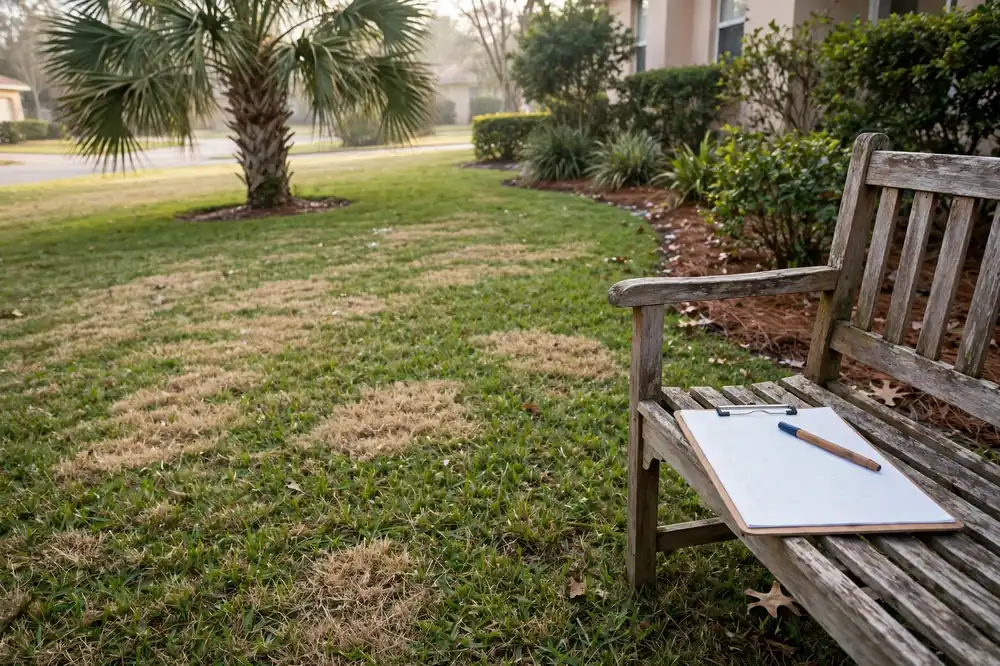
Large patch is the cool-weather disease to watch for in St. Augustine lawns. It shows up during cool, wet periods as round patches of yellow, tan, or brown grass, often with a darker edge. It can look like dormancy or drought at first, which is why many homeowners miss it until the patches grow.
Do not reach for a fungicide on a guess. Large patch often follows heavy rain, overwatering, or late nitrogen feeding, and it favors low, wet spots. If the patches keep expanding while the rest of the lawn rests, get a firm diagnosis before you treat. For photos, symptoms, and steps, see our guide to brown patch on St. Augustine grass.
Frost: Keep Off Frosted Grass
Frost does happen in Palm Coast, and frosted grass is easy to damage. Ice crystals make the blades brittle, so a footstep, a mower wheel, or a pet running across the lawn can bruise or break them. The damage may show up as brown footprints days later.
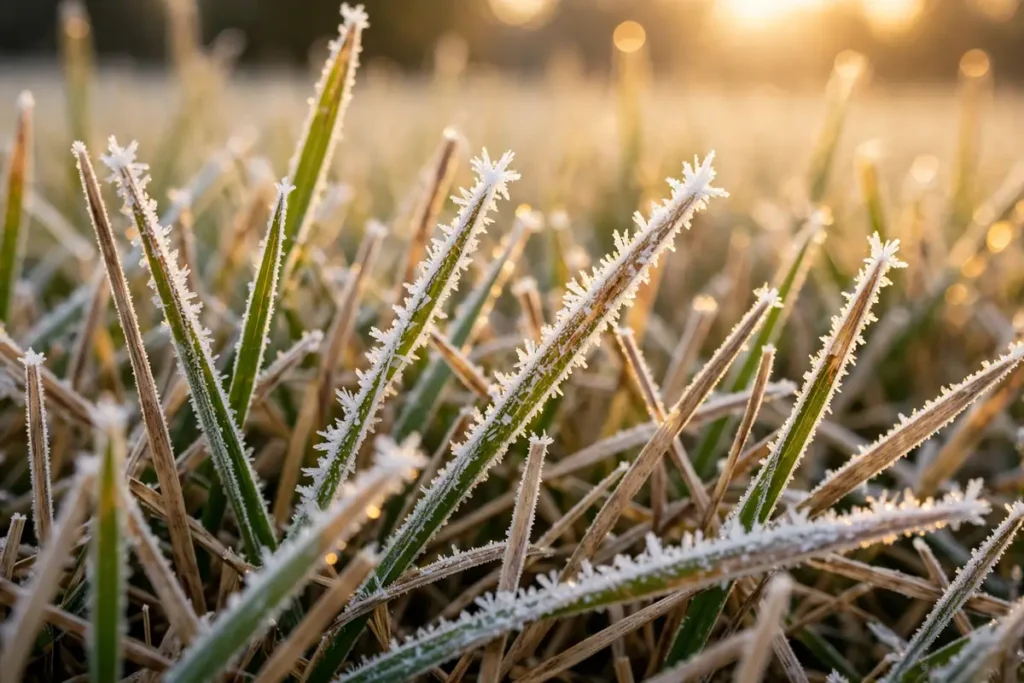
The fix is simple: wait. Stay off the lawn until the frost has melted and the grass has thawed, and mow only after the blades are dry and soft again. A light frost may cause some color change, but that does not always mean lasting harm. The lawn usually recovers as the weather warms if the crowns were not crushed while frozen.
Should You Overseed with Ryegrass?
Ryegrass overseeding gives a Florida lawn green color through winter. The seed goes down in mid-October through mid-November, and the ryegrass grows while your warm-season grass rests.
It also adds work. Ryegrass needs regular mowing, water, and food, and it must fade out in spring so your warm-season grass can take over again. That change can be messy if the ryegrass hangs on too long and shades the grass below it.
Overseeding is not right for every lawn. If you value a low-effort winter and a clean spring green-up, skip it and let the lawn rest. If you do overseed, remember that pre-emergent herbicide will block the ryegrass seed too. Weigh the winter color against the spring work before you buy seed.
What NOT to Do to Your Lawn in Winter
Winter lawn care is as much about restraint as action:
- Do not push growth with quick-release nitrogen while the grass is cool or dormant.
- Do not scalp the lawn or drop the mowing height to force a tidy look.
- Do not mow wet or frosted turf.
- Do not water on a fixed schedule without checking rainfall and soil moisture.
- Do not confuse dormancy with disease, insects, or drought. Check before you treat.
- Do not overseed with ryegrass if you have already applied a pre-emergent herbicide.
Each is easy to make when a lawn looks tired in January. The lawn is not asking for more inputs, only patience and a light touch until spring.
Month-by-Month Checklist: November to February
Use this checklist as a rough guide and adjust it to your yard. A warm December may need more mowing than a cold one, and a wet January may need less water than a dry one.
| Month | Mowing | Watering | Watch for |
|---|---|---|---|
| November | Mow only as growth requires | Cut back as rain and growth fall off | Fall pre-emergent window |
| December | Very little mowing | Water only when soil is dry | Frost traffic; large patch |
| January | Minimal mowing | Lowest water use of the year in most yards | Winter weeds; frost damage |
| February | Still conservative | Water as needed | Spring pre-emergent window |
Keep this table handy. A quick look each month will keep you from doing spring work in January, the most common winter lawn mistake we see.
When to Resume Spring Lawn Care
Spring care starts when the grass does, not on a date on the calendar. Watch for steady new growth and warming soil. In Northeast Florida, that usually builds through March and April, but a cold spring can delay it.
As growth returns, raise mowing and watering step by step. Do not jump back to a summer schedule in one week. Fertilize only when the lawn is fully green and growing. For the warm-season plan, see our guide to spring and summer lawn care.
Conclusion
Winter lawn care in Florida is a quiet season, and that is a good thing. Mow when the grass grows, water when the soil is dry, skip the nitrogen, time your weed control, and stay off frosted grass. Your lawn will rest, and it will come back strong when the warmth returns.
Want a lawn care plan that fits your grass type and local conditions? Ask Dreamscapes Florida about a winter maintenance plan or request a free estimate. We serve Palm Coast, Flagler Beach, Bunnell, Ormond Beach, and St. Augustine. Call us at (386) 237-2983 or visit our lawn maintenance page to learn more.
Frequently Asked Questions
Usually less often than during active summer growth, because warm-season grass grows more slowly and cooler weather reduces water demand. Check rainfall and soil moisture before irrigating. Sandy soils may dry faster, but do not follow a fixed schedule without considering actual conditions and local watering rules.
St. Augustine may slow down or turn tan during cool weather without being dead. Look for living crowns and runners and watch whether the area responds when temperatures warm. Expanding patches or symptoms that persist into active growth may indicate disease, insects, or another problem.
Avoid applying quick-release nitrogen to warm-season turf during cool weather when growth is slow or dormant. Fertilizer timing should follow current UF/IFAS guidance, grass type, local fertilizer ordinances, and lawn condition. Do not fertilize simply because the lawn has lost its summer color.
Pre-emergent timing depends on the weeds being prevented and local seasonal conditions. For winter weeds, UF/IFAS guidance points to October, once nighttime temperatures stay between 55 and 60 degrees for several nights. For summer weeds, the window is mid-February to early March. Apply only a product labeled for the turf and target weeds, following all label directions.
Avoid walking, mowing, or driving equipment over frosted or frozen grass. Ice crystals can make leaf tissue brittle, and traffic may cause additional injury. Wait until the frost has melted and the lawn has thawed before resuming normal activity.
Ryegrass can provide temporary winter color, but it adds seed, mowing, water, and management needs and must transition out as warm-season turf resumes growth. It is not necessary for every lawn. Check UF/IFAS guidance and weigh appearance benefits against spring transition work.