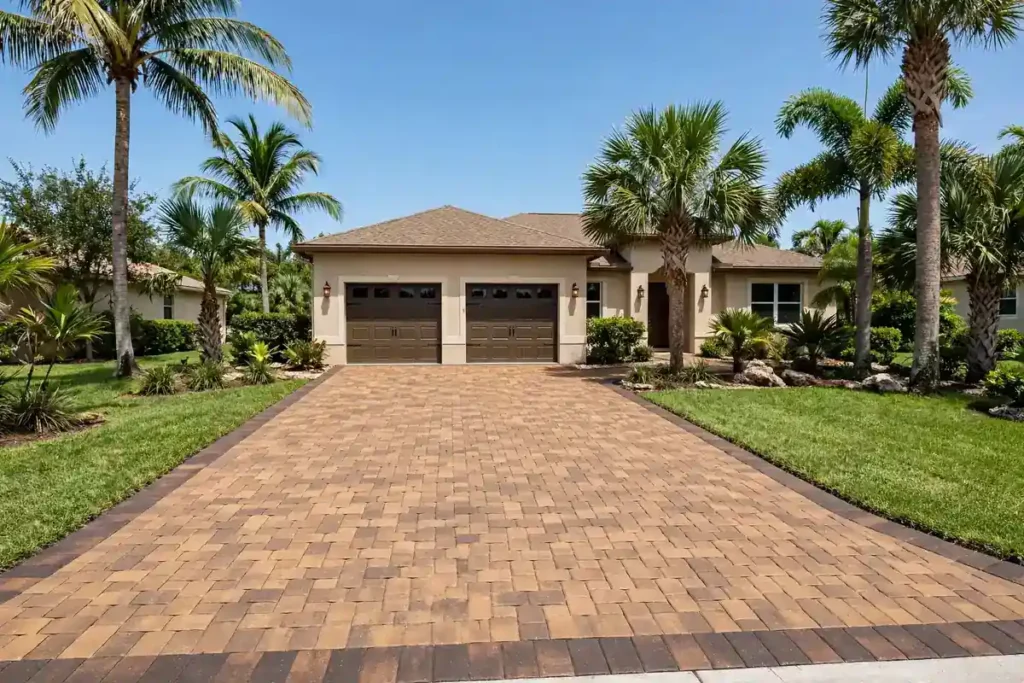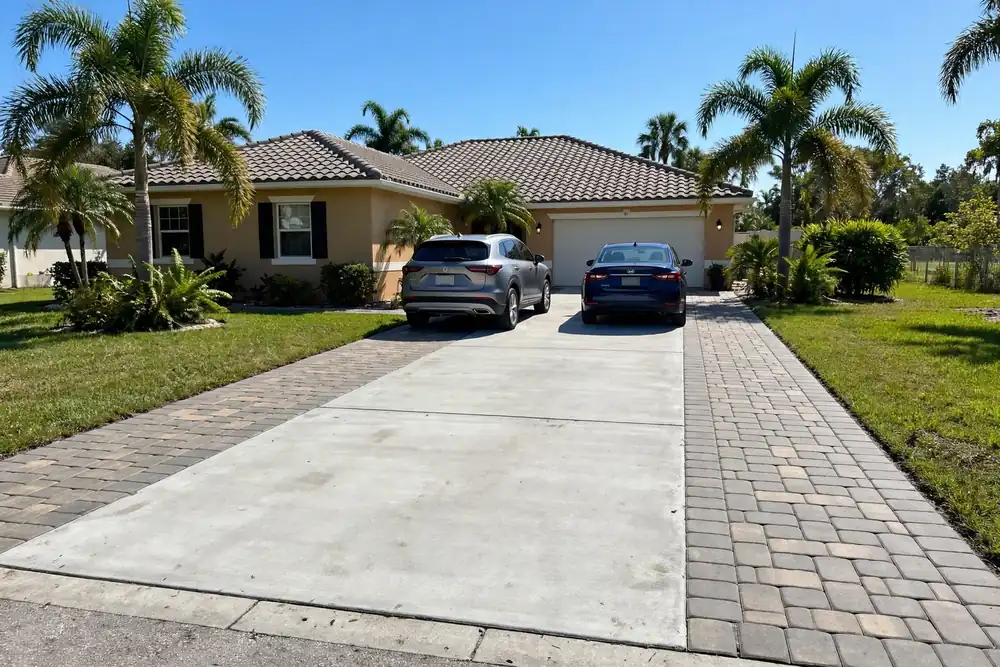
A driveway extension widens your existing driveway so a second car, a boat, or an RV fits without parking on the grass. In Palm Coast, most homeowners add paver strips along one or both sides of the concrete they already have. The job needs a city permit, a deep compacted base, and a plan for drainage.
That is a lot of planning for a strip of pavement. An extension touches your property line, the street, the swale, and sometimes your HOA rules. Get those right first, and the paving itself is the easy part.
Start by Measuring What You Actually Need
Most builder driveways in Florida are 10 to 12 feet wide, room for one car with doors that open onto the lawn. Two cars side by side need 16 to 22 feet of total width, and two sedans fit in 18 to 20 feet. Measure your own cars with the doors open first.
Write down what the extra space is for. A second daily driver needs width at the garage. A boat or an RV needs length, trailer width, and room to walk around it. A teenager’s car needs a spot that does not block the garage door.
Then decide whether to widen one side or both. One side costs less and keeps the job simple. Both sides look more balanced. Also think about turning: a wider apron at the street makes backing a trailer far less stressful.
Check the Rules First: HOA, City Permits, and Setbacks
Start with your HOA, if you have one. Many Palm Coast and Flagler County neighborhoods require architectural review before any driveway work, and some ban gravel or asphalt additions outright. Read your community rules before you spend money on a design.
The City of Palm Coast requires a permit for all residential driveways, and an extension counts. The city’s Residential Site Development guide says your site plan must state how many feet you are extending on each side, whether you are building a circular driveway, the culvert pipe size and location, and the setback from the property line.
The city’s Technical Manual, Section 900, sets the widths at the street. A residential driveway must be at least 10 feet wide at the right-of-way line and 16 feet wide at the roadway edge, and that widening can be a taper. The shoulder inside the right-of-way must be at least 2 feet wide, stabilized and sodded. Concrete in the right-of-way must be 6 inches thick, or 5 inches on 3 inches of limerock or shell base. Behind the right-of-way, it must be at least 4 inches.
Size also changes the inspection path. Under the city’s stormwater guide, an extension under 300 square feet needs a right-of-way final inspection. Over 300 square feet, the city also asks for a right-of-way final survey and a field survey. Find the current forms on the City of Palm Coast Building Division page. Bunnell, Flagler Beach, and the rest of Flagler County have their own offices.
Setbacks are the other limit. You cannot pave right up to the property line, and you must leave the roadside swale working. Call 811 at least two to three full business days before any digging, so underground utilities get marked.
What a Driveway Extension Costs in Florida
Extension prices depend on material, size, and site work. National data from Angi, updated March 2026, puts a driveway extension at $800 to $3,000, with an average near $1,900. HomeGuide’s 2026 figures put an extension at $3 to $12 per square foot, or about $600 to $2,400 for 200 square feet. These are national averages, not Palm Coast prices, and local quotes will vary.
| Material | Installed cost per square foot | 200 square foot example |
|---|---|---|
| Asphalt | $2.50 to $5 | $500 to $1,000 |
| Concrete | About $10 | About $2,000 |
| Brick | $10 to $15 | $2,000 to $3,000 |
| Pavers | $15 to $30 | $3,000 to $6,000 |
Small jobs often cost more per square foot than big ones. A crew, equipment, and a material delivery cost nearly the same whether the job is 100 square feet or 400.
Five things move the price most: drainage or culvert work, a curb cut at the street, tree roots, utility lines that need moving, and matching old concrete. Get the extras listed on the quote. For a full breakdown of paver pricing, see our paver driveway cost guide.
Pavers or Concrete: Which Extension Fits Your Driveway?
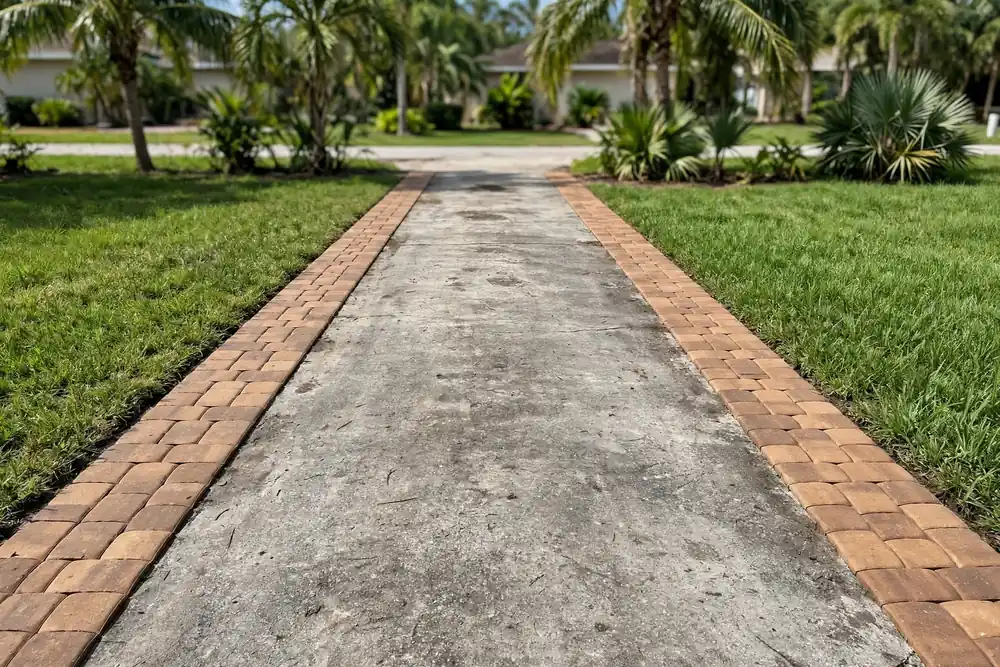
Pavers are the most common choice for an extension in Palm Coast: you do not have to match old concrete. New concrete next to old concrete shows a color line for years. New pavers next to old concrete look like a planned border.
| Factor | Paver strips | Concrete addition |
|---|---|---|
| Match to old driveway | Looks like a planned border | Color line shows for years |
| Repairs | Lift and reset single pavers | Cut out and re-pour a section |
| Cost | $15 to $30 per square foot installed | About $10 per square foot installed |
| Cure time | Drive on it the same week | 5 to 7 days before vehicle traffic |
| Pattern | Herringbone holds up best under tires | Broom finish, joints to control cracks |
Concrete still wins on price, and it suits a driveway that is already concrete and in good shape. If you go that route, put an expansion joint between the old slab and the new pour, so the two sections can move on their own without cracking each other.
Pavers need a pattern that locks. Herringbone is the standard for driveways because the interlock spreads tire loads across the surface. Large, thin slabs belong on patios, not under cars. For the wider comparison, read our pavers vs concrete guide.
The Base Is What Keeps Your Extension From Sinking
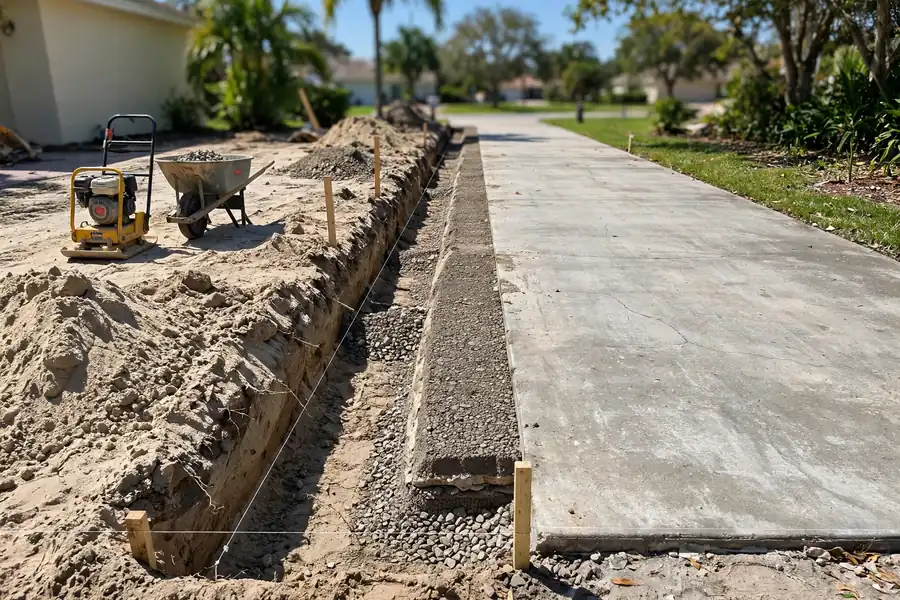
The pavers you see are the thin top layer. The base under them does the real work, and a driveway base is far deeper than a patio base. Unilock gives typical guidance of 10 inches of compacted gravel base for driveways in established areas, and 12 to 14 inches in newer developments. Patios and walkways need only 6 to 8 inches, with about 1 inch of bedding sand on top.
Two details matter as much as depth. First, the base must extend past the paved edge by a distance equal to the base depth itself. Second, edge restraints go on every side. Without them, pavers creep outward under tire loads and the edge sinks.
Florida soil adds its own twist. Our sandy soil drains fast, which is good for stormwater, but it shifts under load. A base compacted in thin layers holds its shape. Unilock also notes that a stabilization grid set into the gravel can let a typical 12 inch base drop to 8 inches.
Ask any contractor for the base depth in writing before work starts. A shallow base is the most common reason a paver extension develops ruts within a year or two. Our guide to installing pavers lays out the full sequence.
Drainage and Swales: The Part Most People Skip
Every new paved area adds runoff, and Palm Coast takes that seriously. The city treats driveways as impervious surfaces under its stormwater rules, which is why the permit asks for a site plan and a culvert detail.
Grade the extension to slope 1% to 2% away from the house and toward the street, about one eighth to one quarter inch of drop per foot.
Never fill in or block the swale along the road. That shallow ditch is part of the neighborhood drainage system, and the culvert pipe under your driveway apron carries water through it. Keep the pipe clear and at the height the city set. If your extension crosses the swale, the permit may require culvert work.
Northeast Florida summer storms drop a lot of water fast. A flat extension that traps water against the garage door turns into a repair bill.
Tree Roots, Utilities, and Other Surprises
Walk the strip before you dig. A live oak root under the extension will lift pavers within a season or two, and cutting a major root can harm the tree. If a big tree sits close to the planned edge, shift the extension. Our post on tree roots lifting pavers shows what happens when roots win.
Utilities hide in the same strip. The 811 call marks gas, electric, water, and cable lines, but not your own irrigation pipes or low-voltage lighting wires. Flag those yourself before the crew arrives, and move any sprinkler heads in the new paved area.
Never pave over a septic tank or drainfield. Check its location on your site plan first: a paver extension over a drainfield can block access and damage the system.
Parking Pads for Boats, RVs, and Extra Cars
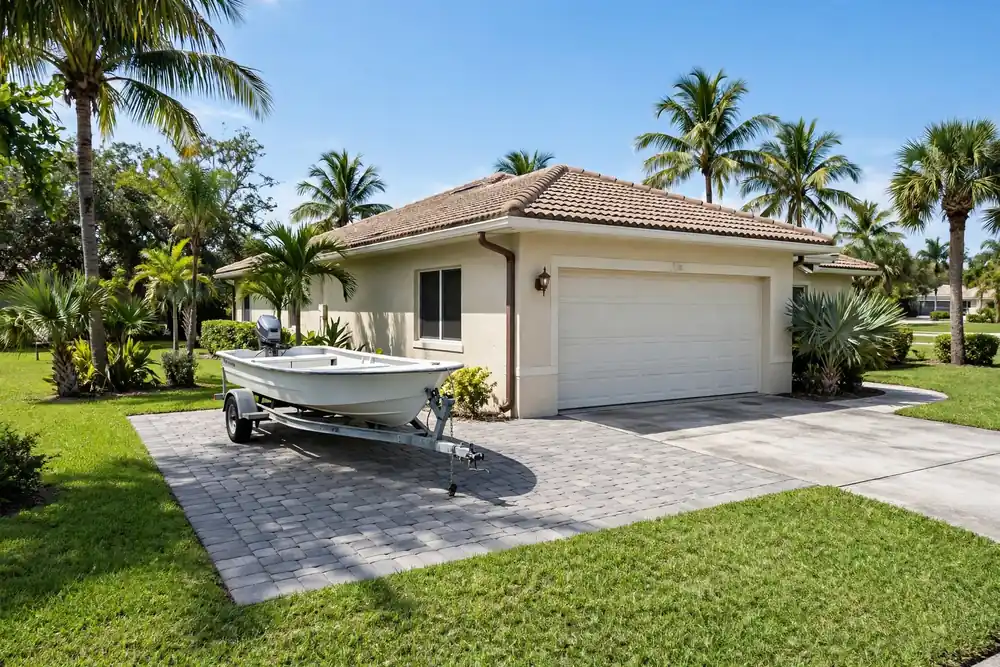
A parking pad beside the garage or along the side yard gives one extra vehicle a home without rebuilding the whole driveway. Size it to the trailer, not just the boat: add room for the tongue, the mirrors, and a step around the sides.
Heavier loads need the same deep base as a driveway. A boat on a trailer or a small RV puts far more weight on the pad than a sedan, so do not let anyone build it like a patio. Ten inches of compacted base is the floor, not the goal.
Turning room matters more than length. A pad you cannot back into will not get used. Walk the backing path with the trailer in mind. Also check your HOA rules on visible boats and RVs: some Palm Coast communities require side-yard placement or screening, and that decides where the pad can go.
Permeable Pavers: Worth It for an Extension?
Permeable pavers let rain pass through the joints into a stone reservoir below, which can help on a lot where drainage is tight. They cost more than standard pavers, need a deeper open-graded base, and need the joints cleaned out now and then. For most Palm Coast extensions, standard pavers with good grading and a clear swale do the job. Read our permeable pavers guide for the full picture.
Driveway Extensions in Palm Coast: Local Notes
Palm Coast lots shape every extension. Many have a swale and a culvert at the street, sandy soil that drains fast but shifts, and an HOA with a design review step. Summer storms test the grading, and salt air near the coast ages exposed concrete faster than inland.
We have built hardscape across Palm Coast since 2015, and the smoothest driveway extensions share one thing: the permit, the base, and the drainage were settled before the first paver arrived.
If you would like help planning a driveway extension, contact Dreamscapes Florida or call (386) 237-2983. We serve Palm Coast, Flagler Beach, Bunnell, Ormond Beach, and St. Augustine. See our full hardscape services to compare pavers, patios, and walkways.
Frequently Asked Questions
Yes. The City of Palm Coast requires a permit for all residential driveways, and an extension counts. Your site plan must state how many feet you are extending on each side, plus the culvert pipe size and the setback from the property line. Check the current forms on the City of Palm Coast Building Division page before work starts.
National data from Angi, updated March 2026, puts a driveway extension at $800 to $3,000, with an average near $1,900. Pavers run $15 to $30 per square foot installed, concrete about $10, and asphalt $2.50 to $5. These are national averages, so local quotes in Palm Coast will vary with site work and materials.
Two cars parked side by side need 16 to 22 feet of total driveway width, and two sedans fit in 18 to 20 feet. Most builder driveways in Florida are only 10 to 12 feet wide, which fits one car. Measure your own cars with the doors open before you decide how much width to add.
Yes, and it is one of the most common driveway extensions in Palm Coast. Paver strips along one or both sides of the old concrete look like a planned border, so you avoid the color line that new concrete shows for years. Use a herringbone pattern, a deep compacted base, and edge restraints on every side.
Unilock gives typical guidance of 10 inches of compacted gravel base for driveways in established areas, and 12 to 14 inches in newer developments. Patios and walkways need only 6 to 8 inches. Add about 1 inch of bedding sand on top, and extend the base past the paved edge by a distance equal to the base depth.
It can if the water has nowhere to go. Grade the extension to slope 1% to 2% away from the house and toward the street, and never fill in or block the roadside swale. Keep the culvert pipe under the driveway apron clear and at the height the city set. Permeable pavers are an option where drainage is tight.