Cinder block is the most underrated material in a Florida yard. It is not pretty on its own, it is heavy, and a bare gray wall will never win a beauty contest. But in Palm Coast — where wood rots, metal rusts, and a summer downpour can move a whole bed of mulch into the street — a well-built block bed or wall will still be standing, straight and useful, long after the prettier options have given up. The trick is using it for the jobs it is actually good at, and building it the Florida way: on a proper base, with drainage, and with plants that can handle the heat it holds.
The short answer: In a Palm Coast yard, concrete block works best for raised beds, retaining walls, terraces and garden borders. It outlasts wood in Florida heat and rain, drains well in sandy soil when built on a compacted base with drainage behind it, and the hollow cells double as mini-planters — provided tall or load-bearing walls are left to a hardscape crew.
Why Concrete Block Works in a Florida Yard (and Where It Does Not)
First, a word about what you are actually buying. The blocks sold in stores today are concrete masonry units — cement, sand and aggregate pressed into a hollow block. They are not the old coal-cinder blocks from decades ago, and that distinction matters most if you plan to grow food in them (more on that below). A standard block is 8 by 8 by 16 inches, which makes the maths easy and the stacking forgiving: a bed, a border or a low wall goes up in straight, repeatable courses.
Block suits Florida for three practical reasons. It does not rot in humidity, it does not rust, and it does not get eaten. Wood beds in Flagler County last a few seasons before the bottom boards soften; block does not have that failure mode. Second, block is heavy, and in a storm that is a virtue — a dry-stacked block bed stays where you put it in a way a plastic or timber edge never will. Third, block is modular. You can start with one bed, add a second next season, or take a wall down and rebuild it in a new shape without throwing the material away.
It has real limits, and a good guide should say so. Bare gray block looks industrial, especially in a front yard, so it needs finishing — a cap stone, stucco, veneer or paint on the outside faces — before it reads as landscaping rather than a construction site. Block also holds heat. On a west-facing wall in August, the blocks themselves radiate warmth into the evening, which is fine for lantana and terrible for a shade plant tucked against them. And block is unforgiving of a bad base: a wall built on uncompacted sand will settle unevenly, and a settled wall shows every inch of it. If the job is tall, load-bearing, or holding back a real slope, it is not a weekend stack — it is hardscape work.
1. Raised Beds That Actually Last in Sand
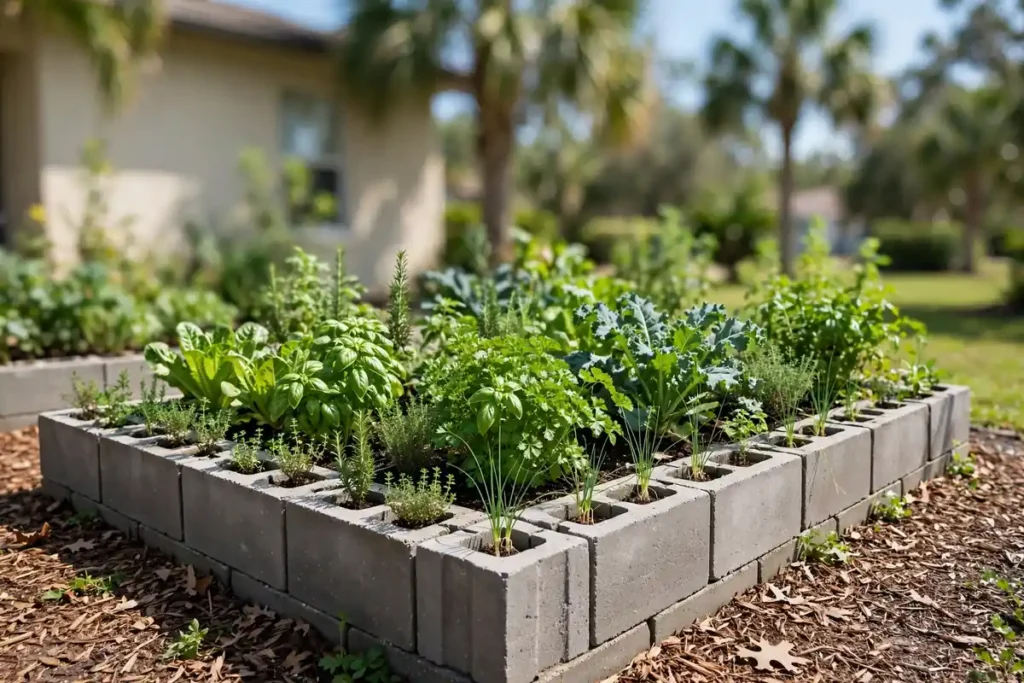
This is the idea everyone photographs, and it earns the attention — provided it is built for Florida soil rather than copied from a northern garden blog. A single course of blocks laid on levelled, compacted ground makes a bed that will not rot, will not bow outward under wet soil the way a timber bed does, and gives you a second garden for free: the hollow cell on top of every block is a small planter in its own right.
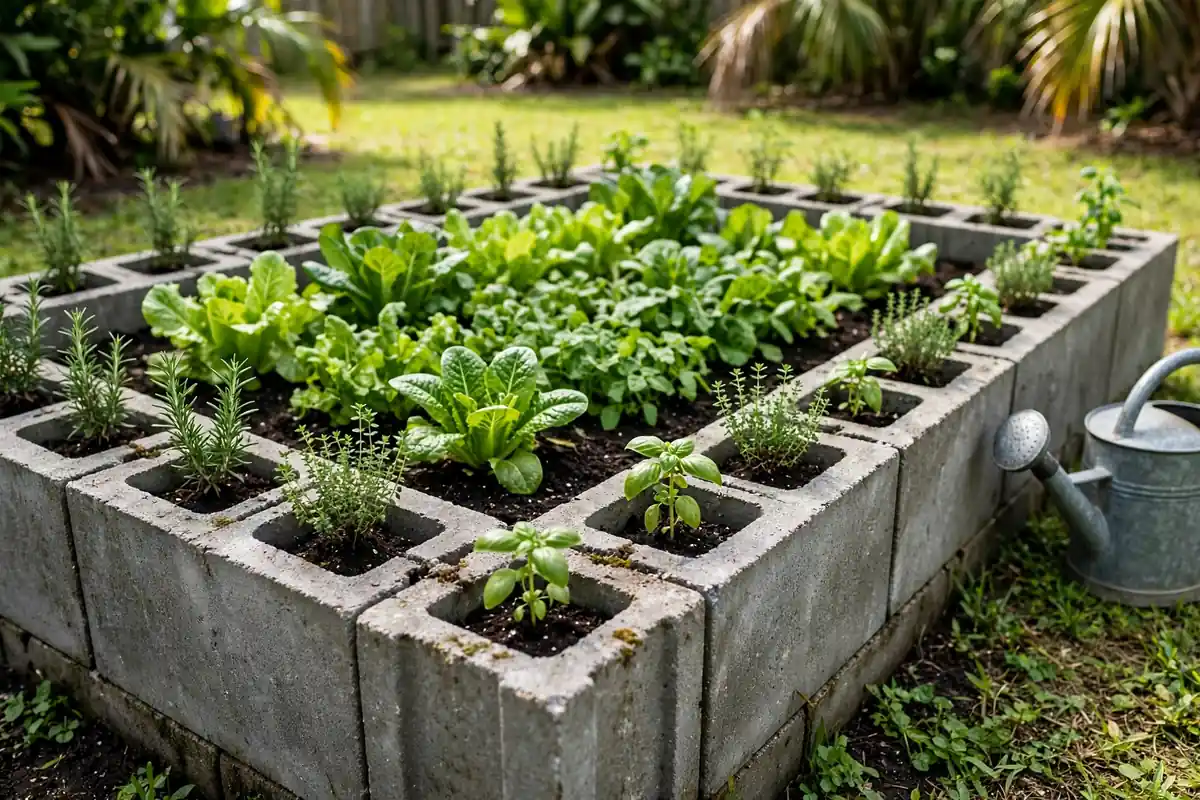
Keep the bed narrow enough to reach the middle without stepping on the soil — about four feet wide if you can walk around both sides, narrower against a fence. Fill it with a soil mix, not straight sand from the yard: sand drains so fast that a bed filled with it dries out between waterings, while a compost-rich mix holds moisture long enough for roots to use it. In Palm Coast’s heat, that mix will still dry faster than it would up north, so plan on watering more often in summer and mulching the surface to slow evaporation.
Use the cells deliberately. They dry out faster than the main bed because they are small and exposed on two sides, so they suit compact, drought-tolerant plants: thyme, rosemary, chives, small sedums, marigolds and strawberries all do well there. Do not put a thirsty lettuce or a spreading mint in a cell and expect it to thrive — the cell is a pocket, not a bed. And keep the main bed for the plants that need real root room: leafy greens, peppers, eggplant and herbs with bigger root systems.
A Note on Growing Food in Block Beds
For ornamental beds, block choice hardly matters. For vegetables, take the cautious route: buy new concrete blocks rather than salvaged blocks of unknown age, because very old true cinder blocks are the ones associated with fly ash and trace heavy metals. If you are reusing blocks and cannot tell how old they are, line the inside of the bed with landscape fabric before filling it, and keep edibles out of the cells themselves. Concrete is also alkaline, so it can nudge soil pH upward over time — if your greens start yellowing for no clear reason, a cheap soil pH test is the first thing to check, not the last. None of this makes block unsafe for a normal new bed, but it is the difference between a bed you stop worrying about and one you keep second-guessing.
2. Low Retaining Walls and Terraces
This is where block stops being a garden craft project and starts being hardscape — and where it pays for itself. A Palm Coast yard with even a gentle slope loses soil every storm: water picks up speed, carves a channel, and carries mulch and topsoil with it. A low block wall, or better, a series of terraced walls, breaks that slope into level steps. Each step slows the water and gives it a place to soak in, and each level becomes plantable ground instead of a bank you cannot mow.
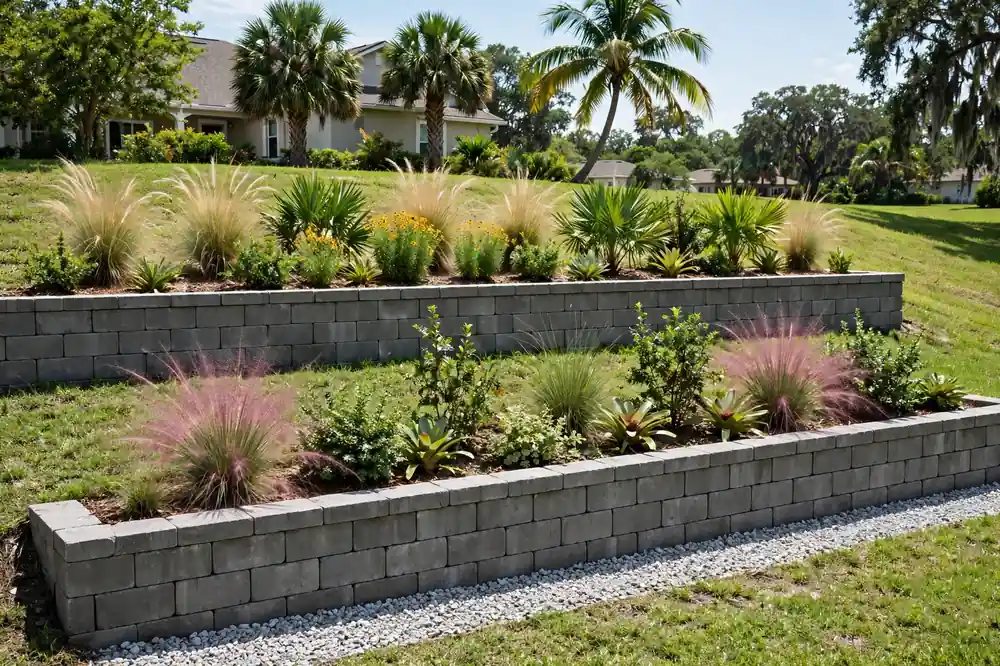
The build detail is what decides whether the wall lasts five years or thirty, and it is all behind the wall where nobody sees it. A block retaining wall needs a compacted crushed-stone base, not bare sand; a drainage zone of clean crushed stone behind the wall, at least a foot deep; a perforated drain pipe at the base of that zone, sloped to a safe outlet; and geotextile fabric between the stone and the soil so sand cannot migrate in and clog the drainage. Courses are staggered so vertical joints do not line up, and each course steps slightly back into the hill — a small backward lean that helps the wall resist the push of the soil behind it. Skip the drainage and the wall becomes a dam, and water behind a dam in a Florida downpour always wins eventually. Our guide to erosion control landscaping in Florida explains why that behind-the-wall drainage is the number one cause of wall failure here, and how terracing fits among the other erosion fixes.
Know where DIY ends. A low garden wall — a course or two, holding back a gentle grade — is a reasonable project for a careful homeowner. A taller wall, a wall holding back a driveway or a pool deck, or a wall on a slope that already moves in storms is not: it needs proper footing, reinforcement and, in many cases, a check with the City of Palm Coast before structural work begins. If water already ponds behind where the wall would go, fix the water first — a wall alone will not fix a wet area, and our comparison of French drains vs dry creek beds shows which drainage fix fits which kind of wet yard.
3. Borders, Edging and Tree Rings
Block makes a better border than most of the edging sold in bags. Plastic strips pop out of sandy soil within a season or two, and thin metal strips bend under a mower wheel. A single course of blocks laid as a border stays put, gives you a clean line to mow against, and keeps mulch where it belongs through a downpour. It is also the cheapest way to test a bed shape: lay the border dry, live with the curve for a week, and only then commit to planting inside it.
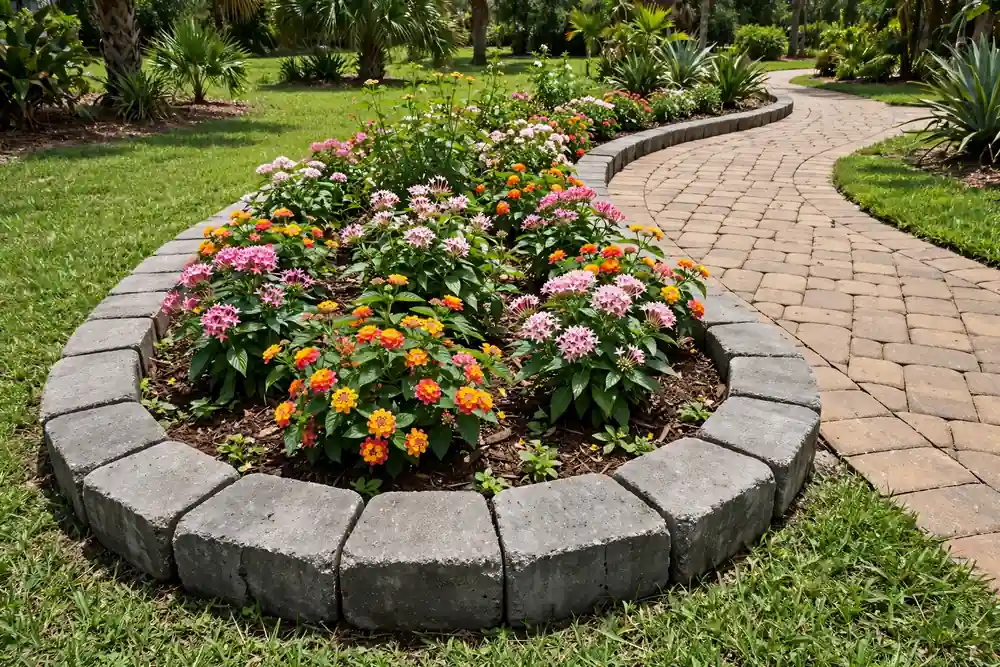
Curves are where block edging earns its keep. Short blocks follow a curve far more gracefully than long timber or rigid plastic, and a curved border around a tree or a bed reads as designed rather than improvised. For a tree ring, leave the blocks a little loose rather than mortared tight — the tree will grow, and a ring that can shift slightly will not crack or strangle the trunk the way a rigid ring can. Keep mulch pulled back from the trunk itself, whatever the border is made of.
There is one honest comparison to make here. Block edging is good; continuous concrete curbing is better where you want a permanent, joint-free border, because it has no gaps for grass runners to slip through. If the border is the whole project — a full front yard of beds — it is worth reading our guide to landscape curbing cost in Florida before choosing: professionally installed curbing runs $8–$18 per linear foot, and for a long, visible border that price can be the better long-term buy. Block edging wins where the border is short, curved, or likely to change.
4. Planters, Steps and Small Features
Once you have the material on site, the small features are almost free. A single block, or two stacked, makes a standalone planter for a patio corner or a walkway — fill the cells with succulents, dwarf herbs or a trailing plant and it looks intentional rather than improvised, especially if you repeat the same plant in several blocks instead of a different plant in every hole. A stepped planter in a corner turns dead space into the most productive square feet in the yard: widest at the bottom, narrowing as it rises, taller plants at the back, trailing plants at the front, and enough room around it to reach every level.
Block steps are the same idea at a bigger scale. On a gentle slope, wide, shallow block steps with a cap stone on each tread give you a staircase that will not rot, shift or wash out — and they pair naturally with the terraced walls above, using the same material and the same base preparation. Around a deck, block planters and a low block border do the job that pots alone cannot: they anchor the deck to the ground and give the planting a finished edge. Our guide to landscaping around a deck covers the layering and drainage that make that ground look designed rather than filled in.
Two small features to skip, or at least think twice about: a block bench or table base looks clever in a photo and feels hard and cold in real life unless it is capped with wood and cushioned, and a block fire pit is a different project entirely — heat, clearance and local rules all apply, and it should never be improvised from a garden-bed design.
How to Make Block Look Designed, Not Leftover
The difference between a block bed that lifts a yard and one that drags it down is almost entirely finishing. A flat cap stone on top of the wall — a paver, a piece of cut stone, or a poured cap — turns a rough edge into a seat, a shelf for pots, and a clean shadow line. Stucco over the outside faces, tinted to match the house, makes a block wall read as part of the home rather than part of a building site; stone veneer does the same job at a higher price and a more natural look. Paint is the cheapest finish, but use it only on outside faces, never inside an edible bed, and choose a mineral limewash or masonry paint that lets the block breathe rather than a standard exterior paint that can trap moisture.
Planting does the rest of the work. A block wall on its own is a gray rectangle; the same wall with a row of lantana spilling over the top, muhly grass behind it catching the light, and a groundcover softening the base reads as a garden. Keep the palette tight — two or three plants repeated, not a different plant in every cell — because repetition is what makes a simple material look deliberate. In a small enclosed space, the same rule applies double: one focal planter and a few repeated plants beat a crowded collection, as our guide to courtyard garden ideas for Florida homes shows for courtyards, where heat and walls already do half the designing for you.
What to Plant Around Block in Palm Coast
Block holds heat, so plant for it rather than against it. Around a sunny block bed or wall, the reliable Palm Coast picks are lantana, pentas, firebush and beach sunflower for colour; muhly grass and coontie for structure; and podocarpus where you want a green screen behind a wall. These are the plants that treat a Florida summer as normal weather, and they are already proven in local yards rather than imported from a northern plant list. In shade cast by a wall or a house, switch to bromeliads, macho ferns, caladiums and variegated ginger — plants that glow in shade instead of stretching for sun they will never get.
One planting rule matters more than any list: do not plant a thirsty plant against a hot west-facing block wall and then blame the plant. Give heat-lovers the sunny wall, give shade plants the east or north side, and leave a hand’s width of air between a plant and a wall that bakes all afternoon. Water newly planted beds deeply and less often rather than lightly every day — in sand, a shallow sprinkle evaporates before roots can use it, while a deep soak reaches the root zone and teaches roots to grow down, not sideways.
When to Hire a Hardscape Crew Instead
Build the small stuff yourself if you enjoy it: a single-course bed, a short border, a standalone planter. Hire a crew when the job is structural, visible from the street, or tied to drainage — a retaining wall of any real height, a terrace on a slope that already erodes, a border that runs the full front yard, or anything where getting the base and drainage wrong means rebuilding the whole thing in two years. A crew also brings the finishing that is hardest to fake: level courses over a long run, clean caps, stucco or veneer that matches the house, and grading that sends water where it should go instead of where it happens to end up.
DreamScapes designs and installs hardscape across Palm Coast and Flagler County — retaining walls, terraces, concrete borders, patios and walkways, built on proper bases with drainage planned in, not added as an afterthought. If your block project is bigger than a weekend bed, or you want a wall that looks like it belongs to the house, call (386) 237-2983 or email dreamscapesflorida@gmail.com for a free estimate. Bring a photo of your yard and a rough idea of the shape you want; the estimate will be measured, not guessed.
Frequently Asked Questions
Are cinder blocks safe for a vegetable garden?
New concrete blocks sold today are generally considered safe for ornamental beds, and for vegetables the cautious route is simple: buy new blocks rather than salvaged blocks of unknown age, line the inside with landscape fabric if you are unsure about the blocks, and test soil pH occasionally, since concrete is alkaline. Avoid very old true cinder blocks for edibles.
Do block raised beds need a footer?
A single-course raised bed does not — levelled, compacted ground is enough. A retaining wall is different: it needs a compacted crushed-stone base, drainage behind it, and, for taller or load-bearing walls, a proper footing and reinforcement. Check with the City of Palm Coast before structural wall work.
How do you stop a block wall from failing in Florida rain?
Drainage behind the wall, not the wall itself, is what saves it: clean crushed stone at least a foot deep behind the blocks, a perforated drain pipe at the base sloped to a safe outlet, and geotextile fabric keeping sand out of the stone. Without that, water pressure builds up behind the wall until it pushes through or over.
What grows well in the hollow cells of a block?
Compact, drought-tolerant plants: thyme, rosemary, chives, small sedums, marigolds and strawberries. Cells dry out faster than the main bed, so they suit plants that tolerate drier soil, not thirsty vegetables or spreading mint.
Is block edging better than concrete curbing?
For short, curved or changeable borders, block edging is cheaper and more flexible. For a long, permanent front-yard border, continuous concrete curbing — $8–$18 per linear foot installed in Florida, per our curbing guide — is usually the better long-term buy because it has no joints for grass runners to slip through.