Sod webworms and armyworms are caterpillars that chew St. Augustine grass and leave ragged, thinning brown patches in Florida lawns. Look for clipped blades, small green pellets called frass, and larvae near the soil. A soapy-water flush can bring hidden caterpillars to the surface, but treat only after you confirm active larvae and fresh damage.
Sod Webworms vs. Armyworms: How to Tell the Difference
Both pests are caterpillars that chew grass blades, but they differ in size, looks, and feeding habits. In Florida lawns, the main webworm is the tropical sod webworm (Herpetogramma phaeopteralis), and the main armyworm is the fall armyworm (Spodoptera frugiperda).
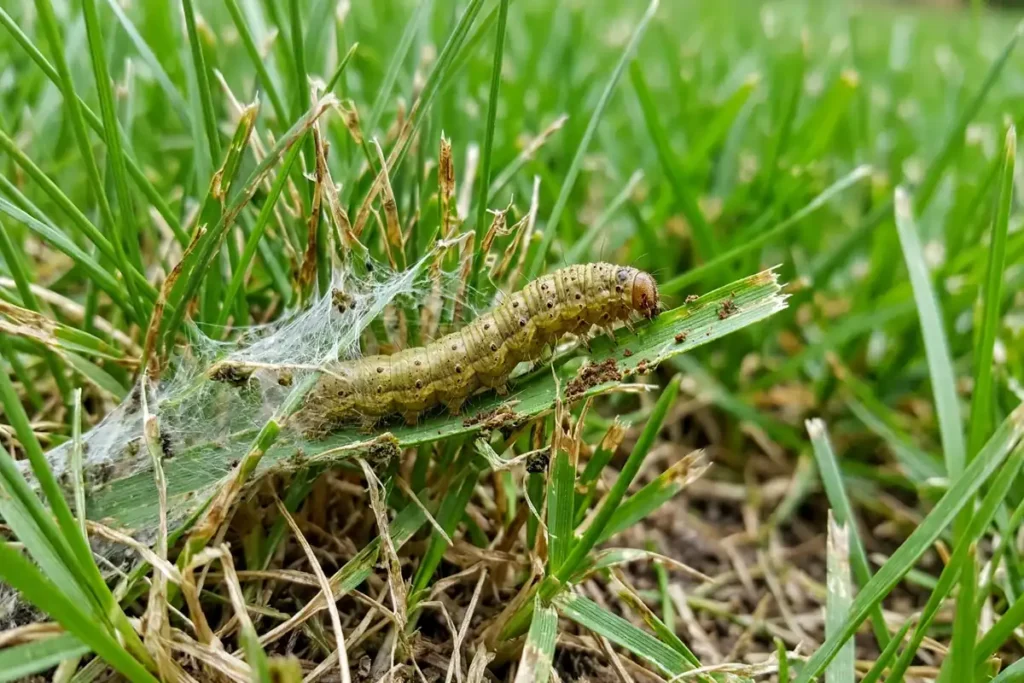
Webworm larvae are small and gray-green, with brown spots on each segment, a light brown head, and a length of about three quarters of an inch. They feed at night and hide in the thatch by day. Young larvae scrape blade surfaces, while older larvae chew near the soil and leave notched, ragged edges.
Armyworm larvae grow larger, up to about one and a half inches, and their color varies from green to brown to nearly black, with many showing a light inverted Y on the head. They feed day and night and move across a lawn in a group, so a lawn can look fine one day and show wide bare patches a few days later.
| Feature | Sod Webworm | Armyworm (Fall Armyworm) |
|---|---|---|
| Larvae | Gray-green, brown spots on each segment, light brown head | Green to brown or dark, often with a light inverted Y on the head |
| Full size | About 3/4 inch | Up to about 1 1/2 inches |
| Feeding | Night feeding; young larvae scrape blades, older larvae chew near the soil | Feeds day and night; can strip wide areas fast |
| Damage pattern | Ragged, notched blades; thinning, irregular brown patches | Large, fast-spreading bare or brown areas |
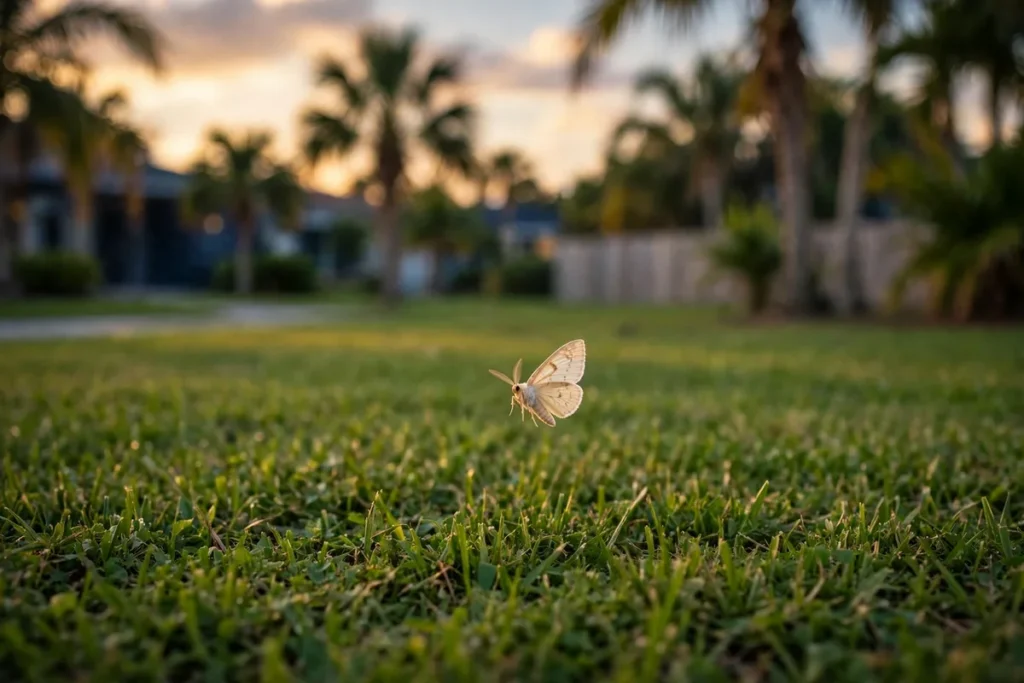
| Adults | Small tan to gray moths, wingspan about 3/4 to 1 inch | Larger brown-gray moths |
| Best check | Soap flush near fresh damage | Soap flush near fresh damage |
Signs of Sod Webworm or Armyworm Damage
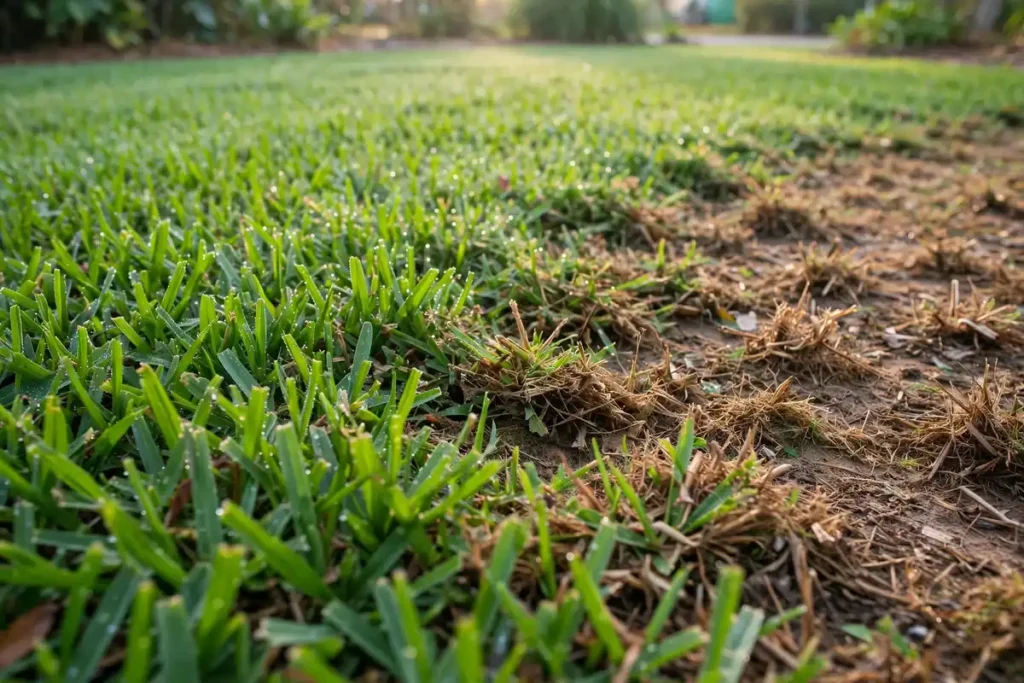
Damage often starts small: a patch where the grass looks thin and blade tips look clipped or torn, with ragged edges. As feeding goes on, the patch turns brown and spreads in an uneven shape. Check the edge where brown grass meets green grass. That is where fresh feeding happens and where you are most likely to find larvae.
Look for small green pellets in the thatch. These pellets are frass, the waste left by feeding caterpillars, and fresh frass near chewed blades is a strong clue. Fine silk threads may also show where webworm larvae rest by day.
Part the grass and look at the soil surface. Webworm larvae curl up in the thatch by day, while armyworm larvae may sit on blades or near the soil. If moths rise as you walk, note where they rise and check that area the same day.
Surface chewing points to caterpillars, while grubs feed below the surface on roots. Read our guide to grubs and the damage they cause in lawns to compare the two.
The Soapy-Water Flush Test: Step by Step
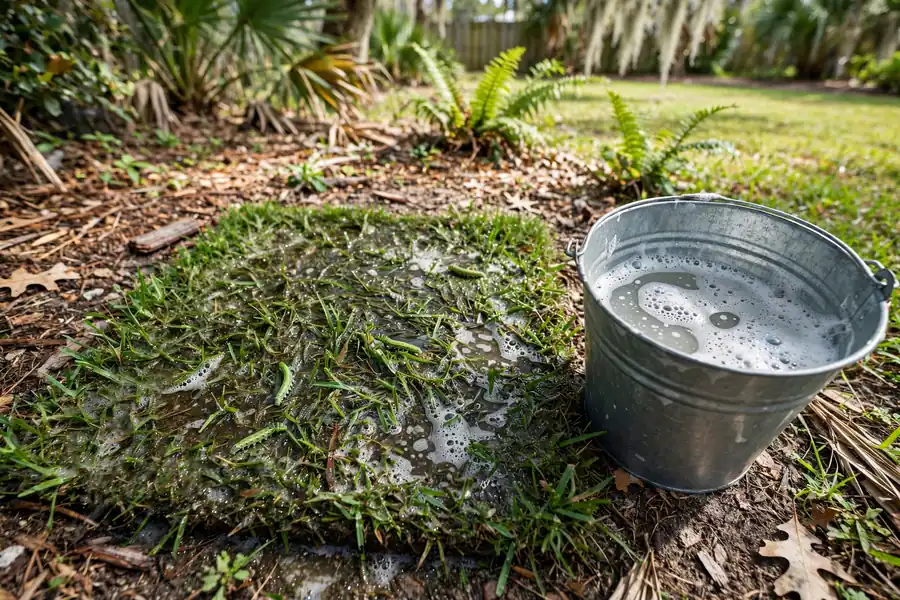
The flush test brings hidden caterpillars to the surface so you can see and count them. UF/IFAS guidance for fall armyworm monitoring uses one tablespoon of plain liquid dish soap in one gallon of water, poured over a four-square-foot area near the damage. For webworm scouting, UF/IFAS also lists two tablespoons in two gallons over one square yard. Pick one method, use plain soap with no degreaser or bleach, and test more than one spot.
- Mark a small test area, about four square feet, at the edge of the fresh damage.
- Mix one tablespoon of plain liquid dish soap into one gallon of water.
- Pour the mix evenly over the test area.
- Watch for five to ten minutes. Caterpillars that are present will crawl to the surface.
- Count what you find and note the size and color of the larvae.
- Repeat the test in two or three spots around the damaged area.
Count per square foot. UF/IFAS guidance points to about five to ten webworm larvae per square foot, and about three to four armyworms per square foot, as the point where treatment is worth a closer look. One or two larvae in one test do not call for a spray.
The soap mix is a scouting tool, not a cure. It can drown a few larvae, but it will not control a real outbreak, and it is no substitute for a labeled product when treatment is truly needed.
Damage Look-Alikes: What Else Could Cause Brown Patches?
Brown does not always mean caterpillars. Several common Florida lawn problems make brown patches, and each one needs a different fix.
| Problem | What you see | Key clue | Next check |
|---|---|---|---|
| Sod webworms / armyworms | Chewed, ragged blades; thinning; frass | Fresh chewing at the green edge; larvae in a flush test | Soap flush; compare larvae with UF/IFAS photos |
| Chinch bugs | Yellow then brown patches that spread in hot, dry weather | Tiny black-and-white bugs at the edge; grass pulls up easily | Soap flush or flotation test |
| Large patch (fungal disease) | Round brown patches with a yellow outer ring; blades rot at the base | Wet weather; blades pull free with a rotted base | Check base of blades; reduce watering at night |
| Drought stress | Even browning across dry areas; footprints stay visible | Dry soil; grass recovers after a deep watering | Check soil moisture; adjust watering |
Chinch bugs are the closest match in summer. They suck sap from the grass, and the damage can look like caterpillar chewing from a distance, but up close chinch damage lacks chewed blades and frass. Our guide to chinch bugs in Florida shows how to tell them apart.
Large patch is a fungal disease, not a pest. It makes round patches with a yellow ring, and blades rot at the base so they pull free with a gentle tug. Our brown patch guide for St. Augustine grass explains the signs and the watering habits behind it.
Drought stress browns a lawn in a more even way, often across the driest spots first, and footprints linger on stressed grass. If the soil is dry and the grass greens up after a deep watering, drought was the likely cause, not insects.
When Are These Caterpillars Active in Northeast Florida?
These are warm-season pests. UF/IFAS notes the tropical sod webworm is most active from April through November, and in northern Florida damage often shows in late summer and into fall, when moth numbers rise and warm nights keep larvae feeding. Fall armyworms follow a similar pattern.
Do not mark a fixed month on your calendar. Weather moves the timing from year to year, so scout when you see fresh chewing or moth activity, not by the date alone.
Moths at dusk are your cue to inspect. Walk the lawn in the evening, watch where moths rise, and check those spots the next morning with a flush test. If you find no larvae and no fresh chewing, keep watching and do not treat.
Treatment Options: Confirm the Pest Before You Treat
Treat only after you confirm active larvae and fresh damage. The right product depends on the pest, the size of the larvae, and the label, and young caterpillars are easier to control than large ones.
Bacillus thuringiensis, often called Bt, is a naturally occurring bacterium used against young caterpillars. Use it only if the product label lists your pest and turf use, and follow the label in full. Bt works best on young larvae.
Other products are made for turf caterpillars too. Choose only one whose label lists the pest you found and St. Augustine grass as a site, and read the full label before you buy or apply anything.
Label-Directed Products and Safe Application
Follow the label for rate, protective gear, re-entry time, watering, and care near water and pollinators. Do not mix products, do not raise the rate, and do not use a product in a way the label does not allow. Apply in the evening when the label calls for it, since many caterpillars feed at night, and keep children and pets off the lawn until the label says it is safe.
If you are unsure about the pest, the product, or the timing, ask a lawn care professional or your county extension office before you spray.
When NOT to Treat
Do not spray because you saw moths. Moths alone do not prove that damaging larvae are present, so inspect first. If the flush test finds no larvae and the damage is old, treatment will not help.
Do not treat minor damage. A small chewed spot with a few larvae often recovers on its own with good care, and a caterpillar product will not fix drought, disease, or chinch bugs.
Do not spray on a schedule. Blanket sprays kill helpful insects that eat pest eggs and larvae, so scout, count, and treat only the areas that need it.
How to Help St. Augustine Grass Recover
Once the pest is handled, give the grass what it needs to fill back in. Mow St. Augustine at about three and a half to four inches, never cut off more than a third of the blade at once, and keep blades sharp for clean cuts that heal fast.
Water deeply and less often so roots grow down, water in the morning so blades dry during the day, and feed only with a balanced, season-appropriate fertilizer. Skip extra nitrogen while the grass is still stressed.
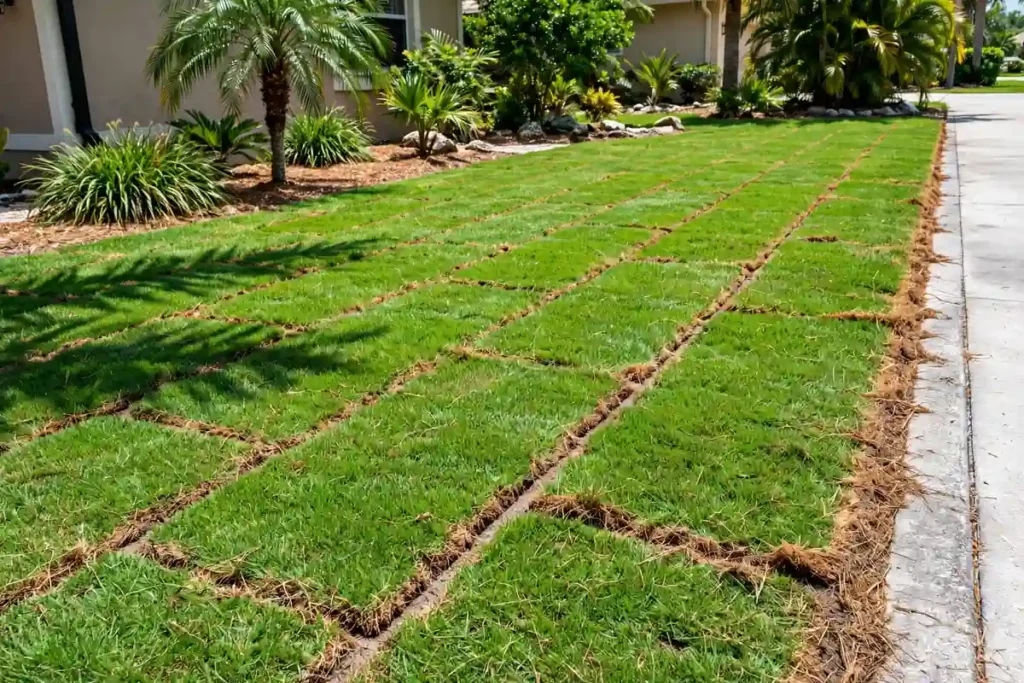
St. Augustine spreads by runners, so thin areas often fill in during the growing season if enough healthy runners and crowns remain. Wide dead areas may need plugs or sod, and if the damage is broad, our 10 signs your lawn needs repair can help you judge the scale of the job.
Thicker turf resists the next round of pests better than thin turf. Our guide on how to make St. Augustine grass thicker covers the mowing, watering, and feeding habits that build density over time.
Preventing Future Lawn Caterpillar Problems
Healthy, dense turf is your best guard. Keep the mowing height up, avoid scalping, and keep thatch in check so larvae have fewer places to hide.
Water by need, not by habit. Lawns that stay wet at night invite disease, and lawns that stay dry invite stress, so water early in the day and let the soil dry between waterings.
Feed with care. A steady, seasonal feeding plan builds strong grass, while heavy nitrogen at the wrong time can push soft growth that caterpillars favor.
Walk your lawn each week in late summer and fall. Catching fresh chewing early means a small fix, not a wide repair, so note the spots that had damage this year and check them first next year.
Conclusion
Sod webworms and armyworms can rough up a St. Augustine lawn fast, but they leave clear signs. Chewed blades, frass, and a flush test tell you what you are dealing with, so confirm the pest, treat only when the count and the damage call for it, and give the grass good care while it fills back in.
Not sure what is damaging your St. Augustine lawn? Ask Dreamscapes Florida about a lawn inspection or a lawn maintenance plan. We serve Palm Coast, Flagler Beach, Bunnell, Ormond Beach, and St. Augustine. Call us at (386) 237-2983 and we will take a look.
Frequently Asked Questions
Sod webworm damage can appear as irregular thinning or brown patches with grass blades that look chewed or clipped. Small green pellets and caterpillars may be found around the thatch or soil surface. Inspect the edge of fresh damage and confirm larvae before choosing a treatment.
Look for fresh chewing damage, thinning turf, and caterpillars near the damaged area. Armyworm feeding can progress quickly, but brown patches alone do not confirm the pest. Inspect the grass closely, use a verified scouting method, and compare larvae with UF/IFAS identification guidance.
A soap flush can bring hidden caterpillars to the surface for inspection. Use the exact area size, soap type, and dilution recommended by UF/IFAS, apply it to a small suspect section, and watch for larvae to emerge. Do not substitute an unverified detergent recipe or treat the test as pesticide control.
No. Sod webworms and armyworms are different caterpillar pests, although both can feed on turfgrass and cause chewing damage. Their appearance, behavior, and seasonal patterns can differ. Inspect larvae rather than relying only on moth sightings, and use an extension identification guide if the species is unclear.
St. Augustine may recover if enough healthy runners and growing points remain and the growing season supports regrowth. Recovery takes time and depends on feeding severity. After confirming and addressing the cause, follow appropriate mowing, irrigation, and seasonal nutrition guidance.
No. Moths alone do not prove damaging larvae are present. Inspect for caterpillars and fresh feeding first, then use only a product labeled for the confirmed pest and turf site. Follow the complete label and current UF/IFAS guidance; avoid unnecessary applications.