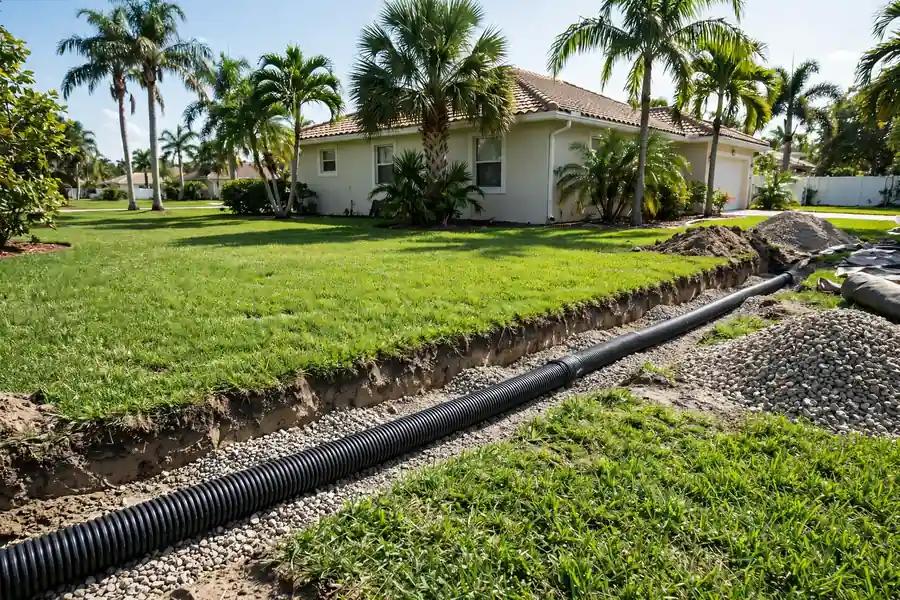
A professionally installed exterior French drain in Florida may cost roughly $20 to $50 per linear foot as a planning range. A 50-foot drain could fall around $1,000 to $2,500 before added parts or tough site work. Depth, soil, sod removal, catch basins, and the discharge point can change the final quote.
Those figures are planning numbers, not a quote from us and not a verified Palm Coast average. They come from widely published national cost guides. The real price depends on drain length, trench depth, soil, and the outlet.
This guide covers each piece in plain terms: per-foot pricing, totals by yard size, cost drivers, Florida conditions, and alternatives. If you want the short version of how the system works, read our guide on what a French drain is first.
How Much Does a French Drain Cost in Florida?
For most Florida homes, the drain in question is an exterior yard drain. It sits in a gravel trench and carries soil water to a safe outlet. That is the system this guide prices. Interior systems, the kind that run inside a basement or along a foundation footer, are a different job, and their prices should not be mixed with yard-drain prices.
The $20 to $50 range covers a standard exterior install: trench, pipe, gravel, fabric, and surface repair. Catch basins, downspout tie-ins, pop-up emitters, pumps, and wide sod replacement can sit outside that range. Price also moves with the job itself. A short run costs less than a long run, and a shallow trench in open lawn costs less than a deep trench under a walkway. If a small machine cannot reach the work area, hand digging adds labor hours.
French Drain Cost Per Linear Foot
The $20 to $50 per linear foot range is broad for a reason. Published cost guides do not all measure the same job. Some count only pipe and gravel. Others count excavation, fabric, and fittings too. A trench 12 inches deep takes less digging than one 24 inches deep, and deeper trenches need more gravel to fill.
Soil plays a part too. Loose sand digs fast. Wet, compacted ground digs slow and can need more hauling. Sandy soil does not always mean a cheap job. A clay layer below the sand can change the plan entirely. Compare equal scopes. A $25 per-foot quote that leaves out basins and outlet work is not cheaper than a $40 quote that includes them.
Interior vs. Exterior French Drain
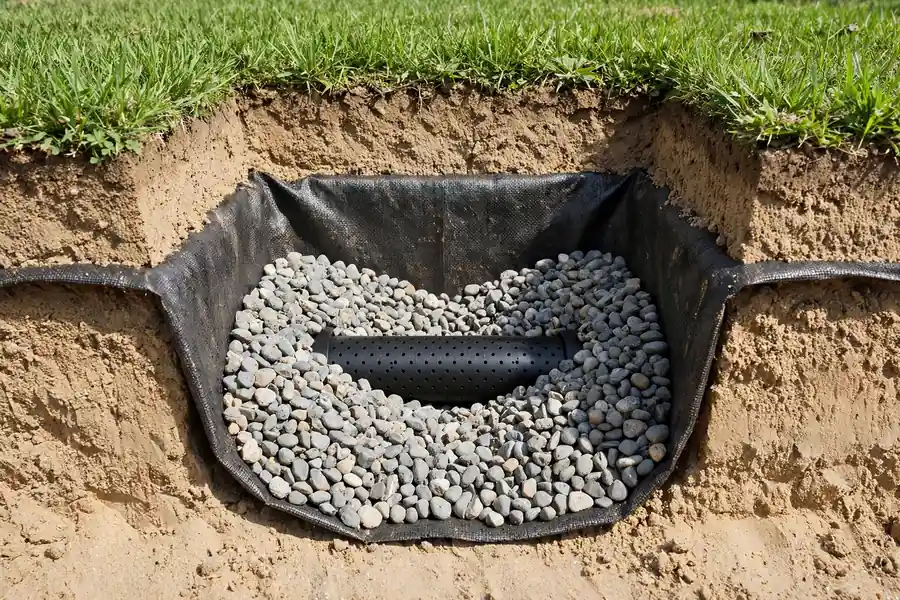
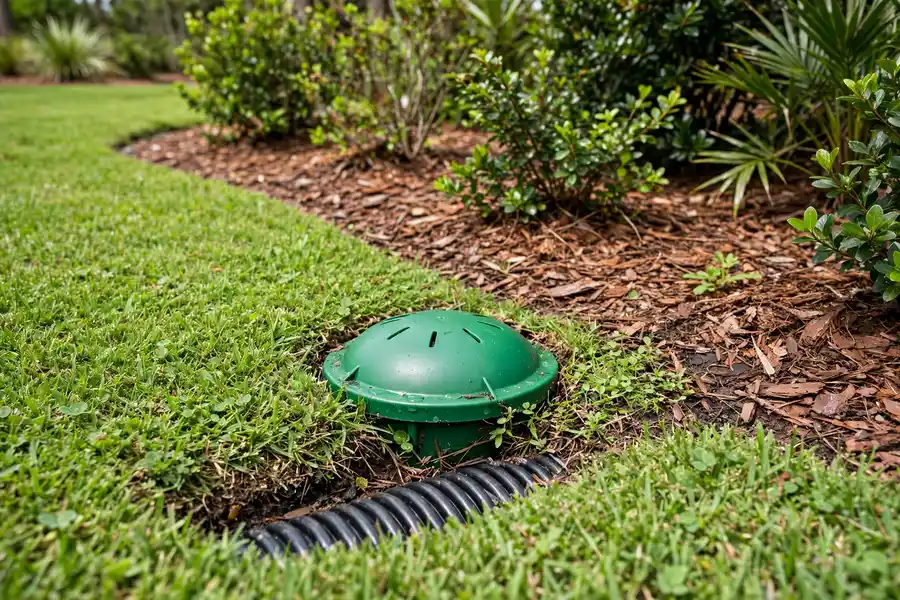
An exterior French drain works in the yard. The crew digs a trench, sets perforated pipe in gravel, wraps it in fabric, and restores the lawn or bed above it. The pipe carries water to a discharge point like a swale or a pop-up emitter.
An interior French drain works inside a home, usually along a basement wall or a foundation footer. It can call for cutting concrete, breaking a floor edge, and adding a sump pump. Labor runs higher, and the system protects the structure rather than the yard. Florida homes rarely have basements, so most homeowners here will only ever price the exterior kind.
French Drain Cost by Yard Size
Drain length, not lot size, sets the price. A large lot with one small wet corner may need only 25 feet of drain. A modest lot with water crossing the whole backyard may need 100 feet or more. That length is your starting point.
The table below shows simple totals using the $20 to $50 per linear foot planning range. These are arithmetic examples, not quotes. Pumps, extra basins, and wide sod replacement sit outside these totals.
| Drain length | At $20 per foot | At $50 per foot |
|---|---|---|
| 25 feet | $500 | $1,250 |
| 50 feet | $1,000 | $2,500 |
| 75 feet | $1,500 | $3,750 |
| 100 feet | $2,000 | $5,000 |
| 150 feet | $3,000 | $7,500 |
Use the table as a starting point, then adjust for your site. A 50-foot run through open lawn will sit near the low end. The same 50 feet through a tight side yard with two catch basins will sit near the high end.
Want to know what your yard’s drainage project may cost? Contact Dreamscapes Florida for a free estimate based on your property’s layout and drainage conditions, or call us at (386) 237-2983.
What Raises the Cost of French Drain Installation?
Depth is the first cost driver. A shallow drain moves less soil and less gravel. A deep drain moves more of both, and the crew spends more hours on the trench. Length is the second driver. Every extra foot adds pipe, gravel, fabric, and labor.
Soil and access come next. Wet, compacted ground slows digging. A yard that a small machine cannot reach forces hand digging. Sod removal and hauling add cost too. The crew must cut the sod, haul out extra soil, and restore the surface when the pipe is in.
Parts add cost in pieces. A catch basin collects surface water. Downspout tie-ins connect roof water. Fittings join pipe runs and turns. A pop-up emitter lets water out at the lawn edge. No single part costs much, but three or four together can move a quote by hundreds of dollars. The fabric that wraps the gravel matters too, and our guide to landscape fabric for French drains explains which types hold up. One more cost sits off the trench entirely: the discharge point. A drain with nowhere to send water is a trench full of gravel. If the outlet needs grading, a longer pipe run, or a pump, that work joins the quote.
Florida-Specific Factors That Affect Cost
Florida yards start with sand, and sand digs easy. That alone does not set the price. Below the sand, some lots hold a clay layer that blocks water from moving down. A drain must be planned around that layer, and the trench may need to run longer to reach a workable outlet. Only a look at the actual soil on the property can tell.
Heavy summer rain shapes the design too. A drain sized for a light shower will fail in a July storm. The system must handle real runoff from the roof, the driveway, and nearby lots. A high seasonal water table adds another limit. In some areas the ground water rises close to the surface for part of the year, and a drain set below that level will sit in water instead of moving it. This is site-specific, not a rule for every Palm Coast yard.
Palm Coast and Flagler County Yards
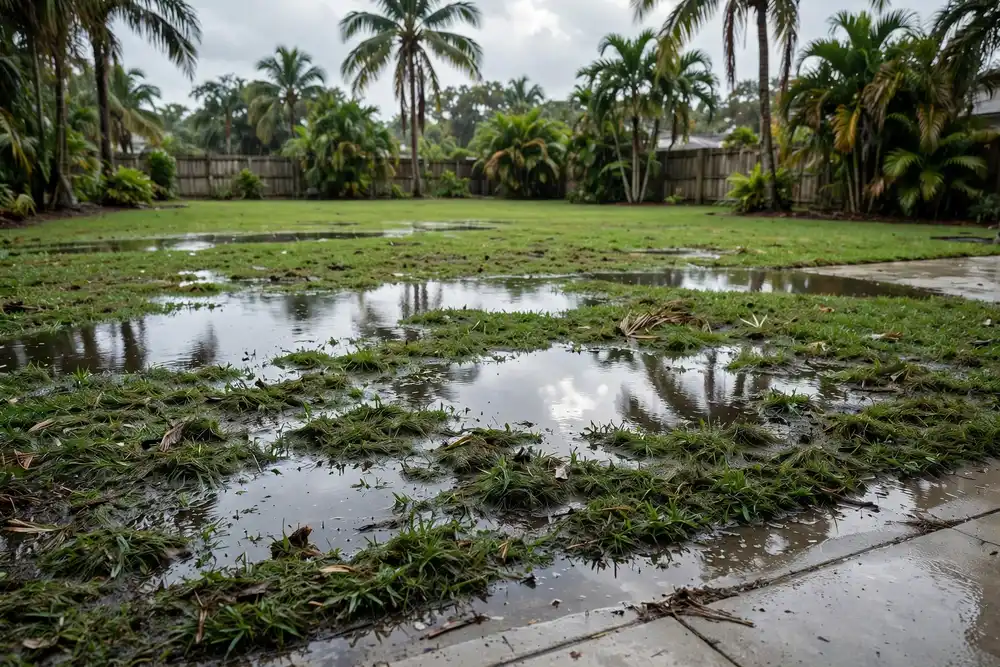
Palm Coast yards often show the same three patterns. Low spots hold water after rain because the grade dips. Runoff from a higher lot next door pools where the grade flattens. Newer homes can settle after construction until water finds the patio or the walkway. Each pattern points to a different fix, so the slope and the outlet get checked before anyone recommends a drain. The price follows the fix, not the other way around.
French Drain vs. Other Yard Drainage Solutions
A French drain suits water that moves through the soil or sits in low ground. It is not the only tool, and it is not the best tool for every yard. The right choice depends on where the water comes from.
A surface or trench drain catches water that runs across a patio, a driveway, or a walkway. It works fast for hard surfaces. A swale is a shallow grass channel that moves surface water across the yard. It costs less than a buried pipe. Regrading reshapes the yard so water flows away from the house on its own. When the problem is surface runoff and the lot can be reshaped safely, regrading may cost less than a drain.
A rain garden holds water in a planted basin and lets it soak in slowly, which suits yards with space and soil that drains well. Our guide to rain gardens in Florida shows where that option fits and where it does not. Some yards mix two solutions. A swale can carry surface water to a French drain that handles the soil water. The point is to match the fix to the water. For a side-by-side look, read our comparison of French drains and dry creek beds.
DIY vs. Professional Installation
A short, shallow drain in open lawn can suit a skilled homeowner with time and the right tools. The work calls for digging a true slope, laying pipe with the holes facing down, bedding it in gravel, wrapping it in fabric, and restoring the surface. A rented trencher speeds the digging. The pipe needs a steady fall toward the outlet, about one inch per eight feet.
Long runs call for a pro. So do drains near a foundation, drains on a complex slope, drains where the water table runs high, and drains where the outlet is unclear. A poor slope or a bad outlet leaves the yard just as wet as before. A contractor also handles utility locating before digging. For a short run in open lawn, DIY can make sense. For a long run past a patio with basins and a street outlet, hire a crew.
Signs Your Florida Yard May Need a French Drain
The clearest sign is water that stays. Puddles that sit for a day after rain, a lawn that stays soft underfoot, and soggy patches after every storm all point to water with nowhere to go. Water near a patio or foundation edge is a stronger sign.
Look for the pattern, not just the puddle. Roof runoff points to gutters and downspouts. Water that sheets across the lawn points to grading. Water that seeps up from below points to soil water, and that is where a French drain earns its keep. The cause gets checked before the fix gets picked. Our guide on how to fix a muddy backyard walks through those checks.
How to Get an Accurate Quote
Start with a written scope. Ask for the drain length, trench depth, pipe and gravel type, basin count, outlet location, excavation, and restoration, all in writing. A quote that lists those items can be compared with another that lists the same items. A quote that lists only a per-foot price cannot be compared with anything.
Ask about the extras before you agree to anything. Find out whether utility locating is included and who handles sod replacement and hauling. Clear answers now prevent surprise charges later. Compare equal scopes, not only per-foot prices. A $30 per-foot quote that includes basins, outlet work, and full restoration can beat a $22 per-foot quote that leaves those items out. Then pick the contractor whose plan fits your yard, not the one with the lowest first number.
Need to know what your yard’s drainage project may cost? Contact Dreamscapes Florida for a free estimate based on your property’s layout and drainage conditions, or call us at (386) 237-2983. We have served Palm Coast, Flagler Beach, Bunnell, Ormond Beach, and St. Augustine since 2015. We will walk your yard, find where the water comes from, and give you a straight answer.
Frequently Asked Questions
A professionally installed exterior French drain may cost around $20–$50 per linear foot as a general planning range. A 50-foot installation could fall around $1,000–$2,500 before unusual site work or added components. Actual pricing depends on depth, access, soil, outlet design, and restoration.
A 50-foot exterior French drain may cost approximately $1,000–$2,500 using a $20–$50 per-foot planning range. This is not a guaranteed quote. Deeper excavation, sod replacement, catch basins, downspout connections, and difficult access can increase the total project cost for the finished job.
It can help when recurring groundwater or persistently soggy areas are the problem and the site has a suitable outlet. Some yards need grading improvements, surface drains, or another solution instead. A site assessment helps identify the water source before choosing a system.
Not necessarily. Sandy soil can be easier to excavate in some locations, but the full soil profile matters. A clay layer, poor outlet elevation, or high seasonal water table can complicate drainage. Assess actual site conditions rather than pricing by soil type alone.
Regrading may cost less when the problem is surface runoff and the yard can be reshaped safely. A French drain may suit subsurface water or persistently wet areas. The right comparison depends on the cause of the problem and the available outlet.
A small project may suit an experienced DIY homeowner, but professional assessment is sensible for long trenches, foundation concerns, difficult grading, or uncertain discharge locations. Palm Coast site conditions vary, so the design should be based on the individual property.