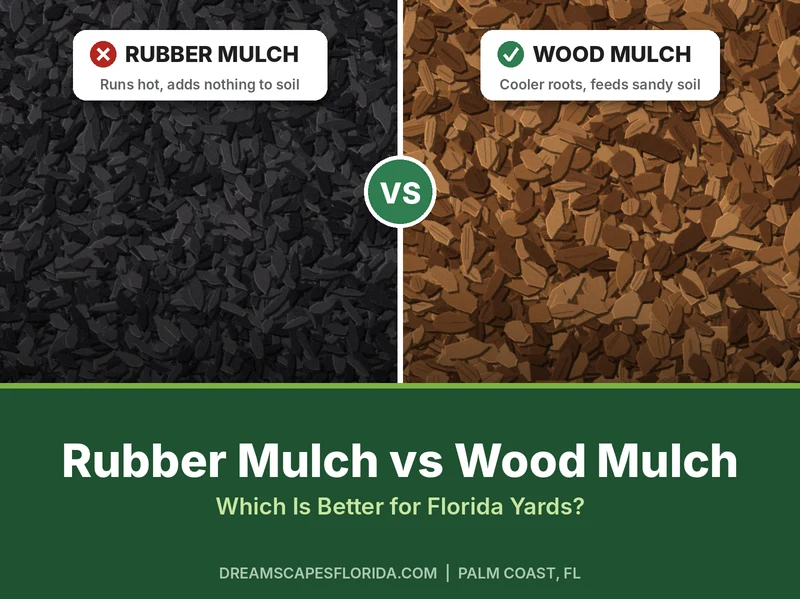
For most Florida landscape beds, wood mulch is the better choice. It keeps roots cooler, holds moisture in sandy soil, and breaks down into organic matter your plants can use. Rubber mulch lasts longer, but it gets very hot in our sun and adds nothing to the soil. Save it for playgrounds and play areas.
Walk through almost any neighborhood in Palm Coast and you will see both. Some homeowners pick rubber because the bag says it lasts ten years. Others stick with pine straw or bark because that is what the yard has always had. Both choices make sense on paper. In a Florida bed with sandy soil, long summers, and weekly watering limits, they perform very differently. This guide walks through what we see in real Flagler County yards so you can pick the right one the first time.
Rubber Mulch vs Wood Mulch at a Glance
| Factor | Rubber Mulch | Wood Mulch |
| What it is made of | Shredded recycled tires | Bark, wood chips, or pine needles |
| How long it lasts | Many years, does not break down | 6 months to 3 years, depending on type |
| Up-front cost | Several times more per bag | Low, and pine straw is often the cheapest |
| Heat in summer sun | Can pass 150°F on the surface | Stays much cooler |
| Effect on soil | Adds nothing, can leach zinc | Breaks down and builds organic matter |
| Moisture | Holds very little water | Holds water and slows evaporation |
| Fire risk | Ignites easily and burns hot | Varies by type, generally lower |
| Best use | Playgrounds and play areas | Planting beds, trees, and shrubs |
Why Wood Mulch Works Better in Florida
Sandy soil needs organic matter
Most yards in Palm Coast, Bunnell, and Flagler Beach sit on fine, sandy soil. Water drains through it fast and nutrients wash out with it. Wood mulch helps fix that slowly. As the bottom layer breaks down, it adds organic matter that holds water and feeds soil life. If you are building up a new bed, our guide to topsoil vs garden soil for Florida yards explains what to put under the mulch. Rubber never breaks down, so the soil under it stays exactly as poor as the day you spread it.
It keeps roots cooler
Florida summers are long. From May through September, bare soil in full sun gets hot enough to stress shallow roots. A layer of wood mulch shades the soil and keeps it cooler and more even. Dark rubber mulch does the opposite. It soaks up heat and can pass 150°F on the surface on a summer afternoon. That heat sits right on top of the root zone of your shrubs and bedding plants.
It stretches every watering day
Flagler County is in the St. Johns River Water Management District. Under its rules, most homes can water lawns and beds only twice a week during Daylight Saving Time and once a week during Eastern Standard Time. Wood mulch slows evaporation, so the water you put down lasts until the next allowed day. Rubber holds almost no moisture, which means beds under it dry out faster between waterings.
The Problems With Rubber Mulch in Florida
It gets very hot
Rubber mulch is usually dyed black, brown, or red, and it holds heat. In full Florida sun it can get hot enough to burn bare skin. That matters for plants, pets, and kids walking across a bed barefoot.
It adds nothing to the soil
Rubber does not rot, so it never feeds the soil. Lab tests have also found that water running through tire rubber picks up zinc. Small amounts are not a big deal, but heavy rain, warm weather, and acidic soil all speed this up. Over years, that can build up around plant roots.
It catches fire easily
In a university extension fire test of 13 common landscape mulches, ground rubber caught fire every time it was exposed to a flame and had to be put out by hand. Pine bark and shredded hardwood were among the more fire-resistant options. During a dry Florida spring, that difference is worth thinking about near your home.
It is almost impossible to remove later
Rubber pieces work their way into the soil, the lawn edge, and the mower deck. If you change your landscape design in five years, you will be picking out bits of tire by hand. Many people choose rubber because they want a bed that needs less work. If that is your goal, a smart plant layout does more than rubber ever will. Our list of low-maintenance landscaping ideas is a better place to start.
Best Wood Mulch Types for Palm Coast and Flagler County
Not all wood mulch is the same. These are the types that work well in our area, based on UF/IFAS Florida-Friendly Landscaping guidance and what holds up in local yards:
- Pine straw: Light, cheap, and easy to spread. It knits together, so it stays put on slopes. It breaks down quickly, so plan to top it off every 6 to 12 months. It also suits azaleas and camellias, which like slightly acidic soil.
- Pine bark nuggets: A good all-around mulch that lasts about two to three years. Large nuggets can float in a heavy storm, so use mini nuggets near drains and low spots.
- Eucalyptus mulch: Made from Florida-grown trees. It breaks down slowly and has a clean, even look.
- Melaleuca mulch: Made from an invasive tree that the state is working to remove, so using it helps the environment. Some research suggests termites tend to avoid it.
- Skip cypress mulch: UF/IFAS advises against it because cypress is an important wetland tree and is often harvested in ways that are not sustainable.
Coastal yards need a little extra thought. In oceanfront homes in Flagler Beach and Hammock, strong wind can blow pine straw around, so a heavier bark mulch often stays put better. Pair it with salt-tolerant plants for Florida and the bed will handle salt spray much better.
When Rubber Mulch Does Make Sense
Rubber mulch has one strong use: play areas. It cushions falls, does not attract bugs, and does not need refilling every year. If you use it, buy a product made and tested for playground safety, and check the surface temperature on hot afternoons before kids play on it.
For paths, side yards, or areas with no plants, stone is usually a better long-term pick than rubber. It does not get as hot, does not leach anything into the soil, and looks natural. Our guide to pea gravel landscaping covers how to lay it so it does not sink into sandy soil.
How to Mulch Florida Beds the Right Way
The right mulch only works if it goes down correctly. Follow these steps:
- Spread 2 to 3 inches. Less than that will not stop weeds. More than that can keep water from reaching the roots.
- Keep it off tree trunks. UF/IFAS recommends leaving 12 to 18 inches of open space around tree trunks. Never pile mulch into a volcano around a tree.
- Give shrubs room. Leave 1 to 2 inches between the mulch and the base of each shrub.
- Stay off the house. Keep mulch a few inches below siding or stucco so you can spot termite tubes and keep the wall dry.
- Top it off on a schedule. Refresh in late winter before spring growth and again in fall after the rainy season.
Mulch is easiest to get right when a bed is first built. When our team handles landscape installation, we prep the soil, set the edging, and choose a mulch that fits the plants and the sun in that spot.
After that, the job is upkeep. Pine straw thins out and bark fades, especially after a wet summer. If you would rather not haul bags every season, ask about adding mulch refresh to your lawn maintenance plan so beds stay neat all year.
The Bottom Line
Rubber mulch saves you a few trips to the store, but Florida beds pay for it with hotter roots, drier soil, and no new organic matter. Wood mulch needs topping off, yet it works with our sandy soil and watering limits instead of against them. For planting beds in Palm Coast, Ormond Beach, Flagler Beach, Bunnell, and St. Augustine, choose pine straw, pine bark, eucalyptus, or melaleuca. Keep rubber for the playground.
Need help picking the right mulch for your yard? Call Dreamscapes Florida at (386) 237-2983 for a free estimate.
Frequently Asked Questions
Rubber mulch is not ideal for planting beds. It gets very hot in full sun, holds little moisture, and can leach zinc into the soil over time. It also never breaks down, so it does nothing to improve sandy Florida soil.
No. Rubber gives termites nothing to eat. That said, termites in Florida are drawn to moisture near your foundation, not just to wood. Keep any mulch a few inches below siding and away from the slab so you can spot termite activity early.
Pine straw, pine bark, eucalyptus, and melaleuca are all good choices for Florida beds. UF/IFAS recommends organic mulches like these and advises against cypress mulch because cypress is an important wetland tree.
Spread mulch 2 to 3 inches deep. Keep it 12 to 18 inches away from tree trunks and 1 to 2 inches away from the base of shrubs.
Pine straw usually needs topping off every 6 to 12 months. Pine bark lasts about two to three years. Hardwood and eucalyptus mulch fall somewhere in between, depending on sun and rain.
Rubber mulch is common on playgrounds because it cushions falls well. Choose a product tested for playground use and check the surface temperature on hot days, since dark rubber can get hot enough to burn skin.