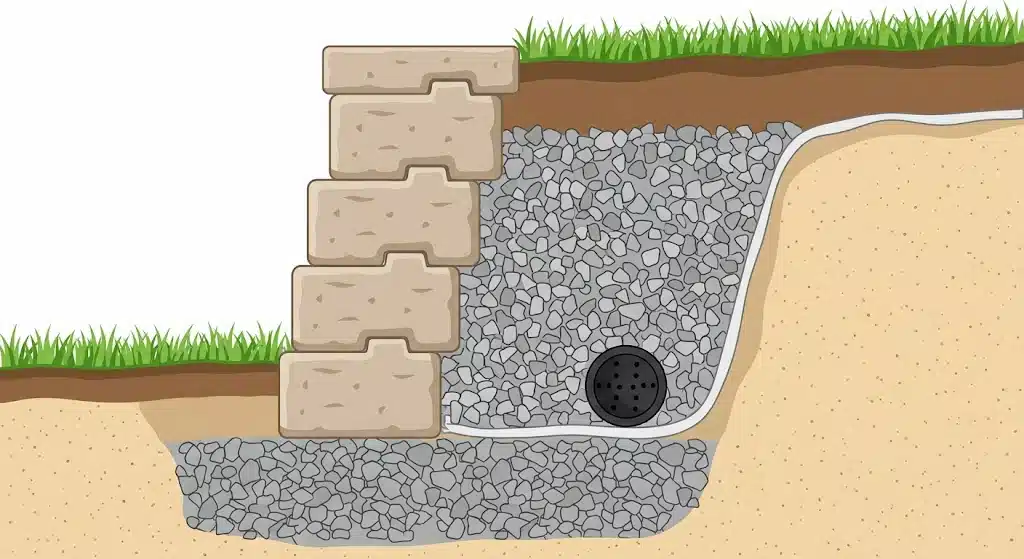
Every retaining wall in Florida needs a drainage system. Build it on a 4 to 6 inch compacted base of crushed stone, fill at least 12 inches behind the wall with clean #57 stone, run a 4-inch perforated pipe along the bottom, and line the sand with non-woven filter fabric. Skip the fabric and Florida sand will clog the gravel within a few rainy seasons.
Most retaining wall guides online come from builders in clay and frost country. They worry about freeze-thaw cracking and slow-draining soil. Here in Palm Coast and across Flagler County, the problem runs the other way. Our sand drains fast, moves easily, and washes right through a wall that was built to northern specs. This guide covers the right gravel for a retaining wall base, the drainage aggregate behind it, the backfill steps, and the Florida details that keep a wall standing through hurricane season.
Why Florida Retaining Walls Fail Differently
Water is the number one reason retaining walls lean, bulge, or collapse. Saturated soil pushes on a wall far harder than dry soil, and water alone weighs about 62.4 pounds per cubic foot. A good drainage system lets that water escape before it builds pressure.
Florida adds three twists that national guides rarely mention:
- Sand migrates. Fine Florida sand travels with water. It slips into the gaps between gravel stones, fills them, and then pours out through block joints. You see a small pile of sand at the base of the wall first, and a sunken spot behind it later.
- Rain arrives all at once. Northeast Florida gets roughly 50 inches of rain a year, and much of it falls in summer afternoon storms and tropical systems. A wall that handles a slow drizzle can fail after two inches of rain in an hour.
- The water table sits high. Near the Intracoastal, the canals, and low lots, groundwater can rise close to the surface in the wet season. That means water pushes on the wall from below as well as from behind.
Irrigation adds a fourth source that most homeowners overlook. A rotor zone that sprays onto the slope above a wall can soak the backfill every single morning. If you plan a wall near an existing sprinkler zone, have an irrigation technician in Palm Coast adjust or convert the heads before the wall goes in.
Florida Retaining Wall Drainage Specs at a Glance
| Component | What to Use | Why It Matters in Florida |
| Base layer | 4 to 6 inches of compacted crushed stone or crushed concrete | Sand alone shifts under load; angular stone locks together |
| First course depth | Bury about 10% of wall height, 6 inches minimum | Keeps the toe from washing out in heavy rain |
| Drainage aggregate | At least 12 inches of clean #57 stone behind the wall | Gives water a fast path down instead of pushing outward |
| Filter fabric | Non-woven geotextile between native sand and gravel | Stops sand from clogging the gravel and washing through joints |
| Drain pipe | 4-inch perforated pipe at the base, sloped at least 1% | Carries water out to daylight during summer downpours |
| Top cap | 6 to 8 inches of compacted native soil or topsoil | Keeps surface runoff from pouring straight into the gravel |
Best Gravel for a Retaining Wall Base
The base carries the full weight of the wall, so it needs stone that compacts hard and stays put. Use crushed stone with angular edges, such as crushed concrete, graded base rock, or a crusher run mix with some fines. Spread it 4 to 6 inches thick, wet it lightly, and compact it with a plate compactor in 2-inch layers. Taller walls may need 8 inches. Our guide to gravel types for landscaping shows how these materials compare in color and size.
Why Pea Gravel and Beach Sand Fail as a Base
Pea gravel looks clean and drains well, but its round stones roll under pressure. A wall built on pea gravel slowly shifts and tilts. Beach sand or fill sand has the same problem, plus it washes away. Save pea gravel for garden paths and keep it out from under your wall.
Drainage Behind a Retaining Wall: Choosing the Aggregate
Behind the wall, you need a different job from your stone. The base must compact. The drainage zone must stay open so water can fall through it. The best drainage aggregate for a retaining wall is clean #57 stone, which runs about 3/4 to 1 inch. It has no fines to fill the gaps.
- Width: At least 12 inches directly behind the blocks. Go to 18 inches for walls over 4 feet or on lots with heavy runoff.
- Height: Fill the gravel zone to within 6 to 8 inches of the top of the wall.
- Compaction: Tamp it lightly. Heavy compaction is for the base and the soil zone, not the drainage stone.
- Cap: Finish with 6 to 8 inches of compacted native soil so rain runs off the surface instead of straight into the gravel.
Filter Fabric: The Step Florida Walls Cannot Skip
Here is where most national advice goes wrong for Florida. Many guides call filter fabric optional. In clay soil, it often is. In our sand, it is the difference between a wall that lasts 25 years and one that sheds sand after its third summer.
Line the cut face of the native sand with non-woven geotextile fabric before you add any gravel. Let it run under the drainage zone and fold back over the top of the gravel before you add the soil cap. This wraps the stone in a sleeve that lets water in and keeps sand out. Use non-woven fabric rated for drainage, not the thin woven weed barrier sold for flower beds. Woven fabric clogs fast in fine sand.
How to Backfill a Retaining Wall Step by Step
- Excavate. Dig the trench for the base and cut back the slope so you have at least 12 inches of working room behind the wall line.
- Line with fabric. Lay non-woven fabric along the back cut and the trench, leaving extra to fold over the top later.
- Build the base. Add crushed stone in 2-inch layers and compact each one until the base is 4 to 6 inches thick and level.
- Set the first course. Bury it about one-tenth of the wall height, with 6 inches as the minimum.
- Lay the drain pipe. Place a 4-inch perforated pipe behind the first course, holes facing down, sloped toward an outlet.
- Add courses and gravel together. Stack one or two courses, fill behind them with #57 stone, tamp lightly, and repeat. Never stack the whole wall and backfill at the end.
- Add geogrid if needed. Taller walls usually need geogrid layers between courses that extend back into the compacted soil.
- Fold and cap. Fold the fabric over the gravel, then add 6 to 8 inches of compacted soil and grade it to slope away from the wall.
Perforated Pipe and Weep Holes
The drain pipe behind a retaining wall is often called a toe drain or French drain. Use a 4-inch perforated pipe wrapped in a fabric sock, laid at the base behind the first course. Slope it at least 1%, which equals about 1/8 inch per foot, and run it to daylight at the end of the wall or every 30 to 50 feet on long walls. Do not tie it into a downspout line. Roof water overloads the pipe and sends extra water right where you do not want it.
Segmental block walls drain through the gaps between blocks, so they rarely need weep holes. Poured concrete and solid masonry walls do. Space 2 to 4 inch weep holes every 4 to 8 feet along the bottom, and keep them clear of mulch and sand.
Does a Small Retaining Wall Need Drainage?
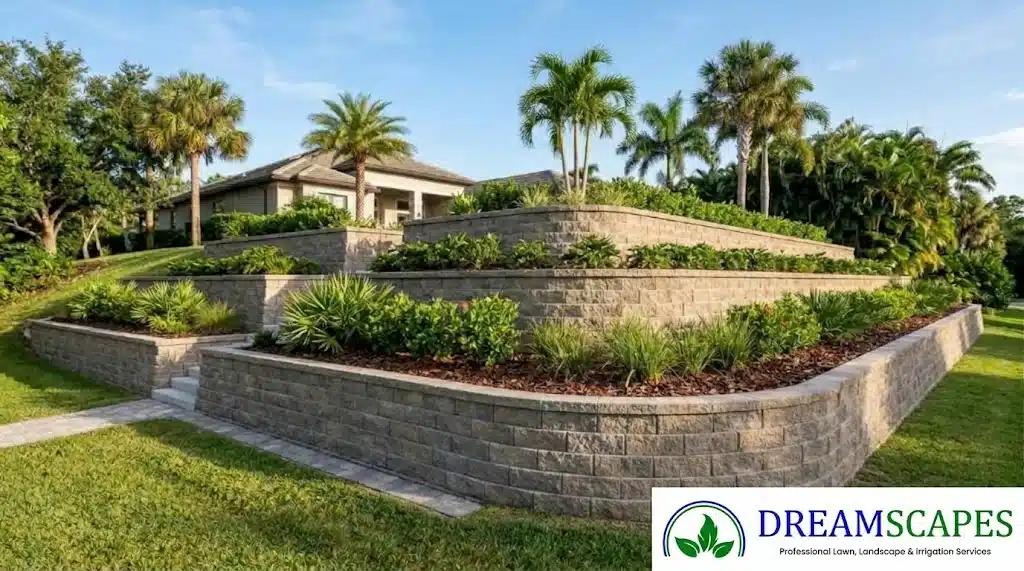
Yes, even a 2-foot garden wall needs gravel and fabric behind it in Florida. A short wall around a raised bed or a pool deck still holds back wet sand after every storm. For walls under about 2 to 3 feet on a well-drained lot, you can sometimes skip the pipe as long as the gravel zone and fabric are in place and water can escape at the ends. Short walls often anchor a raised planting area, so plan the drainage and the landscape design together instead of fixing one around the other.
Warning Signs Your Wall Drainage Is Failing
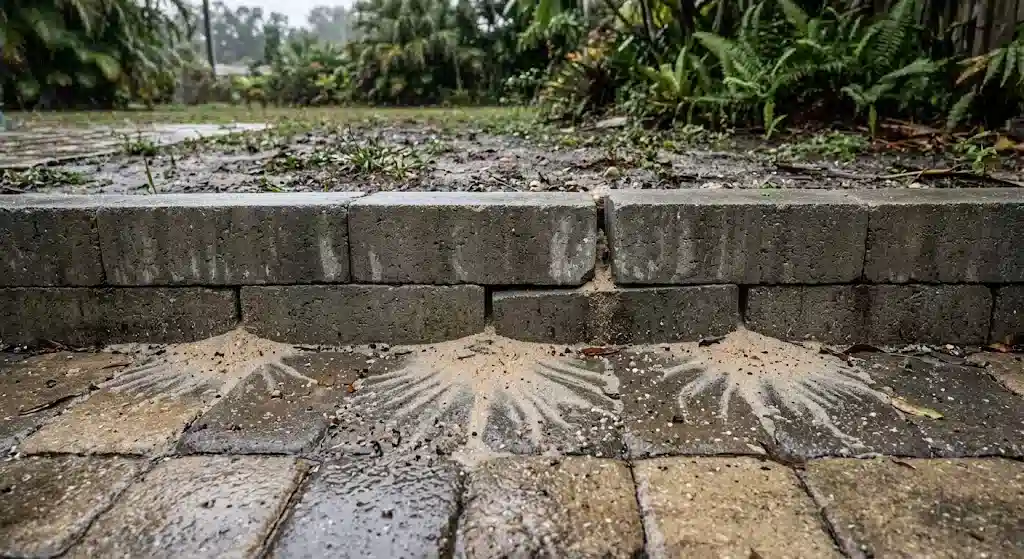
- Sand piles or streaks at the base of the wall or between blocks
- Sunken spots, holes, or soft ground behind the top of the wall
- Bulging in the middle of the wall face
- Leaning or blocks shifting forward
- Standing water or a soggy strip at the toe days after rain
- Nearby pavers or edging settling unevenly
- White or rust-colored staining on the wall face
Catch these early. A drainage fix costs far less than a full rebuild after a hurricane season.
Retaining Walls in Palm Coast and Flagler County
Palm Coast is mostly flat, so local walls look different from the hillside walls in national photos. Here, homeowners usually build walls for raised garden beds, pool deck grade changes, lots that slope toward the street, and planting terraces on canal-front yards. A seawall or bulkhead on a canal is a separate marine structure with its own rules, so keep your landscape wall set back from it.
Many Florida jurisdictions require an engineered design and a permit once a wall holds back about 4 feet of soil, or when it supports a driveway, pool, or structure. Rules vary, so check with the City of Palm Coast or Flagler County building department before you dig. For planting on top of the wall, choose drought-tolerant plants from the UF/IFAS Florida-Friendly Landscaping program so you water less and keep the backfill drier. If the area above the wall will be turf, plan your sod installation after the soil cap settles so the grass roots into firm ground.
DIY or Hire a Professional?
A handy homeowner can build a short retaining wall with drainage using the steps above, as long as it stays under 3 feet. Walls over 3 to 4 feet, walls near a pool or driveway, and walls on lots with a high water table need professional design, geogrid, and often an engineer. A failed wall can damage your home, your pool deck, or your neighbor’s yard.
Dreamscapes has built retaining walls, paver patios, and drainage systems across Palm Coast, Flagler Beach, Bunnell, Ormond Beach, and St. Augustine since 2015. Our hardscape design and installation team builds every wall with Florida sand and storm season in mind. Call (386) 237-2983 or request a free estimate to get started.
Frequently Asked Questions
Yes. Florida’s heavy summer storms, high water table, and loose sand make drainage essential for every retaining wall. At minimum, use 12 inches of clean gravel behind the wall and non-woven filter fabric between the gravel and the native sand.
Clean #57 crushed stone works best behind a retaining wall. Its angular 3/4 to 1 inch stones leave open gaps for water to drain. For the base under the wall, use a compactable crushed stone or crushed concrete instead.
Not directly against the wall. Sand moves with water and washes out through block joints. Keep a 12-inch zone of clean gravel wrapped in filter fabric behind the wall. Native sand can go behind that zone and in the top cap.
Use at least 12 inches of drainage gravel directly behind the wall. Increase it to 18 inches for walls taller than 4 feet or for yards that collect heavy runoff.
Yes. A 2-foot wall still needs gravel and filter fabric behind it in Florida sand. You can often skip the perforated pipe on short walls if water can escape at the ends of the wall.
The drain behind a retaining wall is called a toe drain, a French drain, or a footer drain. It is a 4-inch perforated pipe laid at the base of the gravel zone and sloped so water flows out to daylight