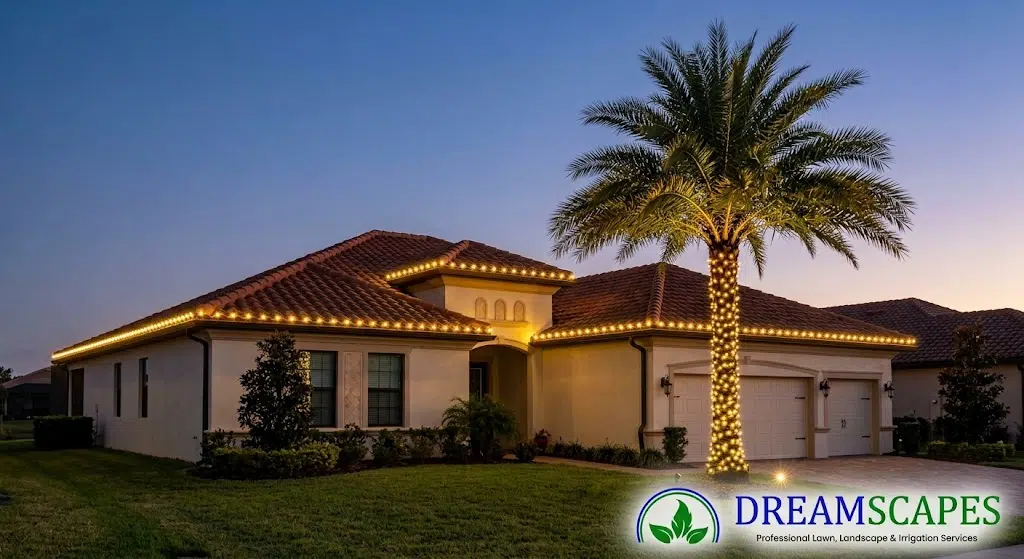
Professional Christmas light installation in Palm Coast usually costs $300 to $1,000 for a single-story home, and October is the best time to book. Florida homes need different gear than homes up north: sealed LED bulbs for salt air, clips that are safe for tile roofs, wraps that don’t harm palm trunks, and plugs kept clear of sprinkler spray.
Most holiday lighting advice online is written for places with snow. It talks about ice dams, frozen ground, and gutters packed with leaves. None of that matters much in Flagler County. Here, the problems are salt, water, tile, palms, and a lawn that is still alive in December. This guide covers what it costs, what goes wrong on Florida homes, and how to plan a display that stays lit until New Year’s.
Why Florida Christmas Lights Are a Different Job
The same weather that wears out year-round landscape lighting also wears out holiday strings. Heat, humidity, UV, and salty air all work on cheap sockets and plugs for six straight weeks. A string that lasts five seasons in Ohio can fail in one season on a house near the Intracoastal.
Florida houses are built differently, too. Many homes in Palm Coast, Ormond Beach, and St. Augustine have concrete barrel tile roofs and stucco walls. Big-box store clips are made for asphalt shingles and wood fascia. Use the wrong hardware on tile or stucco and you can crack a tile or open a path for water that you won’t find until the next summer storm.
What Christmas Light Installation Costs in Palm Coast
Most installers price by the linear foot of roofline, then add trees, shrubs, and walkways. National price guides from HomeAdvisor and Angi put the average job at about $444, with most homeowners spending between roughly $220 and $685. A typical single-story Palm Coast home has 150 to 200 feet of roofline, which lands most full-service jobs between $300 and $1,000.
| Service Type | Typical Price | What It Usually Includes |
| Labor only (your lights) | $2 to $5 per foot | Hanging lights you already own |
| Full service with lease lights | $5 to $10 per foot | Commercial LEDs, clips, cords, timers, takedown |
| Custom display | $8 to $15 per foot | Roofline plus palms, trees, shrubs, and walkways |
| Wrapping one palm or tree | $75 and up per tree | Trunk wrap; price rises with height |
| Permanent track lighting | $2,000 to $8,000 total | Year-round programmable LEDs mounted under the eaves |
Two-story homes, steep tile roofs, and tall palms raise the price because they take more ladder time and special clips. Waterfront homes in the Hammock or along the canals in Palm Harbor often fall in the upper range. These are national figures, so the only number that counts is a quote from an on-site measurement.
The 5 Florida Problems That Ruin Holiday Light Displays
1. Sprinkler Spray and Tripped GFCI Outlets
This is the number one service call in December. Outdoor outlets are GFCI protected, and a single wet plug connection will shut off the whole circuit. Your lights come on at dusk, your sprinklers run before sunrise, and by morning half the house is dark. Before you hang anything, walk your yard during a test run of your irrigation system and note which heads spray toward outlets, cord runs, and yard displays.
Timing helps. The St. Johns River Water Management District moves to once-a-week watering when Eastern Standard Time begins, which is Sunday, November 1, 2026. Homes with odd-numbered addresses water on Saturday, and even-numbered addresses water on Sunday, with no watering between 10 a.m. and 4 p.m. Once you know your day, you know when your connections will get wet. Keep every plug off the ground in a weatherproof cord box, and turn or cap any head that hits the house.
2. Salt Air Near the Coast
Homes within a few miles of the ocean in Flagler Beach, Beverly Beach, and along A1A see sockets turn green and crusty in a single season. Corroded contacts cause flicker, then dead sections. Commercial-grade C9 and C7 LEDs with sealed sockets hold up much better than thin retail strings. The same rule applies to the brass fixtures we use for landscape lighting in Flagler Beach, where salt exposure decides how long any outdoor light lasts.
3. Barrel Tile Roofs and Stucco Walls
Never nail, screw, or staple into tile or stucco. Each hole in stucco is a spot where rain can get behind the wall. On tile roofs, use tile clips that grip the edge of the tile without lifting it, or run lights along the gutter or drip edge with gutter clips. Never walk on barrel tile to reach a ridge. Concrete tile cracks under a person’s weight, and a cracked tile can leak for months before you notice.
4. Palm Trees
Palms are the signature of a Florida display, and they need different handling than oaks. A palm trunk does not heal over a wound the way a hardwood tree does, so every nail or staple leaves a permanent scar. Wrap trunks in a tight spiral and secure the strand with ties or tape, not hardware. For the fronds, aim a spotlight up from the base instead of draping strings over them. Heavy strings on fronds can bend or break them, and fronds are hard to reach safely without a lift on cabbage palms over 15 feet.
5. Yard Displays on St. Augustine Grass
Northern lawns are dormant under snow in December. Ours are not. An inflatable or large yard display that sits on St. Augustine grass for five or six weeks blocks sunlight and traps moisture. When it comes down in January, you often find a yellow or dead patch in its shape. St. Augustine cannot be grown from seed, so that patch has to fill in on its own or be fixed with new sod.
The easy fix is to keep heavy displays off the grass. Set them on a mulch bed, the driveway, or a paver patio or walkway from your hardscape, or move them a few feet each week. Before driving any stakes, flag your sprinkler heads, since lateral lines often sit only a few inches below the surface.
When to Book and When to Take Lights Down
Hurricane season runs until November 30, so most Florida homeowners wait until mid-November to hang lights. Installers know this, which is why their calendars fill up in October. Booking in October gets you a better install date. Most installs happen in the two weeks before Thanksgiving, which falls on November 26 in 2026. Takedown usually happens in the first two weeks of January.
If you live in a community with an HOA, such as Palm Coast Plantation, Grand Haven, or Hammock Dunes, check the rules before you book. Many HOAs set the earliest put-up date and the latest takedown date, and some limit inflatables or colored lights. If you’d rather not climb a ladder at all next year, permanent track lighting mounted under the eaves can be paired with your landscape lighting in Palm Coast and set to holiday colors with a phone app.
DIY or Hire a Pro?
DIY makes sense for a single-story home with a shingle roof, a few shrubs, and outlets that are easy to reach. Hire a pro if you have a two-story roofline, barrel tile, palms over 15 feet, or a long cord run across a lawn with active sprinkler zones. Ladder falls send thousands of people to the emergency room every holiday season, and tile roofs are harder to work on than shingle. A good installer also brings sealed commercial bulbs, handles the takedown, and comes back if a section goes dark.
Frequently Asked Questions
Most single-story homes in Palm Coast cost between $300 and $1,000 for full-service installation, based on national per-foot pricing of $2 to $10. Two-story homes, tile roofs, and palm wraps add to the price. An on-site measurement gives you the real number.
Book in October. Most Florida installs happen in mid to late November after hurricane season winds down, and good dates fill up early. Waiting until December often means a late install or no opening at all.
In Florida, the most common cause is water on a plug connection from sprinklers, dew, or rain. GFCI outlets shut off when they sense moisture. Keep connections off the ground in weatherproof boxes and adjust any sprinkler heads that spray toward outlets or cords.
Yes, with the right clips. Use tile clips or gutter clips that don’t require nails or screws, and avoid walking on barrel tile. Concrete tiles crack easily under foot traffic and can cause leaks.
Yes, if you wrap the trunk without nails or staples. Palm trunks don’t heal over wounds, so hardware leaves permanent damage. Secure strands with ties and use an uplight for the fronds instead of hanging strings in the canopy.
They can. Large displays left on St. Augustine grass for several weeks block sunlight and can leave yellow or dead patches. Place them on mulch, pavers, or the driveway, or shift them every week.
Get Your Holiday Lights Up Without the Ladder
Dreamscapes Florida installs holiday and landscape lighting for homes in Palm Coast, Flagler Beach, Bunnell, Ormond Beach, Daytona Beach, and St. Augustine. We know Florida rooflines, palms, and irrigation systems, so your display stays lit and your lawn stays green. Call (386) 237-2983 or request a free estimate to reserve your install date before the November rush.