If you’ve searched for “landscape fabric for french drain” or “landscaping fabric for french drain,” there’s a good chance you’re standing in the lawn aisle right now, staring at two or three rolls of black fabric, wondering which one is actually right for the job. Here’s the uncomfortable truth we wish more homeowners knew before they started digging: the fabric labeled “landscape fabric” at most home improvement stores is not the same product professional contractors use inside a French drain. Using the wrong one is the single most common reason we get called out to repair a drain that “stopped working” twelve to eighteen months after a homeowner installed it themselves.
We’ve installed and repaired French drains all over Palm Coast, Flagler Beach, and Ormond Beach for years, and our soil here makes this distinction matter more than almost anywhere else in the country. Florida’s fine, loose sand migrates through fabric pores that would hold up fine in clay-heavy soil up north. So this guide isn’t a rehash of generic drainage advice – it’s what we’ve learned from pulling failed drains back out of the ground and seeing exactly what went wrong.
Quick Answer
The correct fabric for a French drain is non-woven geotextile filter fabric, not standard woven “landscape fabric” sold for weed control. Non-woven geotextile (typically 4–8 oz per square yard) lets water pass through while filtering out fine soil particles, preventing the drain rock and pipe from clogging with silt over time. Woven weed-barrier fabric has tighter, more uniform pores designed to block plant growth, not filter water-borne sediment, and it tends to clog faster in sandy or silty soils like ours in Palm Coast.
What Is Landscape Fabric for a French Drain?
Short answer: It’s a permeable fabric layer wrapped around the gravel and/or pipe inside a French drain trench. Its job is to let water flow through freely while blocking soil, sand, and silt from entering and clogging the drainage system.
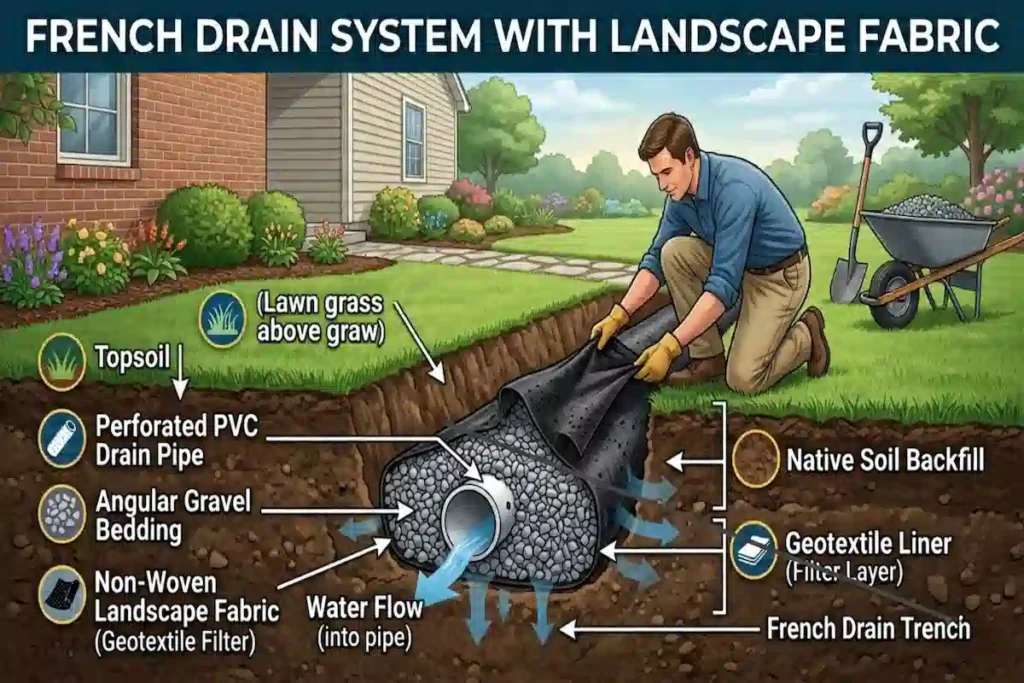
A French drain, at its core, is simple: a sloped trench filled with gravel, usually with a perforated pipe running through the bottom, that collects and redirects groundwater or surface runoff away from a structure or low area. The fabric’s role is often misunderstood. It doesn’t drain water itself — the gravel and pipe do that. The fabric’s only job is filtration: keeping the system clean so it keeps working five, ten, twenty years from now instead of silting up after a couple of rainy seasons.
In the industry, this material is almost always called geotextile fabric or filter fabric, not “landscape fabric.” Homeowners search for “landscape fabric” because that’s the term they’re familiar with from garden centers, and search engines have learned to connect the two — but the actual product specification is different, and that gap is exactly where most DIY French drains go wrong.
From our experience: On a re-dig in a Palm Coast backyard last year, we pulled up a drain that had been installed eighteen months earlier with standard black woven landscape fabric from a hardware store. The fabric itself hadn’t torn — but a layer of fine sand had packed against it so densely that almost no water was passing through. The homeowner had done everything else correctly: proper slope, good pipe, solid gravel. The fabric choice alone caused the failure.
Landscape Fabric vs. Landscaping Fabric vs. Geotextile: Is There a Difference?
Short answer: “Landscape fabric” and “landscaping fabric” are the same product, just different phrasing — both typically refer to woven weed-barrier fabric. “Geotextile” or “filter fabric” is the correct technical term for what’s actually used in French drains.
This is worth clearing up because the confusion costs homeowners real money. Here’s how the terms break down in practice:
| Term | What People Usually Mean | What It’s Actually Designed For |
|---|---|---|
| Landscape fabric / landscaping fabric | Woven black fabric sold near mulch and weed killer | Suppressing weeds under mulch beds |
| Geotextile fabric | Engineered synthetic fabric sold at drainage/contractor supply stores | Filtration, soil separation, drainage, erosion control |
| Non-woven geotextile | A specific geotextile type, felt-like texture | French drains, foundation drains, filtration applications |
| Woven geotextile | A specific geotextile type, tighter weave, higher strength | Soil stabilization under driveways, roads, retaining walls |
| Filter fabric | Generic contractor term | Usually means non-woven geotextile in drainage contexts |
| Sock / socked pipe | Perforated pipe pre-wrapped in fabric at the factory | An alternative to wrapping loose fabric in the trench |
When people type “landscape fabric for french drain” into Google, they’re really asking “what fabric do I use in a French drain,” and the honest, expert answer is: ask for non-woven geotextile filter fabric by name at a landscape supply yard, not the weed-barrier aisle at a big-box store. Some big-box stores do carry true geotextile under brand names like Typar or DeWitt Pro — just check the label specifically says “geotextile” or “filter fabric,” not “weed barrier.”
Key takeaway: If you remember nothing else from this article, remember this — ask for it by its real name. “Non-woven geotextile filter fabric” will get you the right product every time; “landscape fabric” alone often won’t.
Why French Drains Need Filter Fabric in the First Place
Short answer: Fabric prevents soil migration into the gravel and pipe, which is what causes most French drains to fail over time — not pipe damage, not poor slope, but slow clogging from the inside out.
Without fabric, surrounding soil — especially fine Florida sand — works its way into the gravel bed over time, particularly during heavy rain events when the soil around the trench becomes saturated and mobile. Once sand fills the gaps between the gravel, water can no longer move through it efficiently, and the drain effectively stops draining even though the pipe underneath is perfectly intact.
This is a bigger issue here than in many other parts of the country. Palm Coast and the surrounding Flagler County area sit on sandy, well-draining but loosely structured soil with a relatively high water table, especially close to canals and low-lying lots. That combination means soil particles move more freely than they would in denser clay soils, which is exactly the scenario filter fabric is designed to handle.
There’s an ongoing debate among contractors about whether fabric is always necessary. Some argue that in very coarse, gravelly native soils, fabric can be skipped. From our experience working specifically in Central Florida sand, we don’t recommend skipping it — the cost of the fabric is small compared to the cost of re-excavating a clogged drain two years later.
Types of Fabric Compared: Woven vs. Non-Woven vs. Socked Pipe
Short answer: Non-woven geotextile is the standard choice for residential French drains because it balances strong water flow with effective filtration. Woven geotextile offers more strength but less flow. Socked pipe is a convenient alternative that skips loose fabric installation entirely.
| Feature | Non-Woven Geotextile | Woven Geotextile | Socked (Pre-Wrapped) Pipe |
|---|---|---|---|
| Water flow rate | High | Lower | High (factory-applied non-woven sock) |
| Filtration of fine sand/silt | Good | Moderate, can clog on surface | Good |
| Tensile strength | Lower | Higher | N/A (depends on pipe) |
| Best use case | French drains, foundation drains | Under driveways, road base, retaining walls | Simple residential French drains |
| Typical weight | 4–8 oz/sq yd | Varies, often heavier | Pre-applied, usually 4 oz equivalent |
| Ease of DIY install | Moderate | Moderate | Easiest |
| Approx. cost | $0.15–$0.45/sq ft | $0.20–$0.55/sq ft | Pipe cost + $0.50–$1.50/linear ft premium |
For most residential French drains around homes, foundations, and yards, non-woven geotextile fabric in the 4 to 8 oz range is the sweet spot. Lighter weights (under 4 oz) tear too easily during installation and backfilling. Heavier weights (10 oz+) are typically overkill for residential drainage and are more common on commercial or civil projects.
Socked pipe — perforated pipe that arrives from the factory already wrapped in a fabric sleeve — has become popular because it removes a step from installation. We use it often on straightforward residential jobs where the trench is a single, simple run. For more complex systems with multiple junctions, catch basins, or dry wells tied in, we still prefer wrapping fabric around the gravel bed itself in addition to (or instead of) relying on the sock alone, because it protects the entire gravel envelope, not just the pipe.
From our experience: Socked pipe is a great time-saver, but it only filters water entering the pipe directly — it does nothing to keep sand out of the gravel surrounding it. On longer runs, we still wrap the trench in fabric even when using socked pipe, essentially giving the system two layers of protection.
Pros and Cons of Using Fabric in a French Drain
Short answer: Fabric extends the working lifespan of a French drain significantly and is inexpensive relative to the cost of the whole project, but it must be the correct type and installed correctly, or it can do more harm than good.
Pros
- Prevents soil and sand from clogging gravel and pipe, extending system life from a couple of years to a decade or more.
- Relatively low material cost compared to the rest of the project (gravel, pipe, labor, excavation).
- Reduces long-term maintenance and the need to re-excavate.
- Non-woven types allow strong water flow while still filtering effectively.
- Helps maintain consistent drainage performance through Florida’s heavy summer rain season.
Cons
- Wrong fabric type (woven weed barrier) can clog faster than no fabric at all in sandy soil.
- Improper installation (gaps, poor overlap, fabric resting directly on pipe perforations) can create new failure points.
- Fabric can still clog over time in extremely fine, silty soils if not paired with proper gravel sizing.
- Adds a small amount of labor time during installation, which matters on DIY budgets.
- Cannot fix an underlying design problem — fabric does not compensate for incorrect slope or undersized pipe.
Key takeaway: Fabric is a force multiplier, not a fix-all. The right fabric on a well-designed drain dramatically extends its life. The wrong fabric on a poorly designed drain can actually make problems worse by trapping water against the trench.
Common Mistakes Homeowners Make
Short answer: The most frequent and costly mistakes are using weed-barrier fabric instead of geotextile, wrapping the fabric too tightly around the pipe instead of lining the trench, skipping proper overlap at seams, and using the wrong gravel size alongside the fabric.
In roughly a decade of installing and repairing drainage systems across Flagler County, these are the issues we see again and again:
1. Using weed-control “landscape fabric” instead of geotextile. This is the mistake that started this whole article. It’s an easy one to make because the packaging language overlaps, but it’s the difference between a drain that works for two years and one that works for fifteen.
2. Wrapping fabric directly against the pipe instead of lining the trench. Some DIYers wrap fabric tightly around just the pipe, like a sock, then backfill with gravel and soil. This skips filtration for the surrounding gravel bed and tends to fail faster because soil migrates into the gravel from the sides and top of the trench, not just through the pipe perforations.
3. Skipping fabric overlap at seams. Fabric should overlap by at least 6 to 12 inches at every seam, with the upstream piece on top of the downstream piece in the direction of water flow. A common DIY shortcut — butting two pieces edge to edge without overlap — creates a gap where sand pours straight through.
4. Mismatching fabric and gravel size. Fine gravel paired with the wrong fabric weight, or coarse gravel that punctures lightweight fabric during backfill, both undermine the system. We typically pair non-woven 4–6 oz fabric with ¾ to 1.5 inch washed drain rock for most residential applications.
5. Not extending fabric high enough up the trench walls. Fabric should wrap up and over the gravel completely, like wrapping a burrito, with enough overlap on top to fully enclose the gravel before backfilling with soil. Cutting it short on the sides leaves an entry point for sediment from above.
6. Forgetting fabric needs a clean trench to work. Loose soil clods left in the trench bottom before laying fabric and gravel can puncture the fabric under the weight of backfill, or create voids that the fabric eventually sags into.
7. Ignoring slope before worrying about fabric at all. This isn’t strictly a fabric mistake, but we include it because we see it constantly: homeowners focus heavily on fabric and pipe brand while the trench itself has inconsistent slope. Fabric can’t compensate for water that has nowhere to go. A French drain needs a consistent minimum slope (commonly around 1% grade, or roughly a 1-inch drop for every 8 feet of run) to function at all.
From our experience: When we get called for a “failed French drain” inspection, more often than not the pipe and gravel are fine — the problem traces back to one of these fabric or grading mistakes made during the original install, whether that install was DIY or, occasionally, a rushed job by another contractor.
How to Install Step-by-Step Landscape Fabric for a French Drain
Short answer: Dig the trench to the correct slope, line it completely with non-woven geotextile fabric, add a base layer of gravel, place the pipe, cover with more gravel, then fold the fabric over the top of the gravel before backfilling with soil.
- Plan the route and slope. Identify where water needs to go (a dry well, daylight discharge point, storm drain, or low area away from the foundation) and plan a consistent downward slope toward that point, generally about 1 inch of drop per 8 feet of trench.
- Dig the trench. Typical residential French drains run 18 to 24 inches deep and 6 to 12 inches wide, though depth and width depend on the volume of water you’re managing and local soil conditions.
- Clean and compact the trench bottom. Remove loose clods, roots, and debris. A clean, relatively firm base keeps the fabric from sagging or tearing once gravel is added.
- Line the entire trench with non-woven geotextile fabric. Drape the fabric so it covers the bottom and runs up both side walls, with enough excess on each side to fold completely over the top later. Leave several inches of slack rather than pulling it taut.
- Add a base layer of drain rock. Pour 2 to 3 inches of washed gravel (commonly ¾ to 1.5 inch) over the fabric at the trench bottom.
- Place the perforated pipe. Lay the pipe with perforations facing down (this is debated among contractors, but facing the holes down lets water enter the pipe from below where it pools first, while debris settling stays in the upper gravel) and connect it toward your discharge point.
- Cover the pipe with more gravel. Fill in around and over the pipe, leaving roughly 2 to 4 inches of gravel above the pipe before reaching the top of the trench.
- Fold the fabric over the top of the gravel. Bring the excess fabric from both side walls up and over the gravel, overlapping in the middle by at least 6 to 12 inches, fully enclosing the gravel bed.
- Backfill with soil. Add native soil or topsoil over the wrapped fabric, compacting lightly in layers, then restore sod or landscaping on top.
- Test the system. Run a hose at the inlet end, or simply observe performance during the next real rain, to confirm water is flowing through to the discharge point as expected.
Key takeaway: The fabric should fully envelope the gravel — bottom, sides, and top — not just sit underneath it. A drain wrapped like a sealed burrito of gravel will dramatically outlast one where fabric only lines the bottom of the trench.
Cost Considerations
Short answer: Materials alone (fabric, gravel, and pipe) for a basic residential French drain typically run a few hundred dollars for a 30–50 foot run, while professional installation including labor, excavation, and grading generally falls in the range of $20–$50 per linear foot, depending on depth, soil conditions, length, and discharge point.
A rough materials breakdown for a 50-foot trench, for budgeting purposes:
- Non-woven geotextile fabric: roughly $0.15–$0.45 per square foot
- Washed drain rock/gravel: roughly $30–$65 per ton, delivered (a 50-ft, 18-inch-deep trench typically needs around 2–4 tons depending on width)
- Perforated pipe (corrugated or PVC): roughly $1–$5 per linear foot depending on material
- Miscellaneous fittings, end caps, pop-up emitters: $20–$100 total
These are general planning ranges, not a quote — actual costs vary based on local supplier pricing, trench depth and length, soil type, accessibility for equipment, and whether the discharge point requires a dry well, catch basin, or tie-in to existing drainage. Florida properties near canals, retention ponds, or with a notably high water table sometimes require deeper trenches or additional gravel landscaping volume, which affects total cost.
Professional installation costs more upfront than DIY materials alone, but that price typically includes excavation equipment, proper slope grading (often done with laser levels on commercial-grade jobs), site cleanup, sod or landscaping restoration, and a workmanship warranty — none of which is captured in a simple materials estimate.
DIY vs. Professional Installation: Which Is Right for You?
Short answer: A short, simple French drain solving a minor, localized drainage issue is often reasonable for an experienced DIYer. Drains near a foundation, drains longer than 50–75 feet, systems involving multiple junctions or a dry well, or situations with a known high water table are generally better suited to professional installation.
DIY is often appropriate when:
- The drainage issue is minor and localized (a soggy spot in the yard, water pooling near a downspout).
- The run is short and relatively straight, with an obvious gravity discharge point.
- You’re comfortable with manual or rented excavation equipment and accurate slope measurement.
- There’s no risk to a foundation, septic system, or underground utilities along the route.
Professional installation is generally worth it when:
- The drain is meant to protect a foundation, crawl space, or structure from water intrusion.
- The property has a high water table or sits in a low-lying or flood-prone area, both common in parts of Palm Coast and Flagler County.
- The system needs to tie into a dry well, sump pump, or municipal storm drain.
- Previous DIY attempts have failed or you’re dealing with recurring standing water despite past fixes.
- Underground utilities, irrigation lines, or septic fields are near the planned route.
From our experience: We’re always happy to talk through a DIY plan with a homeowner, even if they ultimately do the digging themselves — getting the slope and fabric choice right from the start prevents a callback two summers later. For drains tied into foundation protection or larger yard regrading, though, we strongly recommend bringing in a professional from the start, since the cost of redoing a failed system (including any water damage it allowed) is almost always higher than the cost of a correct install the first time.
Our Professional Recommendations
Short answer: Use non-woven geotextile fabric in the 4–8 oz range, pair it with properly sized washed gravel, fully wrap the gravel bed rather than just the pipe, and don’t skip slope verification — fabric only works as well as the drainage design around it.
A few specific recommendations based on what’s actually held up over years of Florida weather:
- Choose non-woven geotextile, not woven, for standard residential French drains. Reserve woven fabric for soil stabilization applications, not filtration.
- Match fabric weight to soil type. In Palm Coast’s sandy, loose soils, we lean toward the 6 oz range for a bit of extra durability during backfill without sacrificing flow rate.
- Don’t cut corners on overlap. Six to twelve inches of overlap at every seam is non-negotiable; it’s the cheapest insurance in the whole project.
- Always verify slope with a level or laser before backfilling, not just by eye. A drain with perfect fabric and a flat trench still won’t drain.
- Consider a dry well or proper daylight discharge point, not just a vague “let it soak in” endpoint, especially in areas with already saturated soil during the rainy season.
- Inspect existing French drains every couple of years, particularly before hurricane season, since a partially clogged drain often shows no visible symptoms until a major rain event overwhelms it.
Final Thoughts
A French drain is one of those projects where the parts you can’t see — the fabric choice, the overlap at the seams, the half-degree of slope — matter more than anything visible above ground. We’ve dug up enough failed systems to know that the difference between a drain that quietly does its job for two decades and one that’s flooding again by next hurricane season usually comes down to a handful of details covered in this guide: the right fabric, wrapped the right way, on a properly sloped trench.
If you’re tackling a small, low-risk drainage fix in your own yard, the steps above will get you most of the way there. If you’re dealing with water near your foundation, a yard that’s been fighting you for years, or a low-lying lot anywhere in the Palm Coast area, it’s worth having a second set of eyes look at the site before you start digging, sometimes what looks like a simple fabric question turns out to be a grading issue, a downspout problem, or a sign that a French drain isn’t even the right solution on its own.
If you’d like a professional opinion on your specific yard, Dreamscapes Florida offers drainage assessments for homeowners throughout Palm Coast and the surrounding area – no pressure, just an honest read on what your property actually needs.
FAQ
Do I really need fabric in a French drain, or can I just use gravel and pipe?
You can install a French drain without fabric, but in sandy or silty soils like much of Palm Coast, the gravel and pipe will clog with migrated soil noticeably faster — often within a couple of years instead of a decade or more. Fabric is inexpensive relative to the labor of re-digging a clogged drain, so we recommend including it on nearly every residential project.
What’s the difference between landscape fabric and geotextile fabric?
“Landscape fabric” usually refers to woven fabric sold for weed control under mulch beds. “Geotextile fabric,” specifically non-woven geotextile, is the engineered material designed for filtration and drainage applications like French drains. They’re often confused because of overlapping marketing language, but they’re built for different jobs.
Can I use weed barrier fabric for a French drain in a pinch?
It’s not recommended. Weed barrier fabric’s pores are designed to block plant roots and light, not filter water-borne sediment efficiently, and it tends to clog faster in sandy soils than purpose-built non-woven geotextile.
What weight (oz) of geotextile fabric is best for a residential French drain?
Most residential French drains perform well with 4 to 8 oz per square yard non-woven geotextile. Lighter weights tear easily during gravel backfill; significantly heavier weights are typically unnecessary for residential drainage and add cost without much added benefit.
Should fabric go around just the pipe, or the whole gravel trench?
The whole gravel trench. Wrapping fabric only around the pipe leaves the surrounding gravel bed unprotected, allowing soil to migrate in from the sides and top of the trench, which is one of the most common reasons DIY French drains underperform.
How deep should a French drain be?
Most residential French drains are dug 18 to 24 inches deep, though depth depends on the volume of water being managed, frost depth in colder climates (less of a factor in Florida), and the elevation needed to reach a gravity discharge point.
Which way should the holes in the perforated pipe face?
Many contractors, including our team, install perforated pipe with holes facing down so water entering from below (where it tends to pool first) is captured quickly, while sediment settling from above stays in the surrounding gravel rather than entering the pipe. Some situations call for holes facing up instead, depending on whether the drain is collecting surface water or groundwater — this is worth discussing with a professional if you’re unsure.
How long does a properly installed French drain with fabric last?
With the correct non-woven geotextile fabric, proper gravel sizing, and adequate slope, a residential French drain commonly lasts 15 to 30 years before needing significant maintenance, compared to as little as 2 to 5 years for systems missing proper fabric or installed with poor slope.
Can I install a French drain myself, or should I hire a professional?
Short, simple drains addressing minor pooling issues are reasonable DIY projects for a comfortable homeowner. Drains protecting a foundation, longer or more complex runs, or properties with a high water table are generally better handled by a professional, given the cost of repairing water damage from a failed DIY system.
Why does my French drain still flood during heavy rain even though I have fabric installed?
This usually points to one of a few issues: insufficient slope, an undersized pipe or gravel bed for the water volume, a clogged or submerged discharge point, or — in rare cases — fabric that’s the wrong type or was installed without proper overlap. A site inspection is typically the fastest way to pinpoint which factor is at play.
Does Florida’s sandy soil make French drains harder to install correctly?
It changes the calculation more than people expect. Fine, loose sand migrates more readily than denser soils, which makes correct fabric selection and proper sealing around the gravel bed more important here than in many other regions. It’s a major reason we emphasize non-woven geotextile over standard weed-barrier fabric on every drainage project we install locally.