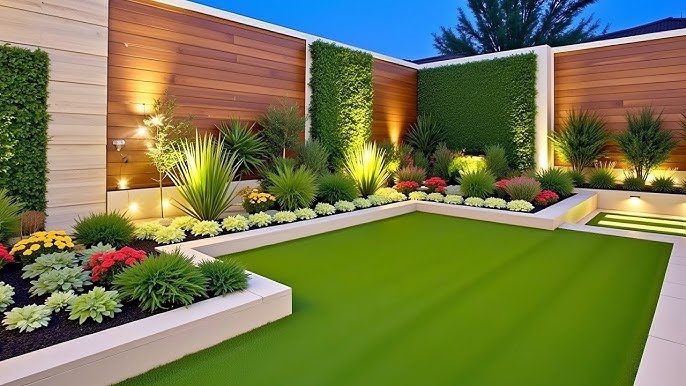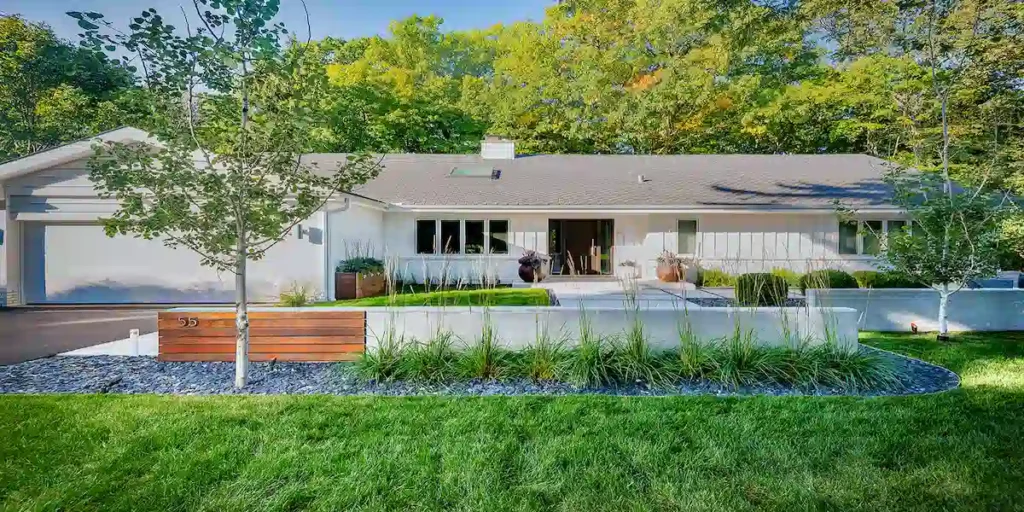
Mid-century modern landscaping relies on clean, horizontal lines, geometric layouts, and a seamless indoor-outdoor flow. It takes the clean look of 1950s and 1960s architecture and carries it outdoors. Straight lines. Open space. Low walls. A short list of plants used again and again. Nothing extra, nothing fussy. Every part of the yard has a purpose, and the whole thing is built to be lived in rather than just looked at from a window.
What Is Mid-Century Modern Landscaping?
Mid-century modern landscaping is a yard design style built around geometric shapes, open ground planes, low horizontal lines, and a small group of bold, sculptural plants. It came from homes built roughly between 1945 and 1970, when architects began using flat rooflines and floor-to-ceiling glass to connect the inside of a house with the yard outside. The point was to make the outdoors feel like one more room in the house. If you want to see how this fits alongside other current styles, our breakdown of modern landscape design covers the broader family it belongs to.
Why the Style Works So Well in Florida
Florida already has the two things this look depends on: strong sunlight and plants with real structure. Agave, yucca, and fan palms cast the kind of hard shadow that makes a flat wall interesting at four in the afternoon. Our winters are mild enough that the yard keeps its shape all year, which matters a lot in a style with so few plants doing so much work.
There is also a practical side. A mid-century modern yard uses less turf, which cuts your mowing and your water bill, and it leans on gravel and paving that shrug off summer storms. Coastal homeowners get a bonus too, since most of the sculptural plants this style favours handle salt spray better than flowering shrubs do.
The Design Rules Behind the Look
Three rules carry most of the weight in this style, and they are easier to follow than people expect.
Straight Lines and Simple Shapes
Beds are rectangles, squares, or long bands. No kidney shapes, no wandering curves. A planting bed should look like it was drawn with a ruler because it was. The same goes for patios, walkways, and the edge where lawn meets gravel. One curve is all it takes to make every straight line in the yard look like a mistake.
Fewer Plants, Repeated More Often
A typical yard might hold twenty different plants. A mid-century modern yard holds five or six, planted in groups of three, five, or seven. That repetition is the whole trick. One agave looks like an accident. Nine agaves in a grid look like a decision. Pick your short list, then commit to it across the front and back.
Let the House Set the Rhythm
Look at your house and find its lines: the roof edge, the top of the windows, the run of the fascia. Repeat those lines in the yard with a low block wall, a horizontal slat fence, or a raised planter. When the yard echoes the house, the two stop looking like separate projects.
Best Plants for a Mid-Century Modern Yard
Choose plants for their shape first and their flowers second. Sharp rosettes, upright blades, round mounds, and clean trunks all read well against a plain wall.
Architectural succulents and spiky forms do the heavy lifting here. Agave, yucca, aloe, ponytail palm, and snake plant all hold their outline year-round and need very little from you. Our guide to spiky plants that thrive in Florida is a good place to shortlist the ones suited to your zone.
Ornamental grasses soften the hard edges without breaking the geometry. Muhly grass, dwarf fakahatchee, and foxtail fern all work, especially planted in long bands rather than scattered clumps. They need one hard cut a year, usually in late winter, and that is the extent of the work.
Palms give you the vertical accent the style is known for. European fan palm, pindo, bottle palm, and foxtail palm all have the clean trunk and strong crown this look calls for. Check mature size before you buy, because a palm that outgrows a small courtyard undoes the proportion the whole design rests on.
Hardscape That Matches the Period
This is where a mid-century modern yard is won or lost. The paving is not background; it is the design.
Large square pavers set in a grid with gravel or grass joints is the signature move. Keep the joints even and the grid true. Exposed aggregate concrete, poured in wide panels with clean control joints, is another period-correct choice that handles Florida heat well and stays cool enough to walk on barefoot.
Gravel fields fill the space between paving and planting. Pea gravel, crushed shell, or dark river rock all work depending on your house colour. Keep to one gravel type across the whole yard, and use our gravel landscaping ideas for spacing, depth, and base prep so the stone stays put instead of migrating into the lawn.
Decorative concrete screen block, often called breeze block, is the one detail that instantly dates a yard to this era. Use it for a privacy screen beside a patio or as a low garden divider. Horizontal wood slat fencing in cedar or ipe does a similar job with a warmer feel.
Clean edges hold the whole thing together. Steel or aluminium edging keeps gravel out of beds and beds out of lawn with a line thin enough to disappear. If your project involves patios, walls, or walkways at any real scale, our hardscape services team handles the base work that keeps them level for decades.
Walkways, Pools, and Outdoor Rooms
Paths in this style go from point A to point B without detouring. Floating concrete pads over gravel, spaced evenly, are the classic solution and cost less than a solid pour. Keep the gaps consistent, since an uneven rhythm reads as sloppy rather than casual.
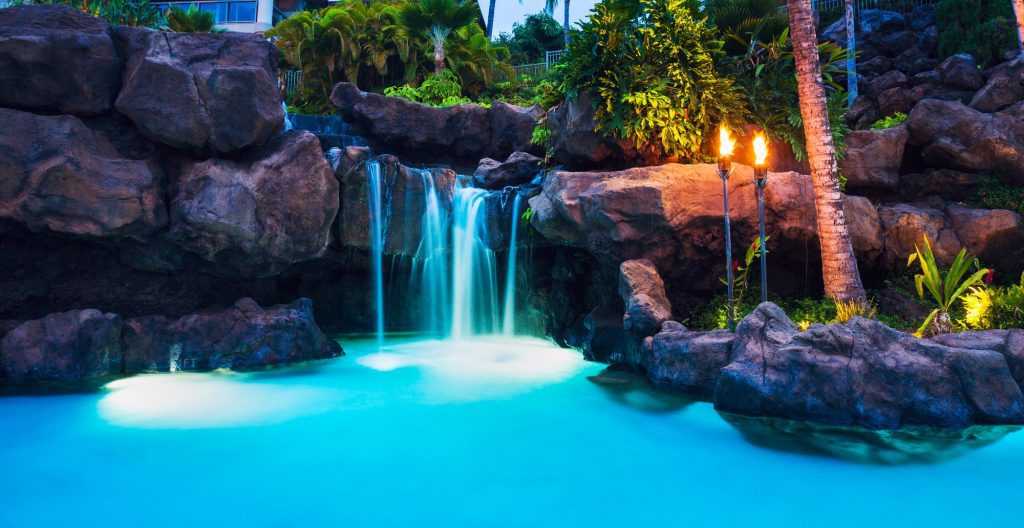
Pools belong in this style more than almost any other, because the era invented the backyard pool as a design feature. A simple rectangle with a wide flat deck and one strong plant grouping at the far end is all it takes. Resist the urge to ring the whole pool with planting, since the empty deck is what makes the shape land.
Lighting Is the Detail Most People Skip
A mid-century modern yard looks its best after dark, because that is when the shadows do the work. Uplight a single agave against a white wall, and you get a piece of art for the cost of one fixture. Keep the fixtures themselves simple: plain cylinders, low bollards, nothing decorative or ornate.
Warm white bulbs around 2700K suit the period far better than cool blue-white light. Aim for a handful of well-placed fixtures rather than a light every few feet along the path, which flattens everything out and kills the contrast the style depends on.
Watering a Low-Water Yard
Once the turf area shrinks, it indicates that your old sprinkler layout is not working. Succulents and gravel beds will rot or grow weeds under a spray head meant for grass. Drip lines in the planting beds and a separate zone for whatever lawn remains is the fix, and most existing systems can be rezoned rather than replaced.
Mistakes That Break the Look
The most common error is adding too much. One more shrub, one more colour, one more pot, and the discipline that made it work is gone. Curved bed edges are the second problem. Red or dyed mulch is a third, because it fights every muted colour in the palette. Stick to gravel, dark bark, or bare soil under groundcover. Mismatched furniture is the last one, since a single ornate patio set can undo an entire yard.
What It Costs
A Mid-Century Modern landscaping project typically costs between $5,000 and $25,000 for a standard yard makeover, while large or complex overhauls involving extensive hardscaping can exceed $40,000 to $50,000. Costs scale based on whether you focus on simple architectural planting or heavy geometric hardscaping.
Ready to Plan Your Own?
Dreamscapes Florida has been designing and building yards across Palm Coast, Flagler Beach, Ormond Beach, Bunnell, and St. Augustine for years, and this style suits our climate better than most. If you have a mid-century home, or you like the clean look of a newer build, get in tou, touch; we will walk the property with you.
Frequently Asked Questions
It is a yard design style based on geometric shapes, open space, low horizontal lines, and a small number of bold, sculptural plants repeated across the property. It came from residential architecture built between about 1945 and 1970.
Agave, yucca, aloe, snake plant, ponytail palm, ornamental grasses such as muhly grass, and clean-trunked palms like European fan palm or foxtail palm. The rule is to plant fewer species in larger groups.
The plant list is usually cheaper than a traditional yard because you buy fewer varieties. The cost sits in the hardscape, since paving, gravel base, and screen walls carry the design.
Yes. The geometry and restraint suit most newer Florida homes, especially those with flat or low-pitched rooflines and large windows.
Generally yes. Less turf, drought-tolerant plants, and large gravel or paved areas cut down on mowing and watering. The trade-off is that weeds show more in gravel, so edging and a good base layer matter.
Gravel, crushed shell, or dark natural bark. Avoid red or dyed mulch, which clashes with the muted colours this style depends on.