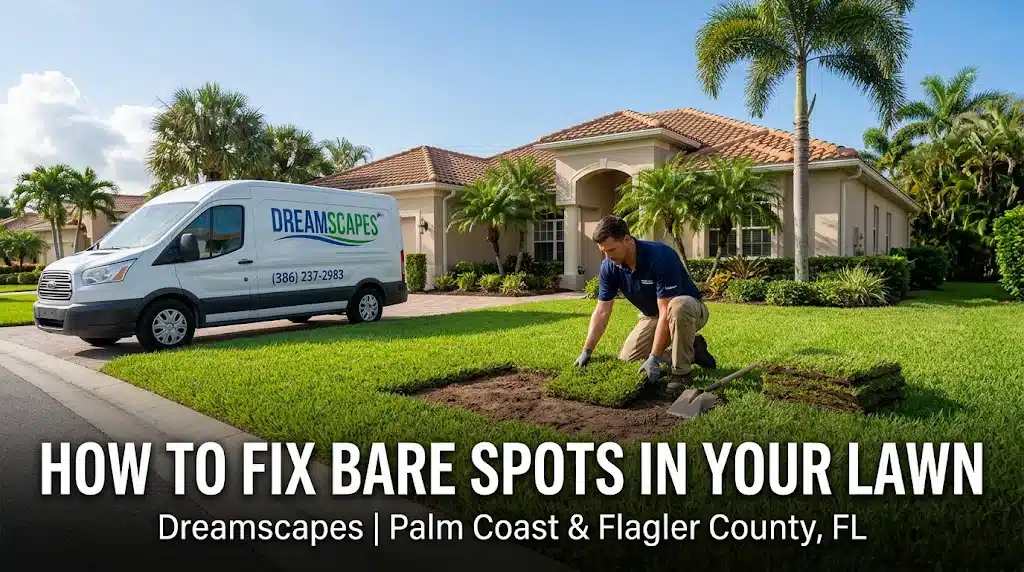
To repair a bare spot in your lawn, identify what killed the grass, clear out the dead material, loosen the top few inches of soil, and fill the gap with sod pieces or plugs that match your existing turf. Water lightly twice a day for two weeks, then taper off. Most patches knit into the surrounding lawn within four to six weeks.
That’s the short version. The longer version matters, because most lawn repair advice online assumes a cool-season lawn up north that you can fix with a bag of grass seed. Our Flagler County lawns don’t work that way, and treating them like they do is how homeowners end up patching the same bald spot three summers in a row.
Why Bare Spots Show Up in Flagler County Lawns
Patching a spot without knowing what caused it is like mopping the floor while the pipe is still leaking. Spend ten minutes figuring out which of these is at work in your yard.
Uneven watering and irrigation gaps
This is the most common cause we see. Sandy Flagler County soil drains fast, so a sprinkler head that’s clogged, tilted, blocked by a shrub, or set too low leaves a dry pocket that browns out and dies. If your thin area has a fan shape or sits at the far edge of a zone’s reach, your irrigation system is the prime suspect.
Run each zone manually in daylight and watch the spray pattern. Heads should overlap so water from one reaches the base of the next. Any spot that isn’t getting hit twice will be the first to fail.
If your coverage is patchy or a zone has stopped working the way it should, our irrigation repair and installation team in Palm Coast can diagnose and correct it, usually the same week you call.
Insect damage
Chinch bugs are the biggest turf pest here, and they love St. Augustine in full sun. Damage starts as a yellowing patch that turns straw-brown and spreads outward, often along a driveway where the soil runs hottest. Pull back the edge and look for tiny black insects with white markings on the stems near the soil.
Grubs cause a different pattern: the turf feels spongy and lifts like loose carpet because the roots are chewed away. Mole crickets tend to hit Bahia lawns, leaving tunneled, crumbly soil.
We’ve written a full breakdown of how grubs damage lawns and what the warning signs look like if you suspect that’s what you’re dealing with.
Fungus and disease
Brown patch and take-all root rot both show up during warm, wet stretches and leave roughly circular dead areas, often with a distinct ring edge where healthy green meets dead brown. Patching over an active fungal problem just gives the disease fresh grass to move into.
Shade
Live oaks are one of the best things about older Palm Coast neighborhoods, and they’re brutal on turf. Most St. Augustine varieties need four to six hours of sun, and under a mature canopy grass thins no matter how well you water. Trimming lower limbs to let in filtered light helps. If it doesn’t, a shade-tolerant variety or a mulched bed is the more honest fix.
Pets, traffic, and compaction
Dog urine burns concentrated spots, and foot traffic along a shortcut to the mailbox compacts soil until roots can’t breathe. Both create bare areas that reappear the moment you patch them unless you change the condition causing them.
Step 1: Rule Out a Simple Dry Spot First
Not every discolored area is dead. Push a screwdriver into the soil in the bad spot and again in a healthy area nearby. If it slides in easily in one and hits resistance in the other, you may have a moisture issue rather than dead turf, and a watering adjustment could bring it back without patching.
Our guide on how to fix dry patches on a lawn covers that diagnosis in more detail, and it’s worth reading before you dig anything up.
Step 2: Pick the Right Repair Method for Your Grass Type
Here’s where Florida differs from almost everything else you’ll read on this topic.
St. Augustine and Zoysia lawns cannot be repaired with seed. These grasses spread by above-ground runners, and viable seed either isn’t sold commercially or doesn’t germinate reliably enough to be worth the money. If your lawn is St. Augustine, which describes most of Palm Coast, your options are sod pieces or plugs.
Sod pieces give instant coverage and are the right call for anything larger than a square foot, or any spot visible from the street. Buy a partial pallet, cut pieces to fit, and you’re done in an afternoon.
Plugs are small circles of sod set a few inches apart that spread to fill the gaps between them. They cost less and suit scattered thin areas, but they take six to ten weeks to close up, and weeds will try to move into the open space meanwhile.
Seed is only practical for Bahia and, in some cases, Bermuda lawns.
Our comparison of sod versus seed for Florida lawns lays out the cost and timeline differences side by side.
One caution on matching: Floratam, Palmetto, and Seville all look noticeably different in blade width and color. Bring a small piece of your existing turf to the supplier so the patch doesn’t stand out like a mismatched carpet square.
Step 3: The Repair, Step by Step
- Treat the cause. Fix the sprinkler head, treat the chinch bugs, or address the fungus, and let any product do its work before you install new grass.
- Remove the dead material. Cut a clean square around the damaged area with a flat spade and lift it out, about two inches deep. Straight edges are far easier to fit new sod into than ragged ones.
- Loosen and improve the soil. Break up the bottom of the hole with a garden fork and mix in an inch or two of quality topsoil or compost. Our native sand drains so fast that roots struggle to find moisture, and this step does more for long-term survival than anything else here.
- Level the base. Rake smooth and set the grade slightly below the surrounding lawn, since new sod sits about an inch tall on top. A patch that ends up high gets scalped by the mower.
- Lay the sod. Cut pieces to fit and butt the edges tightly against the existing turf and each other, since gaps dry out and invite weeds. Press each piece down firmly so the roots contact the soil underneath.
- Water immediately. Soak the patch thoroughly. The first watering matters more than any that follow.
Step 4: The First Thirty Days
New sod lives or dies on watering. For the first week to ten days, water lightly twice a day, morning and mid-afternoon, keeping it damp but not swampy. Drop to once a day in week two, every other day in week three, and your normal schedule by week four.
Keep foot traffic off it. Wait about two weeks for roots to take hold before mowing, and mow high — St. Augustine holds up best at three and a half to four inches. Hold off on fertilizer for a month, since new roots burn easily.
Watering restrictions here are set by the St. Johns River Water Management District and change seasonally. New sod is generally allowed an establishment period outside the normal schedule, but confirm current rules before setting your controller.
The Best Time of Year to Patch in Palm Coast
Spring through early fall is ideal. Warm-season grasses root fastest when soil temperatures are up, so April through September gives the quickest knit — summer included, as long as you stay on top of watering.
Winter patching is possible here but slow. Grass goes semi-dormant in our cooler months, and a patch installed in January may sit unchanged until March. If a bare spot appears in December, it’s usually worth waiting.
Mistakes That Bring the Bare Spots Right Back
- Patching without diagnosing. If chinch bugs killed the first patch, they’ll kill the second.
- Throwing seed on a St. Augustine lawn. You’ve wasted the money and the season.
- Leaving gaps at the edges. Air pockets dry roots out and give weeds an opening.
- Skipping soil prep. Sod laid onto compacted sand rarely roots well.
- Mowing too soon or too short. Both tear up grass that hasn’t anchored.
- Overwatering after establishment. Soggy soil invites the same fungus that may have started the problem.
When to Call a Professional
A single patch under a few square feet is a reasonable weekend project. Bring in a crew when the damage covers a large share of the yard, when patches keep returning in the same places, when the cause isn’t obvious, or when the repair needs to be paired with irrigation work.
Dreamscapes has handled sod installation across Palm Coast and Flagler County since 2015, and we carry St. Augustine, Bahia, Zoysia, and Bermuda so we can match what’s already in your yard.
Get Your Lawn Looking Whole Again
Bare patches always come with a reason attached. Find it, correct it, and the repair itself is simple. Skip that part and you’ll be back out there with a spade next season.
If you’d rather have it handled right the first time, our lawn maintenance team serving Palm Coast, Flagler Beach, Bunnell, Ormond Beach, Daytona Beach, and St. Augustine can find the cause, complete the repair, and keep the lawn healthy afterward.
Call Dreamscapes at (386) 237-2983 for a free quote.
Frequently Asked Questions
Sod pieces look finished immediately and root within two to three weeks. Plugs need six to ten weeks to close the gaps between them. Seeded Bahia germinates in two to four weeks and takes a full season to thicken.
Only if you have a Bahia or Bermuda lawn. St. Augustine and Zoysia don’t establish from seed in any practical way, so sod or plugs are the correct repair for the majority of Palm Coast yards.
A patch that fails repeatedly points to an unresolved cause underneath: an irrigation head that doesn’t reach it, a recurring insect population, buried construction debris, compacted soil, or too little sun. Fix that and the repair will hold.
A small do-it-yourself patch costs a few pieces of sod plus a bag of topsoil. Larger repairs are priced by the pallet and by square footage. We give free, no-obligation estimates so you know the number before work begins.
A useful rule of thumb: if more than roughly forty percent of the lawn is damaged, or patches are scattered rather than concentrated, full replacement is often cheaper and looks far better than a yard of mismatched repairs.